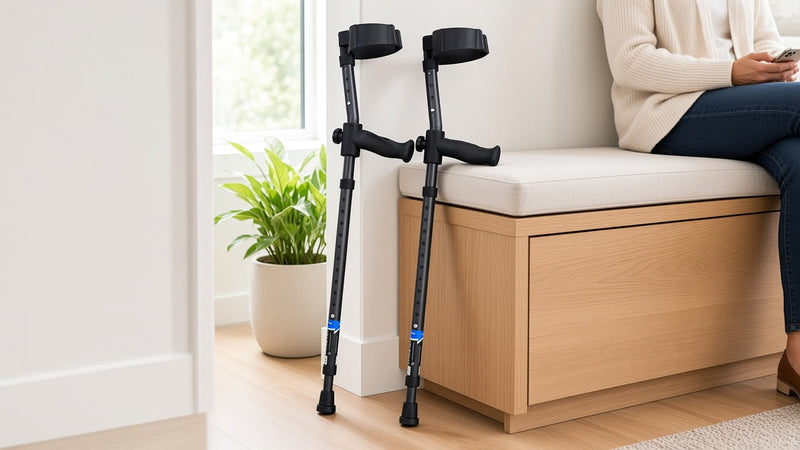
The featured image for this article was generated using AI.
Crutch tips are easy to forget. They're small, they sit on the floor, and they don't hurt the way a sore armpit or a tired wrist does. But they're the only part of your crutches that touches the ground, and when they wear out, every step gets a little less sure.
Here's how to tell when your tips are done, what to look for in a replacement, and how to make sure the new ones actually fit your crutches.
The short answer
- Check your tips every day. MedlinePlus says to check the tips of your crutches daily and replace them if they are worn.
- Replace them when the tread is gone, when the rubber is cracked or split, or when a tip is loose on the post.
- Buy tips that match your crutch. The inside opening has to fit the bottom of your post snugly.
- Replace them as a pair so both crutches feel the same under you.
Why worn tips matter
The tip is where your crutch grips the floor. A fresh tip has tread and some give, so it holds on tile, wood and pavement. As it wears, the bottom gets smooth and hard, and it can slide when the crutch is at an angle, which is exactly when you're leaning on it.
A slip on crutches can quickly turn into a fall, sometimes onto the leg you're trying to protect. Swapping out worn tips is a simple way to lower that risk.
Signs it's time to replace your crutch tips
Turn each crutch over and look at the bottom in good light. Replace the tips if you see any of these:
- No tread left. Patient guidance from York and Scarborough Teaching Hospitals NHS Foundation Trust says to check that rubber tips "are not worn to the point where no tread is showing."
- Cracks, splits or missing chunks in the rubber.
- A tip that spins, rocks or slides on the post instead of sitting tight.
- Uneven wear, like one side worn flat, or one tip much more worn than the other.
- The post showing through the bottom of the tip. If you can see or hear metal touching the floor, stop and replace them right away.
- Slipping on floors that used to feel fine. If your crutches suddenly feel skittish on tile or wood, check the tips first.
The same NHS leaflet says to use a matching pair of crutches, not a mismatched pair. That's a good reason to replace both tips at once, even if only one looks bad.
How often should you replace crutch tips?
There isn't one schedule that fits everyone. How fast tips wear depends on how much you walk, what you walk on and how you walk. Someone on crutches for two weeks around the house may never need new tips. Someone using them every day outside may wear through a set much sooner.
That's why the daily check matters more than the calendar. If you use crutches long term, it helps to keep a spare pair of tips at home so you can swap them as soon as you see wear.
Fixed rubber tips vs. articulating tips
Most standard crutches use a fixed rubber tip, a solid rubber cap that fits over the end of the post. It's simple and it works, but as the crutch tilts forward and back through each step, the part of the tip touching the floor changes.
An articulating tip has a base that pivots. As the crutch moves through each step, the bottom of the tip stays flatter on the ground. Our product pages describe the in-Motion articulating tips as pivoting to keep full contact with the ground at any angle, "where fixed rubber tips tend to slip."
Whichever kind you have, the same rules apply. Look for tread, check that it fits snugly, and replace it when it's worn.
How to make sure replacement tips fit
Crutch tips aren't one size fits all. The opening on the tip has to match the outside of the post at the bottom of your crutch. A tip that's too big can twist or pull off. One that's too small won't seat all the way.
- Pull off one of your current tips. Look inside for a size or item code.
- Measure the bottom of the post or the inside of the old tip's opening.
- Match that number to the inside diameter listed for the replacement tip.
- Push the new tip on all the way until it seats firmly, then stand and test it on a non-slippery floor before you head out.
If your crutches came from a hospital or clinic, the department or supplier that gave them to you may be able to tell you which tips they take.
Replacement tips for in-Motion crutches
If you use in-Motion crutches, our Articulating Tips Pair is the replacement. Per the product page, they fit all in-Motion spring-assist crutches and the most recent version of the rigid posts. They're latex free, sold as a pair, item code TP6A, with a 5/8" inside diameter.
If you've had rigid-post in-Motion crutches for a while, check before you order. The product page says to remove a current tip and measure the top opening. It should be 5/8" for TP6A tips. Older rigid posts used TP8A tips with a 3/4" opening. We have those too, but you'll need to call us to order them.
Not sure which you have? Call us at (877) 753-5556 and we'll help you figure it out. Our short video on replacing the articulating tips shows how the swap is done.
While you're checking the tips
Take another minute to look over the rest of the crutch. Make sure the height buttons or pins are fully seated, nothing rattles, and there are no cracks or dents in the posts. If anything looks damaged, stop using that crutch until it's fixed or replaced.
If you use in-Motion spring-assist crutches, our Lower Spring-Assisted Post Pair page recommends replacing the spring assist every 12 months to keep it working properly.
A quick note on our crutches
The in-Motion Pro Forearm Crutch Set and the in-Motion Pro Underarm Crutch Set both come with articulating tips, and both are rated to 350 lbs. The Pro Forearm, in both Tall and Short sizes, includes a standard cuff and a large cuff in the box.
If you prefer no spring, there are rigid-post versions of the Pro Forearm and the Pro Underarm. You can compare them all on our Shop All Crutches page.
FAQ
How do I know if my crutch tips are worn out?
Look at the bottom of each tip. If the tread is worn smooth, the rubber is cracked or split, or the tip is loose on the post, it's time for new ones. Slipping on floors that used to feel fine is another sign.
How often should crutch tips be replaced?
It depends on how much and where you walk. MedlinePlus recommends checking your tips daily and replacing them if they are worn, rather than waiting for a set date.
Are crutch tips universal?
No. Tips come in different sizes, and the opening has to fit the bottom of your crutch post snugly. Check the size of your current tips or measure the post before you buy.
Should I replace both crutch tips at the same time?
Yes, it's a good idea. Two tips with different amounts of wear can make your crutches feel uneven. Replacing both keeps them matched.
Where can I buy replacement crutch tips?
MedlinePlus notes that you can get replacement tips at a medical supply store or a local drugstore. For in-Motion crutches, you can order our Articulating Tips Pair online, or call us for older TP8A tips.
Do in-Motion articulating tips fit other brands of crutches?
Our product page lists them for in-Motion spring-assist crutches and recent in-Motion rigid posts, with a 5/8" inside diameter. We don't list fit for other brands, so call us at (877) 753-5556 before ordering them for a different crutch.
Related guides
- in-Motion Crutches: Replacing the Articulating Tips
- Tips for Walking Safely on Crutches: Indoors and Outdoors
- Stairs, Curbs & Uneven Terrain: Real-World Crutch Skills
- Maintenance Mastery: Ensuring the Longevity and Performance of Your Mobility Aids
- Types of Crutches Explained: Underarm, Forearm, Platform, and Hands-Free
Sources: MedlinePlus, Using crutches; York and Scarborough Teaching Hospitals NHS Foundation Trust, Use of Crutches (patient leaflet, PDF).
This article is for general information only and isn't medical advice. Talk with your doctor or physical therapist about which crutches are right for your injury, how they should fit, and how much weight you can put on your leg.