If your physical therapist put you on the 4-point gait, you probably walked out of that session with two questions. The first is about the pattern itself, because four steps in a fixed order is harder to hold onto than it sounds when you are also managing crutches, a leg that will not cooperate, and the quiet worry about falling.
The second question is whether you are the only person on earth walking this slowly on purpose.
You are not. The 4-point gait provides the most support of any crutch pattern (StatPearls, Crutches, National Library of Medicine), and that stability costs you speed. Three points stay on the ground at all times. One limb moves, then the next. The pace is deliberate by design, not by accident.
One thing to settle up front. If you had surgery on one leg and your other leg works fine, this is probably not your pattern. You are most likely on the 3-point gait. The 4-point gait exists for situations where both legs need support at the same time.
The Honest Answer to "How Long?"
For orthopedic patients, weeks. You use the 4-point gait while both legs carry some restriction or weakness, then move to something faster as strength and balance come back.
For neurological patients the honest answer is harder, and pretending otherwise does not help anyone. Multiple sclerosis, Parkinson's disease, and stroke recovery each follow their own course, and those courses do not run in a straight line. Some people use the 4-point gait for months. Some use it for good. Some move past it. The underlying condition decides, not effort.
Here is what nobody warns you about. The 4-point gait is mentally demanding in a way the other patterns are not. The alternating sequence takes real concentration to automate, and it falls apart first when you get tired. That is a feature of the pattern, not a sign that something is wrong with you.
Who Actually Uses This Pattern
The 4-point gait requires partial weight bearing on both legs. That single requirement shapes everything about who it is for.
Multiple sclerosis. Weakness in both legs is common in MS, and falls are more common than most newly diagnosed patients expect. In a study of 111 people with MS who used bilateral support for walking, meaning two crutches, two canes, or a walker, 50.5 percent fell at least once over three months. Of the people who fell, 28 percent went down more than once (Coote, Hogan and Franklin, Archives of Physical Medicine and Rehabilitation, 2013). The constant three-point contact of this pattern exists to cut into that number. Our guide to crutches and MS goes deeper on choosing a walking aid at each stage.
Parkinson's disease. Postural instability and freezing of gait drive fall risk here, and some patients use crutches for stability rather than for weakness. Worth being straight about the evidence: research showing that external rhythm improves parkinsonian gait comes from auditory and sensory cueing studies rather than from crutch studies (Ghai et al., Scientific Reports, 2018, pooling 50 studies and 1,892 participants). If your PT is using the four-beat sequence as a rhythmic anchor, that is reasonable clinical thinking rather than a proven technique.
Stroke recovery. This applies most often when the unaffected side also has some weakness, or when trunk control is still being rebuilt.
Bilateral orthopedic surgery. When both knees are replaced in a single operation, both legs carry restrictions at the same time, and the 4-point gait may be the only workable option on crutches.
Balance disorders. Inner ear dysfunction and cerebellar conditions make the faster crutch patterns unsafe. Three points of contact give you a much wider base to work from.
The Sequence, and How to Stop Losing Track of It
Right crutch. Left foot. Left crutch. Right foot.
One thing moves at a time. The memory cue that works for most patients is opposite pairs: each crutch is followed by the foot on the other side of your body. A crutch and its opposite foot never move at the same moment, and that is exactly what separates this from the 2-point gait.
Say it out loud while you walk during the first week. It feels ridiculous. It also builds the motor pattern faster than silent repetition, and most people stop needing it inside two weeks.
The Rules That Matter Most
Three points stay down at all times. This is the whole reason the pattern exists. If you catch yourself moving two things at once, you have drifted into a different gait. Slow down and reset.
Both legs take weight. Unlike the 3-point gait, where the injured leg may carry nothing, this pattern needs real loading on both sides. If one leg genuinely cannot accept any weight, the 4-point gait is the wrong tool and you should be on the 3-point pattern instead.
Keep your steps short and even. Reaching forward too far with any limb breaks the balance equation that makes this work.
Watch your fatigue, not the clock. The sequence is the first thing to go when you get tired, and a broken sequence is when falls happen. Rest before you need to rather than after.
Setting Up Your Home
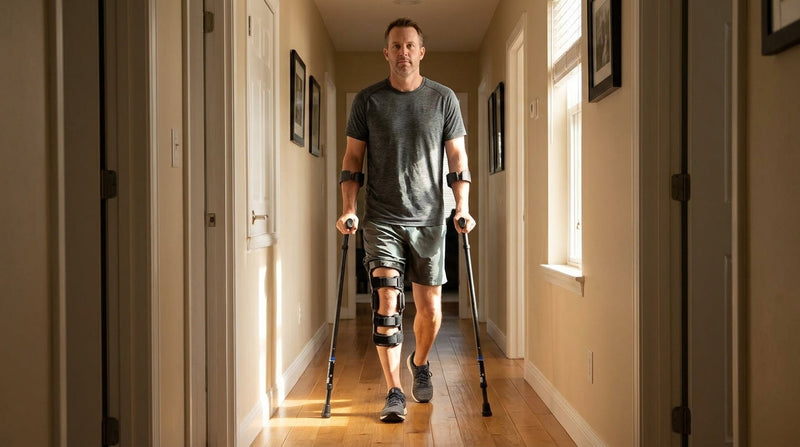
Clear paths matter more here than with other patterns, because the 4-point gait needs more lateral space per step. Standard hallways are fine. Furniture that forces a tight turn will cause trouble, so walk your usual routes with the crutches before your first real day at home.
Hard floors are easier than carpet. Deep carpet drags on crutch tips and takes more force to push through with every step. If your home is mostly carpeted, plan on moving slower rather than fighting it.
Why the Crutch Matters More in This Pattern
The 4-point gait puts sustained demand on your upper body over a longer stretch of time than the faster patterns do. You are not taking a burst of steps and then resting. You are moving slowly and deliberately, which means your hands and wrists carry load for more minutes per trip.
Underarm crutches stack a nerve problem on top of that duration. Resting body weight on the axillary pad compresses the brachial plexus and radial nerve against the arm, which produces numbness and weakness in the hand and forearm known as crutch palsy. A published case report describes a patient who developed wrist drop in both hands after three weeks on badly fitted crutches, and cites earlier work finding that improper crutch use can produce a sevenfold increase in force on the axilla (Chang and DePold Hohler, Journal of Neurology and Neurophysiology, 2012). Patients on the 4-point gait tend to lean into that pad more as fatigue builds, which is exactly the wrong direction.
Forearm crutches remove the pad and the risk with it. This is not a marketing position. Clinical reference material states plainly that axillary crutches are best for short-term use and forearm crutches are better for long-term use (StatPearls, Crutches, National Library of Medicine). The cuff holds the crutch in position without demanding a tight grip, which matters a great deal if you have hand weakness or reduced grip strength.
The in-Motion forearm crutch uses molded V-shaped forearm cuffs and angled, contoured grips, at 1.8 pounds per crutch. Peak axial force through a single crutch during reciprocal gait has been measured at roughly 45 percent of body weight in children using Lofstrand crutches (Slavens et al., Journal of Spinal Cord Medicine, 2007), so where that force lands is not a small detail when you are logging hours a day.
Shop in-Motion forearm crutches
When to Call Your Doctor or PT
Call your PT if the sequence keeps breaking down after you felt like you had it. That usually points to fatigue management, footwear, or a fitting issue, and it is information rather than failure.
Call your physician for new or worsening numbness in your hands or forearms. For neurological patients especially, telling crutch-related nerve compression apart from disease progression matters, and your doctor cannot do that without knowing.
Go to an emergency room for sudden one-sided leg pain or swelling, shortness of breath, or chest pain. Those point to deep vein thrombosis or pulmonary embolism. Symptomatic clots are uncommon after foot and ankle surgery, under about 1.4 percent in most series, but prolonged immobilization is a recognized risk factor (American Orthopaedic Foot and Ankle Society position statement, 2026). Rates after hip or knee replacement can be higher; follow your surgeon's clot-prevention plan.
The Bottom Line
The 4-point gait is slow because safety required it to be. Three-point contact is not an arbitrary rule. It is what lets someone with bilateral weakness cross a room without going down. The pace is the mechanism, not a limitation to work around.
Learning the sequence takes longer than most patients expect, and that is fine. Walking has been automatic for you for decades. Replacing it with a four-beat pattern that includes two external limbs is genuinely hard, and it takes the time it takes.
Whether this is a bridge through orthopedic recovery or a long-term mobility tool, your equipment matters as much as your technique. Technique keeps you safe on today's trip. Equipment decides whether this is sustainable across months.
Frequently Asked Questions
How do I remember the sequence without thinking about it constantly?
Opposite pairs. Right crutch, then left foot. Left crutch, then right foot. Each crutch is followed by the foot on the other side. Saying it aloud while you walk during the first week builds the motor memory faster than practicing in silence, and some physical therapists use tape marks on the floor during early training. Most patients stop needing the cue within one to two weeks of daily practice.
Do I actually need the 4-point gait, or did my PT just default to it?
It is the right pattern when both legs can take some weight but neither is fully reliable. If you had single-leg surgery and your other leg is healthy, you should almost certainly be on the 3-point gait instead, which is faster and better suited to a one-sided restriction. If your PT chose 4-point, the reason is usually bilateral involvement, a balance concern, or a neurological condition. Asking them which criteria drove the choice is a completely reasonable question.
Can I use the 4-point gait if one leg is fully non-weight bearing?
No. This pattern requires partial weight bearing on both legs. With one leg fully restricted you need the 3-point gait, where the crutches and that leg advance together while the good leg does the stepping. Forcing the 4-point sequence with a non-weight-bearing leg produces an unstable pattern and raises your fall risk.
Why is this so much harder to learn than it looks?
Because you are overriding something your brain automated decades ago. Walking runs without conscious input. A deliberate four-beat sequence involving two external limbs does not, and installing it costs real mental effort. That is also why fatigue disrupts it so reliably. When concentration drops, the new pattern goes before the old habit does.
When would I move to a faster pattern?
For orthopedic patients, when both legs have enough strength and coordination to move a crutch and the opposite foot at the same moment. Your PT assesses that during sessions. For neurological patients it depends on how the underlying condition behaves. Some people progress to the 2-point gait or a single crutch. Others stay on 4-point long-term because it provides stability the faster patterns cannot.
Sources and Further Reading
Every number in this guide comes from a published source. Here they are, so you can read the originals yourself.
- Falls in MS walking-aid users: Coote S, Hogan N, Franklin S. Falls in People With Multiple Sclerosis Who Use a Walking Aid: Prevalence, Factors, and Effect of Strength and Balance Interventions. Archives of Physical Medicine and Rehabilitation, 2013. https://pubmed.ncbi.nlm.nih.gov/23127308/
- Rhythmic cueing and parkinsonian gait: Ghai S, Ghai I, Schmitz G, Effenberg AO. Effect of rhythmic auditory cueing on parkinsonian gait: A systematic review and meta-analysis. Scientific Reports, 2018. https://www.nature.com/articles/s41598-017-16232-5
- Crutch fitting, gait patterns and crutch palsy: Crutches. StatPearls, National Library of Medicine. https://www.ncbi.nlm.nih.gov/books/NBK539724/
- Crutch loading forces: Slavens BA, Frantz JT, Sturm PF, Harris GF. Upper Extremity Dynamics During Lofstrand Crutch-Assisted Gait in Children With Myelomeningocele. Journal of Spinal Cord Medicine, 2007. https://pmc.ncbi.nlm.nih.gov/articles/PMC2031971/
- Crutch palsy case report: Chang IT, DePold Hohler A. Bilateral Radial Nerve Compression (crutch palsy): A Case Report. Journal of Neurology and Neurophysiology, 2012. https://www.iomcworld.org/open-access/bilateral-radial-nerve-compression-crutch-palsy-a-case-report-2155-9562.1000130.pdf
- Blood clot risk and immobilization: Venous Thromboembolic Disease Prophylaxis in Foot and Ankle Surgery. American Orthopaedic Foot & Ankle Society position statement, 2026. https://www.aofas.org/docs/default-source/research-and-policy/position-statements/vted-prophylaxis-in-foot-and-ankle-surgery-position-statement.pdf
- in-Motion crutch specifications: product page and sizing specifications, crutches.com. https://crutches.com/collections/forearm-crutches