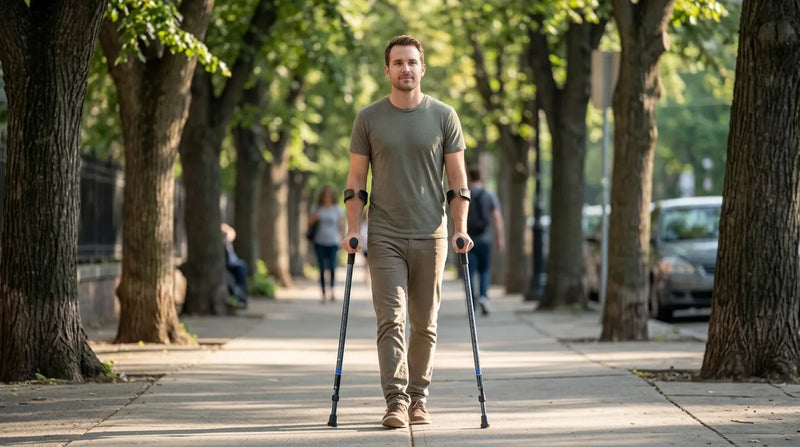
If you have MS, you've probably had someone tell you that using a mobility aid means giving something up. That is not how most people with MS experience it. For many, a well-chosen crutch or walking aid means more time on their feet, more distance covered, and fewer falls. The decision isn't about giving in. It's about staying in the game.
MS affects walking in multiple ways, and often in combinations that are hard to predict: spasticity, weakness, balance problems, fatigue, and heat sensitivity can all be present at once, in varying degrees, on varying days. That variability is one reason the walking aid question is harder than it sounds. What you need during a relapse may be different from what you need when you're stable. What works at year five of your diagnosis may not work at year fifteen.
This guide covers how MS affects mobility, when crutches are appropriate, which types of crutches work best for the MS-specific challenges of fatigue and heat sensitivity, and how to think about walking aid choices across the stages of the disease.
Managing a different long-term condition? See our companion guides for Functional Neurological Disorder and Mobility Aids, Transverse Myelitis and Long-Term Crutch Use, and The Clinical Case for Ergonomic Crutches.
The Honest Answer to "Do I Need a Walking Aid Yet?"
Most neurologists and physical therapists will tell you the same thing: don't wait until you fall. By the time a fall happens, whatever has been causing instability has usually been building for a while.
The numbers on falls are worth sitting with. In a study of 111 people with MS who already used bilateral support for walking, meaning two crutches, two canes, or a walker, 50.5 percent fell at least once over a three-month period. Of the people who fell, 28 percent fell more than once (Finlayson, Peterson and Cho, Archives of Physical Medicine and Rehabilitation, 2013).
That is not meant to be discouraging. It is meant to reframe the decision. Falls are common enough in MS that the question is not whether to take them seriously, but whether your current setup is doing everything it could to prevent them. Getting the right walking aid earlier rather than later is a practical choice, not a symbolic one.
The biggest factor in when people need a walking aid is how MS has affected their specific neurological pathways. Someone with predominantly lower limb spasticity will have different needs than someone whose primary challenge is fatigue or balance. The type of MS matters too.
The Types of MS and What They Mean for Mobility
Relapsing-remitting MS (RRMS) is by far the most common form. Roughly 80 to 85 percent of people with MS are initially diagnosed with it. It's characterized by discrete relapses followed by periods of partial or complete remission. Walking ability during a relapse may be significantly worse than baseline, and you may temporarily need more support than when stable.
Primary progressive MS (PPMS) accounts for roughly 10 to 15 percent of people with MS. There are no relapses. Symptoms accumulate gradually from onset, and walking difficulties tend to develop steadily rather than in episodic steps.
Secondary progressive MS (SPMS) develops in a proportion of people who started with RRMS, with disability accumulating progressively rather than relapse-by-relapse. The often-quoted conversion figures come from natural-history data collected before disease-modifying therapies were widely used, and they do not describe the current picture well. Without treatment, roughly half of people with RRMS converted to SPMS within about ten years. Disease-modifying therapy has reduced that rate, and how much it has reduced it for any individual is a conversation for your neurologist rather than a number to read off a chart.
For walking aid purposes, the practical distinction is between people who need situational support during relapses and people who need consistent support as part of daily life. The right crutch may differ between them.
How MS Affects Walking: The Specific Challenges
Spasticity. Stiff, tight muscles in the legs disrupt normal gait patterns. Spasticity can cause scissoring gait or stiffness that makes initiating steps difficult.
Foot drop. Weakness in the muscles that lift the front of the foot causes it to drag during the swing phase of gait. Foot drop is a common cause of falls in MS, and ankle-foot orthoses (AFOs) are frequently prescribed for it, often in combination with crutches.
Fatigue. MS fatigue is neurological, not just physical tiredness. The central nervous system is working harder to compensate for demyelinated pathways. Any mobility aid that increases the energy cost of walking makes neurological fatigue worse, and standard axillary crutches are the least energy-efficient option on the shelf. This matters enormously for MS.
Heat sensitivity. Uhthoff's phenomenon describes the transient worsening of MS symptoms with increases in body temperature. Even a small rise in core temperature can temporarily impair nerve conduction. Mobility aids that require more physical work generate more heat. Lighter, more efficient crutches reduce this effect.
Balance and coordination. Cerebellar involvement in MS can affect balance and coordination independently of leg strength. Someone with significant cerebellar MS symptoms may need a wider base of support than a single crutch provides.
Choosing the Right Walking Aid for MS
Cane. Appropriate for mild instability or as a balance aid. Should be used on the unaffected side, opposite to the leg that needs support, which many people get wrong.
Forearm crutches. The right next step for most MS patients who need more than a cane. They offer substantially more support, can be used on one or both sides, and can be adapted to different gait patterns. The ergonomics matter specifically for MS: lighter crutches with better handle design reduce energy cost per step, which over the course of a day means more usable walking distance. Our guide to the five crutch gait patterns covers which walking pattern fits which situation.
Rollator walker. For MS patients with significant balance problems or those who tire easily, a rollator provides a wider base of support and allows forward lean. They're heavier and less maneuverable than forearm crutches, but require less grip strength and less coordination to use safely.
During relapses. If you normally manage with a single cane, you may need bilateral forearm crutches during a relapse. This is normal, not a sign of permanent change. Work with your PT to plan for relapse mobility before it happens.
Why Fatigue Changes the Crutch Decision
Crutch walking costs real energy, and there is a measured figure for it. In a controlled comparison of mobility devices, oxygen uptake on standard axillary crutches came in at 20.26 mL/kg/min against 13.14 for normal walking, a 54 percent increase. A knee scooter measured 16 percent above walking and a hands-free crutch 21 percent above (Hackney et al., Foot & Ankle Orthopaedics, 2022).
For someone with MS, that difference is not abstract. MS fatigue is already limiting your total daily energy. Every bit of additional energy cost from your mobility aid comes directly out of what you have left for the rest of your day.
Lightweight forearm crutches reduce energy expenditure in two ways: less weight to swing, and a load path through the forearm that reduces compensatory muscle work at the wrist and shoulder. For MS patients, this is a clinical consideration, not a luxury feature.
The Rules That Matter Most for MS Crutch Use
Get properly fitted and learn the correct gait pattern. The efficiency difference between correct forearm crutch technique and improvised technique is significant. A PT who works with neurological conditions can teach you the right pattern for your specific strength and balance profile. Standard fitting guidance puts the forearm cuff about 1.5 inches below the elbow with roughly 30 degrees of bend at the handgrip (StatPearls, Crutches, National Library of Medicine).
Plan for heat. If Uhthoff's phenomenon affects you, choose the lightest crutch option that meets your stability needs. Walk in the cooler parts of the day. Consider cooling strategies before outdoor activity in warm weather.
Fit crutches over your AFO, not without it. If you have foot drop and use an AFO, your crutch handle height should be set with the AFO in place. The AFO adds height to your shoe and changes your stance height. This is a common fitting error.
Don't measure your MS by your walking aid. Using a crutch during a relapse and then going back to a cane when you recover is not failure. It's appropriate management. The crutch is a tool, not a milestone.
Setting Up Your Home and Routine for MS Mobility
Reduce trip hazards aggressively. Rugs, thresholds, and loose objects are common causes of falls. Install grab bars where they matter most: the bathroom, near the toilet and shower. Plan for bad days. If your MS is relapsing-remitting, having a crutch accessible even on days when you don't usually need one means you're not improvising when a bad day arrives unexpectedly.
Talk to your neurologist about disease-modifying therapy before fatigue becomes a walking problem. Disease-modifying therapies for RRMS have their best effect when started early.
Why Crutch Design Matters for MS
For MS patients who depend on a crutch day in and day out, design decisions start to matter more. Weight affects fatigue. Handle ergonomics affect grip strength and wrist position. Cuff design affects upper arm loading.
The load involved is not trivial. Instrumented gait analysis puts peak axial crutch force at roughly 45 percent of body weight per crutch during reciprocal gait, with the broader literature reporting values spanning 10 to 60 percent of body weight (Slavens et al., Gait & Posture, 2007). Where that force lands on your hand and forearm is a design question.
The In-Motion Pro forearm crutch was built with long-term use in mind: molded V-shaped forearm cuffs, angled and contoured grips that hold the wrist in a natural position, a spring-assist lower post, 1.8 lbs per crutch, and a 350 lb weight capacity. Both standard and large cuff sets ship in the box. For MS patients whose grip strength or coordination is affected, load distribution and crutch weight can mean the difference between a crutch that works all day and one that causes arm fatigue by afternoon.
When to Call Your Neurologist or PT
A sudden worsening of your walking ability could indicate a relapse and should be evaluated promptly. An unexpected fall, where you didn't trip over anything obvious, indicates your balance or coordination has changed and your current mobility setup needs reassessment. Significant fatigue increase during crutch use may mean the crutch design or your technique is the problem. Numbness or tingling in the hand or arm after crutch use should prompt a fit evaluation.
If your walking ability has been gradually declining over months without a discrete relapse, that warrants a full neurological assessment.
The Bottom Line
MS is a long-term condition with a wide range of trajectories. What's consistent across those trajectories is that the right mobility aid, used at the right time, preserves function that wouldn't otherwise be preserved.
The crutch question with MS is not about accepting decline. It is about staying mobile longer, falling less, spending less of your limited daily energy on inefficient gait, and keeping your world as large as possible. Work with your neurologist and PT together on mobility aid decisions. The neurological picture and the functional picture together tell you far more than either does alone.
Frequently Asked Questions
Do I need a walking aid even if I can still walk with MS?
If you're falling, or if fear of falling is limiting where you go, a walking aid is appropriate. You don't need to wait until walking becomes dangerous. Getting the right aid before falls start preserves more function than adding one after an injury.
What's the difference between a cane, forearm crutch, and rollator for MS?
A cane provides minimal support and suits mild instability. Forearm crutches provide substantially more support and can be used singly or in pairs. A rollator provides the broadest base of support with minimal grip demand, suited for significant balance problems or high fatigue levels.
How do I choose a walking aid during an MS relapse?
During a relapse your support needs may be temporarily higher than baseline. If you normally use a cane, forearm crutches may be needed. Discuss this with your PT in advance so you have a plan ready before a relapse happens, not during one when your access to care is more limited.
Will using a mobility aid make my MS progress faster?
No. There is no evidence that using a mobility aid accelerates MS progression. The reverse concern is more relevant: avoiding needed support and falling can lead to injury, deconditioning, and reduced activity, all of which negatively affect quality of life.
How does MS fatigue affect crutch use?
MS fatigue is neurological. Any extra energy cost from your walking aid comes out of your total daily energy budget, which MS has already reduced. Oxygen uptake on standard axillary crutches has been measured at 54 percent above normal walking. Lightweight forearm crutches reduce that cost.
Can I use a crutch with an ankle-foot orthosis for foot drop?
Yes. Set crutch handle height with the AFO and footwear already in place. The AFO adds to your standing height, which changes the correct handle position. Fitting without the AFO and then using it with one is a common error that leads to poor posture and inefficient gait.
Is heat really a factor in which crutch I choose for MS?
For many MS patients, yes. Uhthoff's phenomenon causes MS symptoms to worsen transiently with heat. Any mobility aid that increases physical work generates more body heat. A lighter, more efficient crutch generates less heat during use. If heat is a trigger for you, crutch weight and efficiency are worth factoring into your choice.
Sources
- Falls in MS walking-aid users: Finlayson ML, Peterson EW, Cho CC. Falls in People With Multiple Sclerosis Who Use a Walking Aid. Archives of Physical Medicine and Rehabilitation, 2013. https://www.archives-pmr.org/article/S0003-9993(12)01077-5/fulltext
- Energy cost of crutch walking: Hackney KJ, Bradley AP, Roehl AS, McGrath R, Smith J. Energy Expenditure and Substrate Utilization with Hands-Free Crutches Compared to Conventional Lower-Extremity Injury Mobility Devices. Foot & Ankle Orthopaedics, 2022. https://journals.sagepub.com/doi/10.1177/24730114221139800
- Crutch loading forces: Slavens BA, Sturm PF, Bajournaite R, Harris GF. Upper Extremity Dynamics During Lofstrand Crutch-Assisted Gait in Children With Myelomeningocele. Gait & Posture, 2007. https://pmc.ncbi.nlm.nih.gov/articles/PMC2031971/
- Crutch fitting parameters: Crutches. StatPearls, National Library of Medicine. https://www.ncbi.nlm.nih.gov/books/NBK539724/
- MS types and progression: Types of MS. Multiple Sclerosis Association of America. https://mymsaa.org/ms-information/overview/types/
Related Guides
- Functional Neurological Disorder: A Patient's Guide to Mobility Aids
- Transverse Myelitis and Long-Term Crutch Use
- Crutch Fitting for Physical Therapists
- The Clinical Case for Ergonomic Crutches
- Returning to Work on Crutches
- Ankylosing Spondylitis and Crutches: When You Actually Need Mobility Support