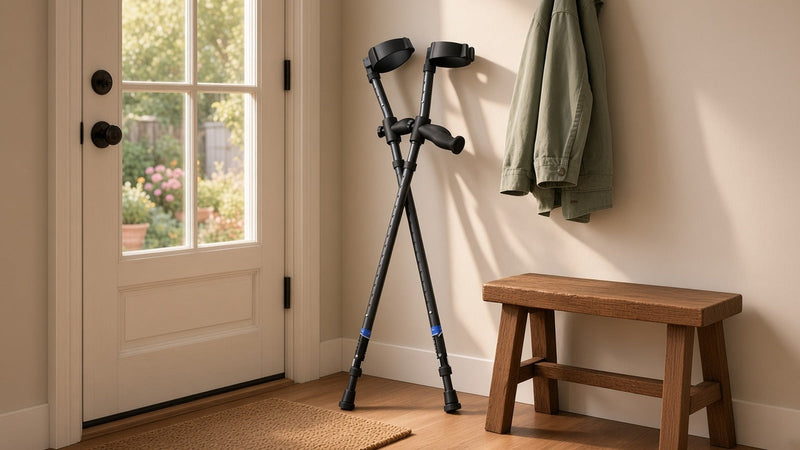
The featured image for this article was generated using AI.
You just got home from the clinic, the ER, or surgery with a pair of crutches and maybe two minutes of instructions. Now you have to get to the couch, the bathroom, and maybe up the stairs without falling or hurting your armpits.
Here is the honest answer: using crutches well comes down to three things. Set them to the right height, carry your weight on your hands, and take slow steps that match the weight-bearing instructions your doctor or physical therapist gave you. Everything else in this guide builds on those three.
Key takeaways
- Fit first. The tops should sit about 1 to 2 inches below your armpits, with the handgrips at your hip line and your elbows slightly bent (AAOS OrthoInfo).
- Your hands carry your weight, not your armpits. Leaning on the tops can hurt the nerves and blood vessels under your arms.
- Walk crutches first: place them about a foot ahead, lean on the handgrips, then bring your strong leg through.
- On stairs, your strong leg leads going up. Going down, the crutches and your injured leg go first.
- Your care team decides how much weight your leg can take and how long you need crutches. Follow their plan, even if you feel better early.
In this guide
- How should crutches fit before your first step?
- What does your weight-bearing instruction mean?
- How do you walk with crutches, step by step?
- How do you sit down and stand up on crutches?
- How do you go up and down stairs on crutches?
- What mistakes do beginners make on crutches?
- How can you make your first days on crutches easier?
- Does the type of crutch change how you use it?
- A note on our crutches
- FAQ
How should crutches fit before your first step?
Crutches that are set wrong make everything harder, so check the fit before you try to walk. Put on the shoes you normally wear and stand up straight. Then check these points:
- The tops. AAOS OrthoInfo says the top of the crutch should be about 1 to 2 inches below your armpits. MedlinePlus says 1 to 1 1/2 inches. Cleveland Clinic describes it as about two finger widths below your armpits.
- The handgrips. They should be even with the top of your hip line.
- Your elbows. They should be slightly bent when you hold the handgrips, not locked straight.
If the tops press into your armpits while you stand, the crutches are too tall. If you have to hunch to reach the grips, the grips are too low. Most crutches can be adjusted longer or shorter, and Cleveland Clinic suggests asking your provider or physical therapist to help you adjust them before you use them. Our crutch sizing guide walks through it step by step.
What does your weight-bearing instruction mean?
Before you take a step, you need to know how much weight your injured leg is allowed to take. Your doctor, surgeon, or physical therapist will tell you. MedlinePlus and Cleveland Clinic describe the common terms like this:
- Non-weight-bearing. Keep the injured leg off the ground completely.
- Toe-touch (touch-down) weight-bearing. Your toes may touch the ground for balance, but you do not put weight on the leg.
- Partial weight-bearing. You can put some weight on the leg. Your provider will tell you how much.
- Weight-bearing as tolerated. You can use the leg as much as feels OK, as long as it does not cause pain or other symptoms.
If you are not sure which one applies to you, ask before you leave the appointment or call the office. It changes how you walk. For more detail, see our guides to non-weight-bearing on crutches and partial weight-bearing.
How do you walk with crutches, step by step?
This is the basic pattern from AAOS OrthoInfo and MedlinePlus for when your injured leg stays off the ground:
- Get your balance. Stand on your strong leg with a crutch under each arm and your hands on the grips.
- Move the crutches forward. Place both crutch tips about 1 foot in front of you, slightly wider apart than your body.
- Lean on the handgrips. Press down through your hands to take the weight, keeping your elbows slightly bent. Keep the injured leg off the floor.
- Bring your body through. Move your body forward between the crutches.
- Land on your strong leg. Finish the step on your strong leg, then get your balance before you move the crutches again.
- Look ahead. Keep your eyes forward, not on your feet.
Go slowly and keep your steps small until you feel steady. MedlinePlus also suggests keeping the crutch tips about 3 inches away from your feet so you do not trip on them.
How do you walk if you can put some weight on your leg?
If your provider says you can put some weight on the leg, Cleveland Clinic describes moving both crutches and your recovering leg forward at the same time, pressing down evenly on both handgrips, and then stepping through with your other leg. Only put as much weight on the recovering leg as you have been told.
This pattern is often called a 3-point gait, and our 3-point gait guide breaks it down further.
How do you turn around on crutches?
MedlinePlus says to turn by pivoting on your strong leg, not your injured one. Take it slowly and keep the crutches close as you come around.
How do you sit down and stand up on crutches?
Sitting and standing are where a lot of wobbles happen, so slow down. A sturdy chair with armrests makes both easier, according to MedlinePlus.
How do you sit down?
- Back up to the chair, bed, or toilet until you feel the seat against the back of your legs.
- Balance on your strong leg and move your injured leg forward.
- Take both crutches out from under your arms and hold them together in one hand. MedlinePlus says the hand on the same side as your injured leg.
- Reach back with your free hand for the armrest or seat.
- Lower yourself slowly. Do not drop into the seat.
Once you are seated, lean your crutches upside down nearby. Both AAOS and MedlinePlus point out that crutches leaned on their tips tend to fall over.
How do you stand up?
- Scoot to the front edge of the seat and move your injured leg forward.
- Hold both crutches together in one hand.
- Push up with your free hand on the armrest or seat and stand on your strong leg.
- Get your balance, then place one crutch under each arm before you start walking.
How do you go up and down stairs on crutches?
Stairs take strength and balance. AAOS suggests having someone help you at first, and MedlinePlus says to avoid stairs until you are ready. Take one step at a time and get your balance before each move.
How do you go up stairs?
- Stand close to the bottom step with your weight on your strong leg.
- Push down on the handgrips and step up with your strong leg first.
- Bring the crutches up onto the same step.
- If you are allowed to, bring your injured leg up. If not, keep it lifted behind you.
How do you go down stairs?
- Stand at the edge of the top step and get your balance.
- Place the crutches on the step below.
- Move your injured leg forward and down, keeping it off the step if you are non-weight-bearing.
- Press on the handgrips and bring your strong leg down.
An easy way to remember it: your strong leg leads going up, and the crutches and injured leg lead going down.
What if there is a handrail?
Use it. Hold the rail with one hand and hold both crutches together on your other side. AAOS describes tucking both crutches under the arm opposite the rail, and MedlinePlus describes holding them in one hand. It can feel awkward at first, so go slowly.
Can you scoot on your bottom instead?
Yes, and it is a good option if you feel unsteady. Sit on the step, hold your injured leg out in front of you, hold the crutches in one hand, and use your strong leg and free hand to move up or down one step at a time. Our guide to stairs, curbs, and uneven terrain covers more real-world situations.
What mistakes do beginners make on crutches?
- Leaning on the tops. It is tempting when you are tired. Cleveland Clinic says leaning on your armpits makes you less stable and can hurt your shoulders and the nerves and blood vessels under your arms. Rest your weight on the handgrips.
- Looking at your feet. AAOS and MedlinePlus both say to look forward when you walk, not down at your feet.
- Rushing. Cleveland Clinic calls going slowly the most important part of using crutches safely.
- Ignoring worn tips. MedlinePlus says to check crutch tips daily and replace worn ones. Our crutch tips guide shows what to look for.
- Wet floors and debris. Cleveland Clinic warns that crutch tips can be slippery when wet and suggests clearing stones or leaves from the tips after you go outside.
- Carrying things in your hands. Your hands belong on the grips. A backpack, fanny pack, or shoulder bag keeps them free.
- Stopping too soon. Cleveland Clinic says to keep using your crutches as long as your provider tells you to, even if you feel like you are recovering quickly.
How can you make your first days on crutches easier?
A few changes at home help a lot. AAOS OrthoInfo and MedlinePlus recommend:
- Clear away throw rugs, cords, and clutter, and make paths wide enough for you and your crutches.
- Keep floors clean and dry, and add a nightlight between your bedroom and bathroom.
- Use nonslip bath mats, grab bars, and a shower seat in the bathroom.
- Wear shoes or slippers with rubber, non-skid soles. Skip heels and leather soles.
- Keep the things you use every day within easy reach.
- Practice with a friend or family member nearby the first few times.
For more ideas, see tips for walking safely on crutches indoors and outdoors and our guide to showering and bathing on crutches.
When should you call your care team?
Call your doctor or physical therapist if you fall, if your pain gets worse, or if you are not sure you are following your weight-bearing instructions. Numbness, tingling, or weakness in your hands or arms is also a reason to call. It can be a sign of too much pressure under the arms. Our guide to crutch palsy explains the warning signs.
Does the type of crutch change how you use it?
The basic steps in this guide are the same for underarm and forearm crutches. The difference is how the crutch holds on to you. Cleveland Clinic describes underarm (axillary) crutches as having a padded top that fits below your armpit, and forearm crutches (also called elbow or Lofstrand crutches) as having a supportive cuff plus a handgrip.
With forearm crutches there is no underarm pad, so cuff position and grip height matter more. Our step-by-step guide to how to use forearm crutches covers that setup, and underarm vs. forearm crutches can help you decide which style fits your recovery. If your hands or underarms are sore with underarm crutches, see how to use underarm crutches without discomfort.
A note on our crutches
According to our product pages, the in-Motion Pro Underarm Crutches have foam padding at the underarm cradle, contoured left and right handgrips angled to keep your wrist in a natural position, a spring in the lower post that absorbs the impact of each step, and articulating tips that pivot to stay in contact with the ground.
The underarm cradle and handgrip adjust separately: 11 cradle and 4 handgrip positions on Short, and 15 cradle and 5 handgrip positions on Tall, so you can dial in the fit described above.
The in-Motion Pro Forearm Crutches have the same spring assist, ergonomic grips, and articulating tips, with two cuff sizes in the box. If your provider says you only need one crutch, we also sell a single in-Motion Pro Forearm Crutch. And if your crutches keep sliding off the couch, the in-Motion Handy Clip keeps a pair of in-Motion crutches together and standing upright when you set them down.
You can compare every model on our Shop Crutches page. Product details are from our live product pages as of November 10, 2026.
FAQ
How long does it take to get used to crutches?
It is different for everyone. AAOS OrthoInfo notes that everything may feel harder at first, but with a few tips and some practice, most people gain confidence quickly. Short practice walks at home with someone nearby are a good start.
Should my armpits touch the tops of my crutches?
No. The tops should sit about 1 to 2 inches below your armpits when you stand up straight, and your weight should rest on your hands.
Which leg goes first on stairs?
Going up, your strong leg goes first. Going down, the crutches and your injured leg go first, followed by your strong leg.
How do I use just one crutch?
Cleveland Clinic says to hold the crutch on the side opposite your recovering leg and move the crutch and the recovering leg forward together. Only switch to one crutch if your provider says it is OK.
How do I carry things on crutches?
Use a backpack, fanny pack, or shoulder bag so both hands stay on the grips. Our guide to picking something up from the ground on crutches helps with dropped items too.
How long will I need crutches?
That depends on your injury or surgery, and your provider will tell you. Keep using them for as long as they say, even if you feel ready to stop.
Related guides
- Crutch Sizing Guide: Find Your Perfect Fit in 3 Easy Steps
- How to Use Forearm Crutches
- Stairs, Curbs and Uneven Terrain: Real-World Crutch Skills
- Best Crutches for Non-Weight-Bearing
- Tips for Walking Safely on Crutches: Indoors and Outdoors
- Building Upper-Body and Core Strength for Crutch Users
Sources: American Academy of Orthopaedic Surgeons (OrthoInfo), How To Use Crutches, Canes, and Walkers; Cleveland Clinic, How To Use Crutches (last updated November 12, 2025); MedlinePlus Medical Encyclopedia, Using crutches (reviewed April 1, 2025). Product details are from crutches.com product pages as of November 10, 2026. This article features no affiliate products.
About the author
The in-Motion Team is the crew behind Millennial Medical. We're the people behind in-Motion crutches, and we write these guides to help you move with more comfort and confidence.
This article is for general information only and isn't medical advice. Follow your doctor's or physical therapist's guidance on crutch fit and use, and contact your care team if you have numbness, tingling, weakness, or pain that gets worse.