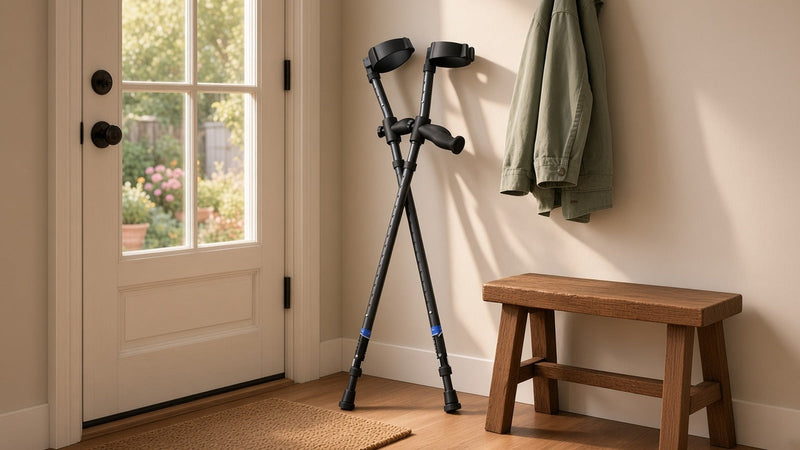
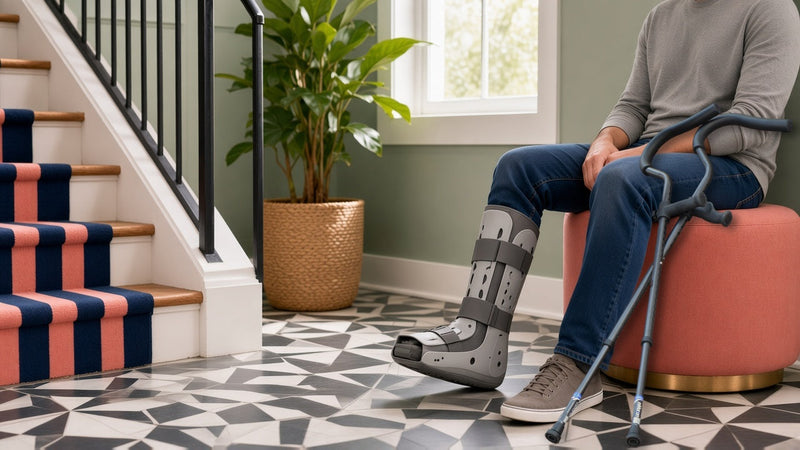
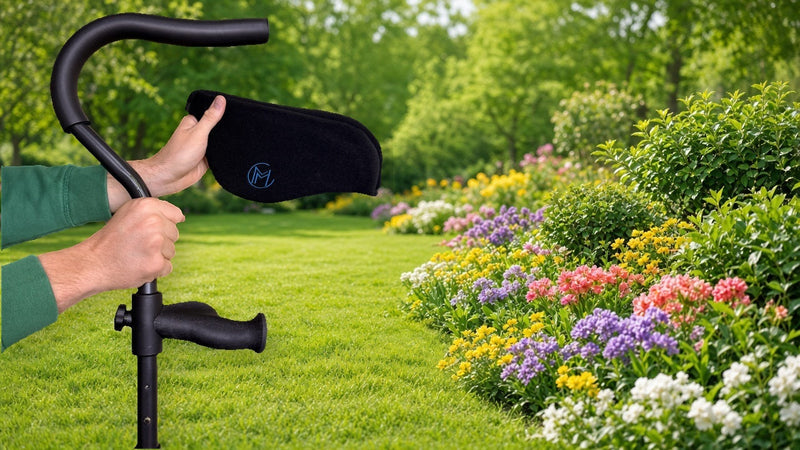
The featured image for this article was generated using AI, with a real photo of in-Motion forearm crutches added to the scene.
Hereditary spastic paraplegia, or HSP, usually starts quietly. You catch a toe on a rug, stumble on a curb, or notice your legs feel stiff and heavy by the end of the day. Changes can be so gradual that, as the Spastic Paraplegia Foundation puts it, other people often notice them first.
Many people with HSP use a walking aid at some point, and forearm crutches are one of the options. This guide covers what HSP is, how it affects walking, how people and their physical therapists choose between a cane, poles, one forearm crutch, or two, and how to set crutches up for long-term use. It's general information, not medical advice.
Key takeaways
- HSP is a group of rare, inherited conditions that cause stiffness (spasticity) and weakness in the legs. NINDS says there are more than 80 genetic types.
- It usually changes slowly. NINDS says many people with HSP eventually need a cane, walker, or wheelchair, but the Spastic Paraplegia Foundation notes that some people never need assistive devices.
- Cleveland Clinic lists a cane, crutches, splints, or a wheelchair among the mobility devices used for HSP. The Spastic Paraplegia Foundation lists "Cane (or forearm crutches)".
- Crutches don't treat HSP or slow it down. NINDS says no current treatment can prevent, slow, or reverse it. A walking aid can make getting around steadier and less tiring.
- Your physical therapist is the right person to decide which aid fits you, and to recheck that choice as things change.
In this guide
- What is hereditary spastic paraplegia (HSP)?
- How does HSP affect walking?
- Do people with HSP need crutches or other walking aids?
- How do you choose between a cane, poles, and forearm crutches?
- Why do some people with HSP choose forearm crutches?
- How do you set up forearm crutches when you have HSP?
- How can you lower your fall risk on crutches?
- A note on our forearm crutches
- When should you check in with your doctor or physical therapist?
- FAQ
What is hereditary spastic paraplegia (HSP)?
The National Institute of Neurological Disorders and Stroke (NINDS) describes HSP as a group of rare and progressive inherited disorders that cause weakness and stiffness of the legs. You may also hear it called familial spastic paraparesis or Strümpell-Lorrain syndrome.
The Genetic and Rare Diseases Information Center (GARD) explains that HSP affects the upper motor neurons, the nerve cells in the brain and spinal cord that send movement signals toward the muscles. In HSP, these neurons slowly degenerate, so the leg muscles don't get the right messages.
It's rare. Cleveland Clinic says researchers estimate it affects about 1 to 5 out of every 100,000 people worldwide, and that it's often misdiagnosed. The Spastic Paraplegia Foundation estimates 20,000 to 30,000 cases in the United States.
What's the difference between pure and complicated HSP?
Cleveland Clinic says about 90% of people with HSP have the uncomplicated, or pure, type, where stiffness and weakness in the legs are the main symptoms. About 10% have complicated HSP, which can also affect balance and coordination, vision, hearing, thinking, or the nerves in the arms and legs.
When does HSP start, and how fast does it change?
GARD says symptoms can start at any time in life. The Spastic Paraplegia Foundation says they appear in most people between the second and fourth decades of life, roughly ages 10 to 40. NORD, whose HSP report was written by neurologist John K. Fink, MD, explains that when HSP starts after early childhood, it usually worsens very slowly over a number of years.
When it starts in very early childhood, NORD says symptoms may not worsen for many years and can look a lot like spastic cerebral palsy. NINDS adds that the outlook varies widely. Some people have severe disability, others have only mild symptoms, and most people with HSP have a normal life expectancy.
How does HSP affect walking?
The main problem is walking with legs that are stiff and weak. NORD says both legs are affected, usually to a similar degree. Weakness tends to show up most in the muscles that lift the thigh, swing the leg out to the side, bend the knee, and lift the front of the foot.
That pattern explains a lot of what people with HSP describe. Cleveland Clinic says early on you might trip and stumble because you don't pick your foot up high enough to clear a curb or a rug, and over time this can lead to falls and make walking difficult and unsafe.
The Spastic Paraplegia Foundation lists other common symptoms:
- Muscle tightness, spasms, or cramps in the legs and feet
- Imbalance and frequent falls
- Fatigue
- Sensitivity to cold, with more stiffness in cold weather
- High arched feet
- More tightness when you're stressed or upset
Cleveland Clinic also lists back pain, knee pain, fatigue, cold feet, and tight, shortened calf muscles as complications. All of that matters when you pick a walking aid, because the right one should help with balance and fatigue without adding new strain.
Do people with HSP need crutches or other walking aids?
Many do, but not everyone, and not right away. NINDS says many people with HSP eventually need a cane, walker, or wheelchair. Cleveland Clinic says you may need mobility assistance years after you first notice symptoms.
The Spastic Paraplegia Foundation puts it this way in its patient guide: as HSP progresses, canes, walkers, and eventually wheelchairs may become needed, although some people never require assistive devices. Everyone's course is different.
Crutches show up in the medical guidance too. Cleveland Clinic lists mobility devices like a cane, crutches, splints, or a wheelchair among the ways to manage HSP symptoms, alongside medications, physical therapy, occupational therapy, and shoe inserts. The Spastic Paraplegia Foundation's fact sheet lists assistive devices that include "Cane (or forearm crutches)".
A walking aid is a tool for getting around safely. It isn't a treatment. NINDS says no current treatment can prevent, slow, or reverse HSP, and that regular physical therapy helps people maintain strength and flexibility.
How do you choose between a cane, poles, and forearm crutches?
There's no single sequence everyone follows, and the choice belongs to you and your physical therapist. Cleveland Clinic suggests asking your provider directly whether you need a cane, walker, or wheelchair, and which activities are safe for you. The options below are the ones people with HSP commonly talk through with their care team.
Is a cane enough?
For some people, especially early on, it can be. The Spastic Paraplegia Foundation says a cane can support up to 25% of your weight, and that a doctor or physical therapist can help you choose one and show you how to use it. A cane works on one side only, though, and HSP usually affects both legs.
What about Nordic walking poles?
They're worth asking about. A 2017 review on balance and falls in HSP, published in the Journal of Rehabilitation Medicine, says that when falls happen regularly, walking aids are best used not to lean on but to give extra feedback through the arms. For that reason, its authors prefer Nordic walking sticks over conventional canes or crutches.
That same review says some people prefer a walker, and that people who rely on walking aids should keep doing daily balance exercises taught by a physical therapist. If balance is your main problem and you don't need much weight support, poles may be worth trying. Your physical therapist can help you compare.
When does one forearm crutch make sense?
Some people use a single forearm crutch for extra steadiness on longer walks, outdoors, or on uneven ground. Others carry one as a step up from a cane. Whether one is enough depends on your balance, strength, and how much support you need, so it's a question for your physical therapist.
When do two forearm crutches make sense?
Two crutches give support on both sides, which suits a condition that usually affects both legs. People often move to a pair when one aid no longer feels steady, when fatigue builds over a day, or when falls become more frequent. Your physical therapist can teach a gait pattern that matches how your legs move.
Where do walkers, rollators, and wheelchairs fit?
For some people, a different aid is the safer choice. The Spastic Paraplegia Foundation says a walker can support up to 50% of your weight, and a wheeled walker may suit someone who has balance problems, tires quickly, or lacks the upper-body strength for a standard walker. The foundation also notes that wheelchairs may eventually become needed for some people.
Using more than one aid is common. Someone might use forearm crutches around town and a different aid for long days out. Your care team can help you match each aid to the situation.
Why do some people with HSP choose forearm crutches?
Forearm crutches, also called Lofstrand or elbow crutches, have a cuff that wraps around your forearm below the elbow and a handle you grip lower down. Your weight goes through your hands and arms, not your armpits. Our guide to Lofstrand crutches explains the design in more detail.
People living with long-term conditions often like them for a few reasons:
- The cuff keeps the crutch with you. You can let go of the handle to open a door or hold a rail without the crutch falling over.
- Support on both sides. Used as a pair, they steady you on the left and right, not just one side like a cane.
- Made with long-term use in mind. Nothing presses into your armpits, and our Lofstrand guide explains why clinical references describe forearm crutches as the usual choice for long-term use.
They also take some practice and good arm strength, and your hands and wrists carry a lot of the load. If you're deciding between styles, our guide to underarm vs. forearm crutches walks through the tradeoffs.
How do you set up forearm crutches when you have HSP?
Have your physical therapist check the fit the first time, and again if your walking changes. Our guide on how to use forearm crutches covers handle height, cuff position, and basic gait patterns step by step.
A few things matter more with HSP:
- Size them in your everyday shoes and braces. NORD says ankle-foot orthotics can help reduce toe dragging and tripping. If you wear them, wear them when the crutches are set, since they can change your height and how you stand.
- Pay attention to the tips. Toe drag and stumbling make good grip important. Check tips often and replace them when they're worn smooth or cracked.
- Plan for fatigue. Fatigue is a common HSP symptom. A lighter crutch and a grip that keeps your wrist in a natural position can make longer days easier on your hands, wrists, and shoulders.
- Expect good days and stiff days. The Spastic Paraplegia Foundation says most people report more stiffness in cold weather, and many find their muscles get tighter when they're stressed or upset. Leave extra time on those days.
- Keep up your exercise. NORD recommends a daily exercise routine guided by a physical therapist or personal trainer. Stronger arms and shoulders also make crutches easier to use.
How can you lower your fall risk on crutches?
Falls are one of the biggest worries with HSP. The Spastic Paraplegia Foundation lists imbalance and frequent falls among the most common symptoms, and Cleveland Clinic notes that tripping over curbs and rugs can lead to falls and injuries over time.
Some practical habits help:
- Clear rugs, cords, and clutter from the paths you walk every day.
- Slow down on wet floors, curbs, ramps, and uneven ground.
- Use a handrail on stairs whenever there is one. Our guide to stairs, curbs, and uneven terrain covers technique.
- Keep doing the balance exercises your physical therapist gives you, even after you start using a walking aid.
- Let your care team know if you're falling more often, since that may mean it's time to recheck your aid.
A note on our forearm crutches
We sell our own in-Motion forearm crutches. The in-Motion Pro Forearm Crutch Set is a spring-assisted pair. Its product page says the lower-post spring absorbs the shock of each step and returns that energy forward, with a firm, controlled feel that runs significantly quieter than traditional spring-loaded crutches.
The grips are contoured left and right to keep your wrist in a natural position. The crutches use a semi-closed cuff, which the product page says gives more support than open-cuff models while still allowing easy entry and hands-free use. Two cuff sizes, standard and large, come in the box.
Other details from the product page: articulating tips that pivot to stay in contact with hardwood, carpet, grass, gravel, and uneven ground; 1.8 lbs per crutch; a 350 lb weight capacity; Short and Tall sizes set by your floor-to-hip measurement in the shoes you normally wear. They don't fold, but each crutch comes apart into two pieces for travel.
If you only need one, the Single in-Motion Pro Forearm Crutch is the same spring-assisted crutch sold on its own, with a Left or Right grip. Both are FSA/HSA eligible. No crutch treats HSP, so let your physical therapist confirm that forearm crutches suit you before you buy.
When should you check in with your doctor or physical therapist?
Cleveland Clinic recommends letting your provider know if your symptoms get worse or you notice new ones, so your treatment can be adjusted. Reach out if:
- You're falling more often, or a walking aid no longer feels steady.
- Your hands, wrists, elbows, or shoulders hurt from using crutches or a cane.
- Stiffness, cramps, or fatigue are making daily walking harder.
- Your symptoms change quickly. NORD says sudden onset or rapid worsening over weeks or months is not typical of HSP and may point to another condition.
- You're feeling low. Cleveland Clinic notes that living with a condition that affects mobility can take a toll on mental health.
FAQ
Will I need crutches if I have HSP?
Not necessarily. NINDS says many people with HSP eventually need a cane, walker, or wheelchair, but the Spastic Paraplegia Foundation notes that some people never need assistive devices. If you do need support, your physical therapist can help you decide whether a cane, poles, forearm crutches, or another aid fits best.
Can crutches slow down HSP?
No. NINDS says no current treatment can prevent, slow, or reverse HSP. A walking aid can make getting around steadier and less tiring, and physical therapy helps maintain strength and flexibility, but neither changes the underlying condition.
Should I use one forearm crutch or two?
It depends on your balance, strength, and how much support you need. Some people use one crutch for extra steadiness outdoors, and others need a pair because HSP usually affects both legs. Your physical therapist can watch you walk and recommend the right setup.
Is HSP the same as cerebral palsy?
No, they're different conditions. NORD explains that HSP that starts in very early childhood may not worsen for many years and can resemble spastic cerebral palsy, which is why doctors consider cerebral palsy when they're working out a diagnosis. NINDS says genetic testing can confirm HSP and identify the type.
Does HSP shorten life expectancy?
NINDS says most people with HSP have a normal life expectancy. Cleveland Clinic adds that certain types may have a different outlook, so your own provider is the best person to ask about your situation.
Related guides
- Crutches for Cerebral Palsy: A Forearm Crutch Guide for Patients, Parents, and Caregivers
- Crutches and Multiple Sclerosis: Choosing the Right Walking Aid at Every Stage
- Crutches and Ehlers-Danlos Syndrome: A Real-World Guide for the EDS Community
- Crutches for Post-Polio Syndrome: One Crutch or Two?
- How to Use Forearm Crutches: Walking, Sitting, Stairs, and the Mistakes That Cause Sore Wrists
- Forearm (Lofstrand) Crutches: What They Are, Who Uses Them, and How to Choose
Sources: National Institute of Neurological Disorders and Stroke (NINDS), Hereditary Spastic Paraplegia; Cleveland Clinic, Hereditary Spastic Paraplegia (updated August 22, 2024); NORD, Hereditary Spastic Paraplegia (John K. Fink, MD, updated July 12, 2017); Genetic and Rare Diseases Information Center (GARD), Hereditary spastic paraplegia.
Also: Spastic Paraplegia Foundation, Hereditary Spastic Paraplegia (HSP): A patient's guide through the medical maze, and Assistive Devices; Nonnekes J, et al., Journal of Rehabilitation Medicine (2017;49:369 to 377), Pathophysiology, diagnostic work-up and management of balance impairments and falls in patients with hereditary spastic paraplegia.
Product details are from crutches.com product pages as of November 16, 2026.
About the author
The in-Motion Team is the crew behind Millennial Medical. We're the people behind in-Motion crutches, and we write these guides to help you move with more comfort and confidence.
This article is for general information only and isn't medical advice. HSP affects everyone differently. Talk to your doctor or physical therapist about which walking aid is right for you, how to fit it, and how to use it safely.