Forearm Crutches vs. Underarm Crutches: What Nobody Tells You Before Surgery
If you've had surgery and you're about to be sent home with crutches, the hospital might give you a choice. More likely, they'll hand you one type without much explanation and wish you good luck. Either way, the question is going to come up: are underarm crutches better, or forearm crutches? Is there a right answer?
There is, and it depends almost entirely on how long you will be on them.
For short-term users, people doing six weeks or less and learning from scratch, the evidence favors underarm (axillary) crutches. They are faster to learn and feel more stable when you are new to this. But that advantage is about early performance, not long-haul use. Once you cross the three-month mark, or if you are going to be on crutches indefinitely, forearm crutches are the clinical standard, because the axillary design starts creating problems it was never meant to handle.
And here is what neither type advertises: both load your hands and wrists heavily if you are on them long enough. The question isn't which one is perfect. It's which one fits your situation.
Recovering from a specific surgery? Our companion guides go deeper:
ACL Surgery Recovery,
Hip Replacement Recovery,
Knee Replacement Recovery,
Meniscus Surgery Recovery,
Foot & Ankle Surgery Recovery,
Achilles Tendon Repair Recovery.
The Honest Answer to “Which Is Better?”
The research that most directly answers this question is a 2021 prospective cohort study by Yap and colleagues in the Malaysian Orthopaedic Journal. Twenty volunteers aged 40 to 80 were compared on axillary and forearm crutches using a three-point crutch gait, the standard post-surgical pattern. The axillary group walked faster, 0.50 meters per second versus 0.44 meters per second (p=0.002), reported less effort, rated the crutches more stable, and preferred them. The authors concluded that axillary crutches were superior for three-point crutch gait.
That is a real finding, and it is worth taking seriously. It is also a short-duration comparison in people new to crutches. It does not tell you anything about what happens after three months of daily use, and that is where the picture changes.
The biggest determining factor here isn't which type is technically superior in a single test. It's how long you'll be on them. Clinical reference material puts it plainly: underarm crutches are best for short-term use, forearm crutches are better for long-term use.
One thing most patients don't know going in: the reason forearm crutches are used by people with permanent mobility needs isn't because they look better. It's because pressure in the armpit compresses the brachial plexus and radial nerve when the crutches are used for extended periods, and the cumulative hand and wrist loading of any conventional crutch, used day in and day out for months, is substantial in what starts as a perfectly healthy upper body.
The Two Types Explained (And When Each One Fits)
Underarm crutches (axillary crutches) are the ones most Americans picture. They have a padded top that sits below the armpit and a grip handle below that. They're stable, easy to size roughly, and most people figure out a basic walking pattern in a few hours. Most hospitals and surgical centers stock them.
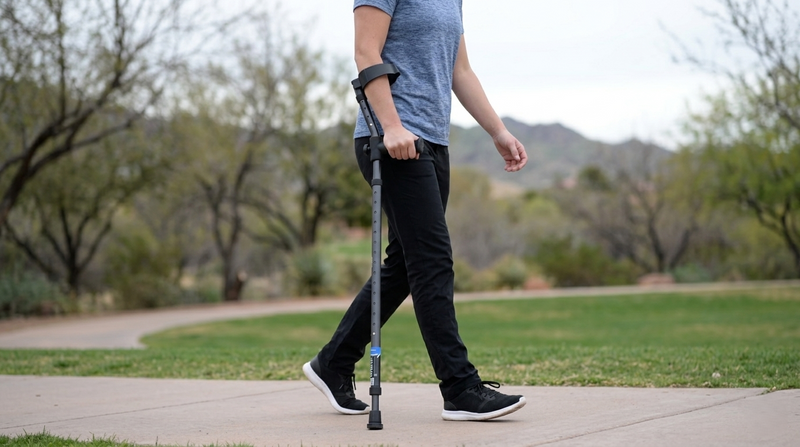
Forearm crutches (also called Lofstrand or elbow crutches) have a cuff that wraps around your forearm and a grip handle lower down. They're the standard for people with long-term or permanent mobility needs in most of the world outside the U.S., where the axillary design still dominates for short-term post-surgical recovery.
Here's how to think about which one fits your situation:
Short-term recovery (6 weeks or less)
Underarm crutches are the practical choice for most people. You'll learn faster and feel more stable initially. The risk of nerve injury from the axillary pad is low if your recovery is short and you use them correctly, meaning the pad never carries your weight. That distinction matters.
Medium-term recovery (6 weeks to 3 months)
This is the crossover zone. By 6 to 8 weeks, most patients have the motor skill to use either type effectively. If you're still uncomfortable on underarm crutches at this point, with wrist pain, shoulder fatigue, or the sensation that your hands are constantly overloaded, switching to forearm crutches is worth discussing with your PT.
Long-term recovery or permanent use (3 months or more)
Forearm crutches. The axillary design was never intended for extended use. Persistent axillary pad pressure compresses the brachial plexus and radial nerve, which produces crutch palsy, weakness and numbness in the hand and wrist. It usually resolves after you stop using the crutches, but not always. The forearm cuff design also allows hands-free moments, since you can briefly release the grip without dropping the crutch, which matters a lot when you're eight weeks in and need two hands to carry a cup of coffee.
The Rules That Matter Most
Fit matters more than type. A badly fitted underarm crutch set too high forces you into the axillary pressure zone every step. Set too low, you'll hunch and overload your wrists differently. With axillary crutches, leave roughly two finger widths between the axilla and the pad when you're standing straight, not jammed up into it. The grip should put about 30 degrees of bend in your elbow when your hand is on it. For forearm crutches, the cuff sits about 1.5 inches below the elbow, and the grip height follows the same elbow-bend rule. Getting this wrong is very common.
Don't ignore wrist pain. Early wrist discomfort on crutches is normal, because you're loading joints that aren't used to it. But persistent pain, or pain that worsens over weeks rather than improving, is a signal. Tenderness in the fleshy pad at the base of your thumb or pain across the back of the wrist point to overuse. Ring and little finger numbness suggests ulnar nerve compression. Get it evaluated before it becomes a real problem.
Never rest your weight on the axillary pad. This is the instruction that comes with every pair of underarm crutches and the one most patients ignore. The grip handles carry your weight. The pad is a guide, not a support. Leaning into the armpit pad transfers force directly onto the nerves passing through the axilla. Do it long enough and you'll have crutch palsy.
Plan for a learning curve with forearm crutches. If you get them and feel immediately unstable, that's normal, and it matches what the Yap study found in new users. Forearm crutches require more coordination than axillary crutches, especially on stairs and uneven terrain. Most people reach comfort and efficiency within a week of consistent use. Don't give up after one hallway.
Setting Up Your Home Before Surgery
The right crutch type changes some of your home setup choices, but the fundamentals are the same.
Stairs in your home: If you have stairs and no rail on one side, axillary crutches can be harder to manage. You can't easily use one crutch and one railing simultaneously with an axillary design. Forearm crutches can be held in one hand while the other grips a railing. If you're on axillary crutches and have stairs, practice the three-point stair technique with your PT before going home.
Small spaces and narrow doorways: Both types require roughly the same lateral clearance. Forearm crutches are slightly more maneuverable in tight spaces because you have better grip control and can more easily adjust on the fly.
Everything within reach: Plan to carry nothing in your hands while on crutches. A small backpack, a fanny pack, or crutch bag attachments are worth buying before surgery. Every kitchen item you'll need in the first two weeks should be between knee and chest height. Get a shower chair and a bathmat with grip.
Floor hazards: Both types will catch on rugs, thresholds, and loose mats. Remove them before surgery or tape them flat. Your crutch tips should be replaced if they're worn smooth. A worn rubber tip on a wet bathroom floor is how a lot of crutch falls happen.
Why Crutch Choice Matters More Than Most People Think
Here's what doesn't get discussed in the hospital discharge summary: conventional crutches of any design put substantial load on the hands and wrists. Instrumented gait analysis of forearm crutch users measured peak axial crutch force at roughly 45 percent of body weight per crutch during reciprocal walking, rising to about 57 percent in a swing-through gait, with the wider literature reporting values from 10 to 60 percent of body weight (Slavens et al., Gait & Posture, 2007). You're repeatedly generating forces at the wrist and hand that, in any other context, would be described as repetitive loading.
For a 2-week recovery, that's fine. Your body can absorb it. For a 3-month recovery, you're looking at thousands of loading cycles daily on joints and soft tissue that weren't designed for it.
The design problem with both conventional types is the same: nearly all the load transfers through the grip. Your hand takes the hit every step. The In-Motion Pro forearm crutch was built to spread it out. Molded V-shaped forearm cuffs distribute contact across the forearm rather than concentrating it at the wrist, angled and contoured grips hold the wrist in a natural position, and a spring-assist lower post absorbs impact at ground strike. Each crutch weighs 1.8 lbs and is rated to 350 lbs, and both standard and large cuff sets ship in the box. See them in our
forearm crutch collection.
When to Call Your Surgeon
Armpit or arm numbness on underarm crutches. If you feel tingling, weakness, or numbness in your forearm, hand, or fingers, particularly in the ring and little finger, stop using the crutches and call. This is nerve compression. It usually resolves, but the sooner you address it the better.
Wrist or hand pain that isn't improving. Some wrist soreness in the first week is expected. Pain that worsens or doesn't improve by week 2 to 3 deserves attention. Don't white-knuckle through it.
Fever over 101°F (38.3°C) or increasing redness, warmth, or swelling at the surgical site. Call your surgeon's office same day.
Calf pain, tightness, or swelling, especially in one leg, combined with any shortness of breath or chest pain. Go to the emergency department. Don't wait to call the office. DVT and pulmonary embolism are serious risks in the weeks after orthopedic surgery.
A fall. If you fall on crutches and feel anything at the surgical site, call before your next appointment.
The Bottom Line
Underarm crutches are a reasonable choice for most short-term post-surgical recoveries in people who've never used crutches before. They're easier to learn, they tested faster in new users, and they're standard issue for good reason. If your recovery is 6 weeks or less, use them correctly and they'll serve you fine.
If you're looking at 3 months or more, or you're 6 weeks in and still struggling, look hard at forearm crutches. Clinical guidance is consistent on this: they are the long-term tool, and they keep pressure out of the armpit entirely.
The crutch phase feels enormous when you're in it and much shorter in retrospect. A 12-week crutch recovery is genuinely hard. It's also 12 weeks in a recovery that typically spans a year or more. Getting the equipment right makes the rest of it easier.
Frequently Asked Questions
Can I switch from underarm to forearm crutches partway through recovery?
Yes, and for many patients it makes sense to. If your surgeon put you on axillary crutches for the first few weeks of non-weight-bearing and you're transitioning to partial weight-bearing, that's a natural time to evaluate a switch. Talk to your physical therapist. They can fit you for forearm crutches and teach you the gait adjustment in one session.
My hospital gave me underarm crutches. Does that mean forearm crutches aren't right for me?
Not necessarily. U.S. hospitals and surgical centers default to axillary crutches because they're inexpensive, available, and most patients go home with them for short recoveries. Your PT is the better person to ask about what type fits your specific recovery length and mobility goals.
Are forearm crutches harder to use?
For most people, yes, at first. The learning curve is real, and it showed up in the Yap study, where new users were slower and rated forearm crutches less stable. By the end of the first week, most people have adapted, and the comfort advantages of the forearm design tend to show up over longer recoveries.
I keep hearing underarm crutches can cause nerve damage. How common is that?
Crutch palsy does occur, but it's relatively uncommon in short-term users who fit their crutches correctly and keep weight off the axillary pad. The risk increases with long-term use, poor fit, and the habit of resting in the crutches. If you're on axillary crutches for more than 8 to 10 weeks, the risk is worth paying attention to.
Can I use forearm crutches if I'm non-weight-bearing?
Yes. Forearm crutches are fully compatible with non-weight-bearing, partial weight-bearing, and touch-down weight-bearing gaits. The gait pattern is slightly different from axillary crutches and takes more learning initially, but physically there's no reason they can't be used for any weight-bearing restriction.
What about platform crutches?
Platform crutches, which rest your forearm flat on a horizontal platform rather than gripping a handle, are used primarily for patients who can't grip a handle due to hand or wrist injury. They're a distinct category from forearm crutches and they're not common in standard orthopedic recovery. If a standard crutch grip causes ongoing hand or wrist pain and switching between types hasn't helped, ask about a platform attachment or alternative mobility aid.
Sources
Related Recovery Guides