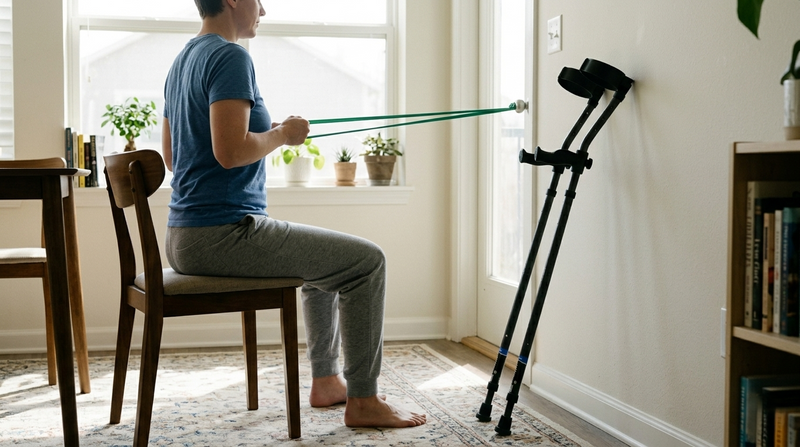
If your surgeon has used the words "meniscus surgery" with you in the same sentence, the first question on your mind is probably how long you’re going to be on crutches. The answer is anywhere from one day to more than six weeks, depending on which surgery you’re actually having.
That range sounds absurd. It isn’t. "Meniscus surgery" is two completely different procedures with two completely different recoveries, and most patients don’t know which one they’re getting until they wake up.
Recovering from a different procedure? Try our companion guides for ACL Surgery or Hip Replacement.
The Honest Answer to "How Long?"
Crutch timelines for meniscus surgery range from one day to more than six weeks. The single biggest factor is not your age, your fitness level, or which surgeon you have. It’s whether the meniscus was trimmed or repaired.
Partial meniscectomy (trimming the damaged portion away) usually means crutches for one to seven days, with weight-bearing as tolerated almost immediately. Most patients are walking unassisted by the end of the first week.
Meniscus repair (stitching the torn tissue back together) usually means crutches for four to six weeks, often with strict non-weight-bearing or partial-weight-bearing restrictions. The repaired tissue needs time to heal before bearing any load. Pull on it too early and the repair fails.
Meniscus root repair (a technique for tears at the meniscus attachment point) usually requires the most conservative protocol. Six to eight weeks non-weight-bearing is typical.
If your surgeon hasn’t told you which type of procedure you’re having, ask. The answer determines almost everything else about your recovery.
Why the Two Surgeries Are So Different
The meniscus is a C-shaped piece of cartilage that cushions the knee joint. It has two zones. The outer "red zone" has good blood supply and can heal. The inner "white zone" has almost no blood supply and generally cannot.
If your tear is in the red zone, your surgeon will likely try to repair it to preserve the meniscus tissue. That means a longer recovery, but better long-term joint health. If the tear is in the white zone or the tissue is too damaged to save, the surgeon trims the torn portion (a meniscectomy). Faster recovery, but you lose some of the cushioning tissue permanently.
That’s why two patients with the same diagnosis can have completely different surgeries. The surgeon often makes the call once they’re inside the joint and can see the actual tear, which is also why most patients don’t find out which procedure they had until they’re in the recovery room.
Other Factors That Affect Your Timeline
Concurrent procedures. Meniscus repair often happens alongside ACL reconstruction. When that happens, the more conservative meniscus protocol is what drives the recovery timeline, not the ACL one.
Tear size and complexity. Larger or more complex tears (bucket handle, root, radial) usually need longer protected weight-bearing than smaller tears.
Your surgeon's protocol. Surgeons disagree on how aggressive to be with post-op weight-bearing. Some let meniscus repair patients bear weight in a locked brace from day one. Others require strict non-weight-bearing for six weeks. Both approaches have evidence behind them. Follow the specific instructions you were given.
Age and activity level. Younger patients with stronger leg muscles tend to progress faster than older or more sedentary patients. Not always, but usually.
Realistic Timelines by Procedure
As always: your surgeon’s specific instructions take priority.
If you had a partial meniscectomy:
- Days 1 to 2: Crutches for balance and protection. Weight-bearing as tolerated. Ice, elevate, manage swelling.
- Days 3 to 7: Most patients move to one crutch or no crutches as comfort allows. Walking is usually possible without significant pain by the end of the week.
- Weeks 2 to 4: Back to most daily activities. PT focuses on range of motion and strength. Low-impact exercise (cycling, swimming) usually cleared.
- Weeks 4 to 6: Most patients return to running and higher-impact activity. Full recovery for uncomplicated cases.
If you had a meniscus repair:
- Weeks 1 to 2: Crutches for every step. Often non-weight-bearing or touch-down weight-bearing only. A locked hinged brace held in full extension during walking is common. Range of motion is usually limited (often 0 to 90 degrees).
- Weeks 3 to 4: Some surgeons start allowing partial weight-bearing in this window. ROM restrictions may relax slightly. Crutches still required for ambulation.
- Weeks 4 to 6: Progressive weight-bearing in the brace. Many patients move from two crutches to one in this window, then off crutches by week six if cleared.
- Weeks 6 to 12: Brace usually comes off. PT intensifies, working on strength, balance, and gradually loading the knee.
- Months 4 to 6: Return to running, cutting, and pivoting sports. Full recovery for repair patients commonly takes four to six months.
If you had a root repair or complex repair:
Recovery is similar to the meniscus repair timeline above, but with a longer non-weight-bearing window (usually six to eight weeks) and tighter range-of-motion restrictions. Patients in this category should follow their surgeon’s protocol exactly. The downside of premature loading is higher than for standard repairs.
The Crutch Rule That Matters Most
Meniscus repair recovery has one rule above all others. Don’t violate your weight-bearing protocol. If you put weight on a repair before the tissue has healed, you can disrupt the repair, which means a failed repair, which means a second surgery.
This is harder than it sounds. Meniscus repair patients are often younger and active. They feel pretty good by week two and the temptation to put weight on the leg "just for a second" or skip the crutches "around the house" is real. Surgeons see that temptation act itself out often enough that the protocol conversation gets repeated at every visit.
Specific rules during meniscus repair recovery:
- Use both crutches every time you take a step, even short distances around the kitchen
- Keep the brace locked in full extension when walking unless your surgeon has specifically cleared otherwise
- Don’t cross your operated leg over the other or pivot on it
- No deep knee bending until cleared
- Stairs: lead with your non-operated leg going up, lead with crutches and operated leg going down
Setting Up Your Home Before Surgery
Most meniscus repair patients know their surgery date weeks in advance. Use that lead time.
Stage your essentials at counter height. In the kitchen and bathroom, move the things you use every day to waist or eye level so you’re not bending down to reach them.
Try to set up on one floor. Stairs on crutches in a brace are doable but slow and tiring. If you can sleep on the main floor for the first two to four weeks, do it.
Sort the bathroom out. A shower chair and a handheld shower head turn the bathroom from the most dangerous room in the house into a manageable one. A raised toilet seat helps if your range of motion is restricted.
Get a small backpack. Carrying anything in your hands is impossible on two crutches. A backpack lets you move drinks, snacks, books, and your phone without setting down a crutch.
Driving is off the table for several weeks. Right-leg surgery means no driving until cleared (usually four to six weeks for repairs). Left-leg surgery in an automatic transmission may allow earlier driving, but check first.
Why the Crutches You Use Matter for Meniscus Recovery
Meniscus repair patients are usually younger and more active than the average crutch user. Many are athletes or weekend warriors who got hurt doing something they love. They tend to push their bodies hard, which is part of how they got injured in the first place, and they tend to push their crutches hard, too.
Crutches move a real load into the hands, wrists, and shoulders. Instrumented gait analysis measured peak axial crutch force at roughly 45 percent of body weight per crutch in reciprocal gait, rising to about 57 percent in a swing-through gait (Slavens et al., Gait & Posture, 2007). For someone using crutches for a few days after a meniscectomy, that’s a minor inconvenience. For someone using crutches for four to six weeks after a repair, it adds up to real secondary problems: shoulder strain, wrist pain, hand numbness, and the kind of upper-body fatigue that makes physical therapy harder than it needs to be. Underarm crutches add another risk, because pressure in the armpit can compress the brachial plexus and radial nerve and cause hand and wrist weakness.
That’s why the In-Motion Pro forearm crutch is built the way it is. Molded V-shaped forearm cuffs spread contact across the forearm rather than concentrating it at the wrist, angled and contoured grips hold the wrist in a natural position, and a spring-assist lower post absorbs impact at ground strike. Each crutch weighs 1.8 lbs and is rated to 350 lbs, and both standard and large cuff sets ship in the box. For meniscus repair patients facing weeks of daily use, that makes the protocol easier to actually follow.
Shop crutches for meniscus surgery recovery
When to Call Your Surgeon
Meniscus surgery is generally low-risk, but complications happen. Call your surgeon’s office immediately if you experience any of these:
- A sudden pop or sharp pain in the operated knee, especially if it comes with a giving-way feeling. Can mean a failed repair.
- Locking or catching of the knee. Repaired tissue may have displaced.
- New swelling, redness, or warmth around the incision. Possible infection.
- Calf pain, swelling, or tenderness. Possible deep vein thrombosis. Serious if missed.
- Fever above 101°F
- Loss of motion or weight-bearing capacity you previously had
The Bottom Line
The most important question to ask before meniscus surgery is which procedure you’re actually having. Meniscectomy or repair. The answer drives your crutch timeline, your weight-bearing protocol, your return-to-activity expectations, and the equipment that’s going to make the recovery survivable.
Meniscectomy recovery is short and forgiving. Repair recovery is long and demanding, but it preserves tissue that will protect your knee for decades. Both are good operations for the right patient.
Frequently Asked Questions
How long after meniscus surgery before I can walk?
Depends on which surgery you had. After a partial meniscectomy, most patients can walk with weight-bearing as tolerated within 24 hours and are off crutches inside a week. After a meniscus repair, most patients are non-weight-bearing or partial-weight-bearing for the first four to six weeks before transitioning to full weight-bearing.
What's the difference between meniscectomy and meniscus repair recovery?
A meniscectomy removes the damaged portion of the meniscus, which means immediate weight-bearing and a one-to-six-week return to activity. A meniscus repair sutures the torn tissue back together, which means four to six weeks of protected weight-bearing on crutches and a four-to-six-month return to sports. Repair preserves more meniscus tissue (which protects the knee long-term) but takes much longer to recover from.
Can I drive after meniscus surgery?
After a meniscectomy, most patients can drive within a few days to a week, once they’re off pain medication and have full control of the leg. After a meniscus repair on the right knee, driving is usually off-limits for four to six weeks. Left-knee repairs in an automatic may allow earlier driving, but always confirm with your surgeon first.
When can I return to sports after meniscus surgery?
After a meniscectomy, most patients return to running and recreational sports at four to six weeks and to higher-level competition by six to eight weeks. After a meniscus repair, the timeline is much longer. Four to six months for return to running, cutting, and pivoting sports, with full clearance often not until six months post-op.
Do I need a brace after meniscus surgery?
Most meniscectomy patients don’t need a brace. Most meniscus repair patients do. The brace is usually a hinged knee brace, locked in full extension during walking for the first several weeks, then progressively unlocked as healing progresses. Your surgeon provides and adjusts it based on your specific procedure.
Sources
- Crutch loading forces: Slavens BA, et al. Upper Extremity Dynamics During Lofstrand Crutch-Assisted Gait. Gait & Posture, 2007. https://pmc.ncbi.nlm.nih.gov/articles/PMC2031971/
- Crutch types and crutch palsy: Crutches. StatPearls, National Library of Medicine. https://www.ncbi.nlm.nih.gov/books/NBK539724/