Nobody hands you a pair of crutches and explains that there are five different ways to walk with them. You get a quick demonstration from a nurse, maybe a minute with a physical therapist, and then you are in your own kitchen wondering why your hands hurt and whether you are doing any of this right.
The pattern you use is called a gait, and which one you are assigned depends on how much weight your leg can take, whether both legs are involved, and where you are in recovery. Using the wrong one is a common reason crutch walking feels harder than it should.
This guide covers all five. What each one is, who it is for, and how to tell which applies to you right now.
First, the Part That Is Not Up to You
Your surgeon sets your weight-bearing status. Your physical therapist assigns the gait pattern that matches it, based on that status plus what they see when they watch you move. You do not pick your own pattern off a list.
What you can do is understand why you were given the one you have, what it is asking your body to do, and what changes when you move to the next one. That understanding is what makes the difference between following instructions and following them correctly.
The Five Patterns
1. 3-point gait
The most common pattern after lower extremity surgery. The crutches and injured side move together, then the good leg steps through. If you are allowed to touch the injured foot (toe-touch or partial), that foot lands with the crutches; if you are fully non-weight bearing, that foot stays off the ground while the crutches take the load.
Who it is for: anyone non-weight bearing, toe-touch weight bearing, or partial weight bearing on one leg. Your good leg does the actual work, and the crutches support the injured side without overloading it.
What makes it hard: upper body fatigue in the first week, and the pull toward letting the injured foot take more weight than it should.
2. 4-point gait
Right crutch, left foot, left crutch, right foot. One limb at a time, with three contact points on the ground at every moment. It is the most stable pattern available on crutches, and the slowest.
Who it is for: patients with both legs involved who can partially bear weight on each side. Multiple sclerosis, Parkinson's disease, stroke recovery, bilateral procedures, and balance disorders show up here far more often than routine post-op recovery does.
What makes it hard: the pace, and the concentration. Four beats in a fixed order takes most people one to two weeks to automate.
3. 2-point gait
One crutch and the opposite foot advance together, then the other pair. Right crutch with left foot, left crutch with right foot. It borrows the arm-swing rhythm you have used your entire life.
Who it is for: patients whose surgical (or weaker) leg is cleared for enough load to participate, with the strength and balance to work from two contact points. It is usually the last stop before a single crutch or nothing at all.
What makes it hard: how normal it feels. Patients rush off crutches from here and build limps that take months to correct.
4. Swing-to gait
Both crutches advance together, then you swing your body forward until your feet land level with the crutch tips. No alternating leg movement at all.
Who it is for: patients whose legs cannot drive a reciprocal stepping cycle. Spinal cord injury during early gait training, and bilateral involvement from neurological conditions. Not a standard post-op pattern.
What makes it hard: both crutches load at the same instant, so the demand on your arms can be higher than in reciprocal patterns.
5. Swing-through gait
Same start as swing-to, but your feet travel past the crutch tips and land in front of them. The pendular motion builds real speed, and experienced users move quickly.
Who it is for: often people with paraplegia who have strong upper bodies and distance to cover.
What makes it hard: it is the most physically demanding pattern here. Peak force through each crutch has been measured at about 57 percent of body weight, against roughly 45 percent in reciprocal gaits (Slavens et al., Journal of Spinal Cord Medicine, 2007).
Matching Your Orders to a Pattern
This is a map for understanding, not a self-assignment guide.
- Non-weight bearing on one leg: 3-point gait.
- Toe-touch weight bearing on one leg: 3-point gait. Light contact for balance only, not propulsion.
- Partial weight bearing on one leg: 3-point gait, moving toward 2-point as tolerance improves. Partial should come with a percentage, usually 30 to 50 (Physiopedia, Weight bearing). Ask if nobody gave you one.
- Weight bearing as tolerated on one leg: often still 3-point at first, then 2-point as pain, strength, and balance allow. Your PT decides.
- Both legs partially weight bearing: 4-point gait, possibly progressing to 2-point.
- Minimal or no functional leg movement: swing-to, progressing to swing-through as strength allows.
Most patients with one injured leg travel the same road. 3-point, then 2-point, then off crutches. If you were assigned a 4-point or a swing pattern for a single-limb recovery, ask your PT what led to that. There may be a good reason, and it is worth hearing.
What Changes When You Progress
Progression is not automatic and it is not a reward for good behavior. Your PT is watching for specific things: how the leg handles load, whether your balance holds, what your gait quality looks like, and whether the strength is there to justify less support.
Rushing shows up later rather than immediately. A patient who moves to a single crutch too early can feel fine for a week and then develop a limp that outlasts the recovery by months. A patient who puts more weight through the surgical leg than the protocol allows often feels nothing at the time, because the surgical area can still be numb. The bill arrives afterward.
When your PT says wait, specific criteria have not been met. That judgment comes from watching you walk, not from how the trip to your kitchen felt this morning.
Why the Crutch Affects All Five Patterns
Every pattern loads your upper body, just differently. 3-point concentrates it. 4-point and 2-point alternate it. The swing patterns deliver it through both arms at once on every landing.
Underarm crutches route that load through a pad pressed into your armpit, and the brachial plexus and radial nerve run directly through that space.
When the pad is too high, or the crutch is slightly too tall, or you are simply tired and leaning on it, compression there produces numbness and weakness in the hand and forearm. That is crutch palsy, and it is documented well enough in the orthopedic literature that it has a name.
There is also a fatigue cost worth knowing about. In a controlled comparison of mobility devices, oxygen uptake on axillary crutches measured 54 percent above normal walking, at 20.26 versus 13.14 mL per kilogram per minute (Hackney et al., Foot & Ankle Orthopaedics, 2022). If you have been wondering why a trip to the mailbox wipes you out, that is the answer.
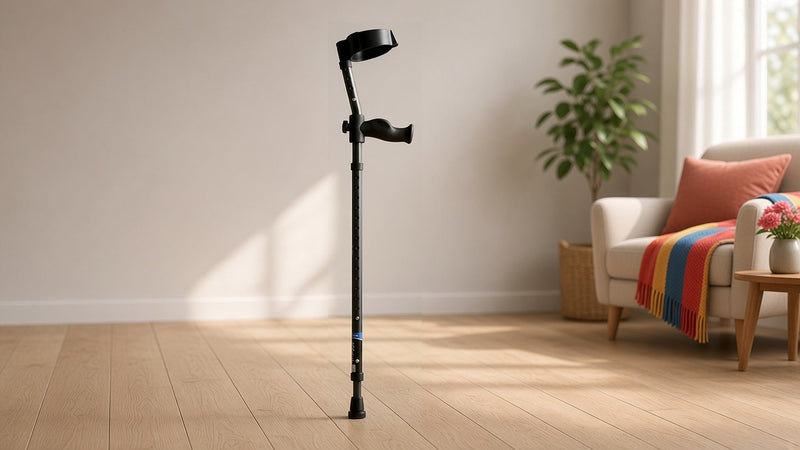
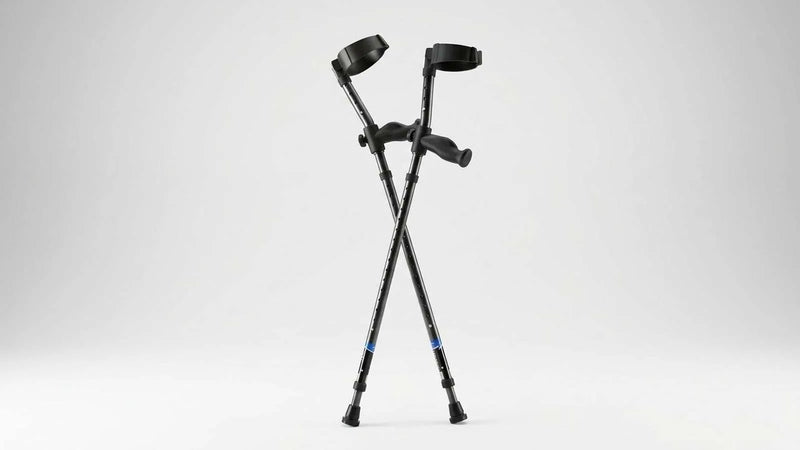
Forearm crutches move the load off the axilla entirely. Clinical reference material states it plainly: axillary crutches are best for short-term use, forearm crutches are better for long-term use (StatPearls, Crutches, National Library of Medicine). The in-Motion forearm crutch uses molded V-shaped forearm cuffs and angled, contoured grips, weighs 1.8 pounds per crutch, and is rated to 350 pounds.
Shop in-Motion forearm crutches
When to Call Your Surgeon
The same warning signs apply across all five patterns.
- Numbness or tingling in your fingers, hand, or forearm during or after crutch use
- Sharp or catching shoulder pain, particularly reaching overhead
- Wrist pain that is localized and worsens with use rather than settling over a few days
- Pain at the surgical site that spikes while you are using your assigned pattern
- Any fall with impact to the hip, pelvis, wrist, or head
- Calf pain, swelling, warmth, or redness in the lower leg. Call the same day. If shortness of breath or chest pain comes with it, call 911.
The Bottom Line
Five patterns exist because different clinical situations need different mechanics. 3-point protects one injured leg. 4-point stabilizes weakness on both sides. 2-point bridges the gap back toward walking. The swing patterns serve people whose legs cannot drive a stepping cycle at all.
The pattern you were given is not arbitrary. It reflects your weight-bearing status and where you sit in the recovery arc. Understanding it will not change the assignment, but it makes following it correctly much easier, and it makes the conversation with your care team a lot more useful when something feels off.
Frequently Asked Questions
How do I know which gait I should be using?
Your surgeon sets your weight-bearing status and your physical therapist assigns the matching pattern. If nobody told you which one you are on, or the instructions were unclear, ask at your first post-op appointment. Using the wrong pattern can slow your recovery or cause harm, and it is a two-minute conversation.
Can I switch patterns on my own if one feels easier?
No. Each pattern corresponds to a specific level of weight-bearing tolerance and stability. Moving to a less protective one before the tissue has healed can load the surgical site in ways you will not feel at the time. Progression is a clinical decision based on measurable criteria.
Why does crutch walking hurt my hands and wrists?
Usually fit, grip, or handle design. Crutches set too tall make you push down and out through the handle instead of loading through your arm.
Gripping too tightly concentrates pressure into a small area of the palm, which is a common source of hand pain over a long recovery. And conventional handle shapes create pressure points that better-shaped grips avoid. If the pain persists, have your PT check your fit before assuming it is just part of recovery.
What is the difference between 3-point and 4-point gait?
In 3-point gait, both crutches and the injured leg move as one unit, and the injured leg takes only as much weight as your orders allow (none, if you are non-weight bearing). In 4-point gait, each limb moves separately in sequence and both legs take partial weight at different points in the cycle. 3-point is for one restricted leg. 4-point is for both legs partially loaded.
Is it normal for crutch walking to be this exhausting?
Yes, especially in the first two weeks. Oxygen uptake on axillary crutches measured 54 percent higher than normal walking in a controlled device comparison, so the fatigue has a physiological cause rather than a fitness one. What is not normal is fatigue that shows no improvement at all after the first week, or that makes your pattern feel unsafe. Raise either one with your PT.
Sources and Further Reading
Every number in this guide comes from a published source. Here they are, so you can read the originals yourself.
- Energy cost of crutch walking: Hackney KJ, Bradley AP, Roehl AS, McGrath R, Smith J. Energy Expenditure and Substrate Utilization with Hands-Free Crutches Compared to Conventional Lower-Extremity Injury Mobility Devices. Foot & Ankle Orthopaedics, 2022. https://journals.sagepub.com/doi/10.1177/24730114221139800
- Crutch loading forces: Slavens BA, Frantz JT, Sturm PF, Harris GF. Upper Extremity Dynamics During Lofstrand Crutch-Assisted Gait in Children With Myelomeningocele. Journal of Spinal Cord Medicine, 2007. https://pmc.ncbi.nlm.nih.gov/articles/PMC2031971/
- Crutch fitting, gait patterns and crutch palsy: Crutches. StatPearls, National Library of Medicine. https://www.ncbi.nlm.nih.gov/books/NBK539724/
- Weight-bearing status definitions: Weight bearing. Physiopedia. https://www.physio-pedia.com/Weight_bearing
- Crutch palsy case report: Chang IT, DePold Hohler A. Bilateral Radial Nerve Compression (crutch palsy): A Case Report. Journal of Neurology and Neurophysiology, 2012. https://www.iomcworld.org/open-access/bilateral-radial-nerve-compression-crutch-palsy-a-case-report-2155-9562.1000130.pdf
- Gait asymmetry after knee surgery: White K, Logerstedt D, Snyder-Mackler L. Gait Asymmetries Persist 1 Year After Anterior Cruciate Ligament Reconstruction. Orthopaedic Journal of Sports Medicine, 2013. https://journals.sagepub.com/doi/full/10.1177/2325967113496967
- in-Motion crutch specifications: product page and sizing specifications, crutches.com. https://crutches.com/collections/forearm-crutches
Deep-Dive Guides in This Series
- 3-Point Gait on Crutches
- 4-Point Gait on Crutches
- 2-Point Gait on Crutches
- Swing-To and Swing-Through Gaits