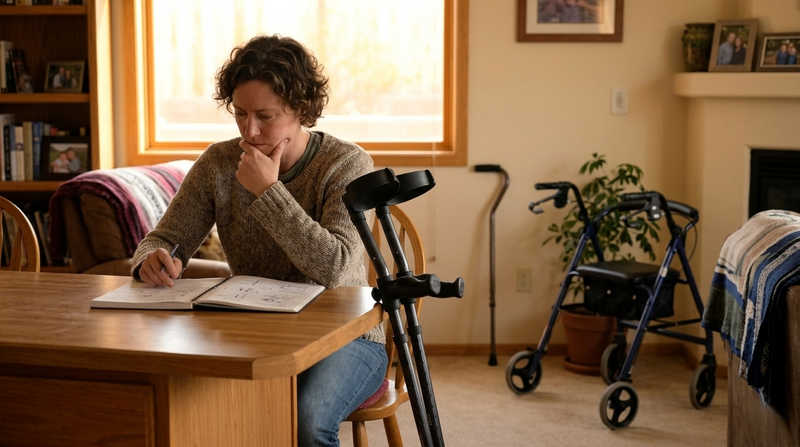
Crutches turn your arms into your legs. Every step, your shoulders, arms, and core do work that your lower body normally handles, and over time that is a lot of load on muscles that were not built for full-time duty. The stronger those muscles are, the easier crutch walking feels and the better your joints hold up.
This is the piece most crutch users never get told. A bit of targeted strength work pays off twice. It makes getting around less exhausting day to day, and it protects the shoulders and wrists that long-term crutch use tends to wear down. You do not need a gym or heavy weights, just a little consistency and the right focus.
One important note before anything else. Talk to your doctor or physical therapist before starting new exercises, especially if you are recovering from surgery or injury or have a condition that affects your joints. What follows is general information, and your team can tailor it safely to you. Nothing here should replace their advice.
This pairs with our guides on preventing shoulder and wrist pain and choosing crutches for long-term comfort.
The honest answer: why this is worth your time
Walking on crutches costs far more energy than ordinary walking, and the research puts a number on it. In a comparison of assisted gait, oxygen consumption during swing-through crutch walking was about 54 percent higher than during normal walking (Hackney et al., Archives of Physical Medicine and Rehabilitation). Most of that extra work falls on your upper body. If those muscles are weak, you fatigue fast, your form falls apart, and the load piles onto your joints instead of your muscles. That is the chain that leads to sore shoulders and aching wrists.
Stronger muscles flip that chain. They carry the load so your joints do not have to, they delay the fatigue that makes everything harder late in the day, and they make each step take less out of you. For anyone on crutches long-term, this is one of the highest-return habits you can build, and it is genuinely doable from home.
The muscles that matter for crutch users
A few areas do most of the work when you are on crutches, so that is where to focus.
- Shoulders and upper back, which stabilize and drive each step and take the brunt of the load. Strong, balanced shoulders are your best protection against the shoulder problems that long-term upper-limb weight bearing tends to produce.
- Triceps and arms, which straighten your arms to push your body forward and up with every stride.
- Grip and forearms, which hold the crutches and tire quickly without conditioning.
- Core, which keeps you upright and stable and quietly supports everything else. A weak core makes the arms work even harder.
Gentle exercises for crutch users to consider
These are common, low-equipment options that target the right areas. Treat them as ideas to bring to your therapist, who can confirm what is safe for you and show you proper form. Start light, move slowly, and stop if anything hurts.
For shoulders and upper back
Resistance band pull-aparts and seated rows build the upper back muscles that stabilize your shoulders. Light shoulder presses, done with control, strengthen the pressing motion crutches rely on. Keep the weight modest and the movement smooth.
For arms
Seated dips using a sturdy chair, within whatever range your body allows, and band or light dumbbell triceps work strengthen the push that drives each crutch step. Quality of movement matters far more than how much you lift.
For grip and forearms
Squeezing a soft ball or a grip trainer, and simple wrist curls with a light weight, build the grip endurance that keeps your hands from giving out late in the day.
For the core
Seated or supported core work, like gentle seated twists and controlled abdominal bracing, builds stability without putting you on the floor if that is hard to manage. Your therapist can suggest versions that fit your situation.
Doing it safely
Strength work helps only if it does not hurt you, so a few rules keep it productive.
- Get cleared first. Run your plan past your doctor or therapist before you start, especially after surgery or with a joint condition.
- Warm up and start light. Cold muscles and ego lifting are how people get injured. Begin easy and add slowly over weeks.
- Train balanced. Work the upper back as much as the front of the shoulders, because balanced strength protects the shoulder joint better than brute pushing power.
- Listen to the difference between effort and pain. Muscle effort is fine. Sharp or joint pain means stop and reassess.
- Rest and recover. Muscles get stronger between sessions, not during them, so give yourself days off and do not train through soreness that lingers.
Strength is only half the equation
Building strength reduces the load on your joints, and so does using equipment that does not fight you. The two work together. The load is measurable: instrumented gait analysis put peak axial force at roughly 45 percent of body weight per forearm crutch in normal walking, rising to about 57 percent in swing-through (Slavens et al., Gait & Posture, 2007). Even strong shoulders suffer under a heavy, poorly designed crutch, while a well-made one lets your conditioning go further.
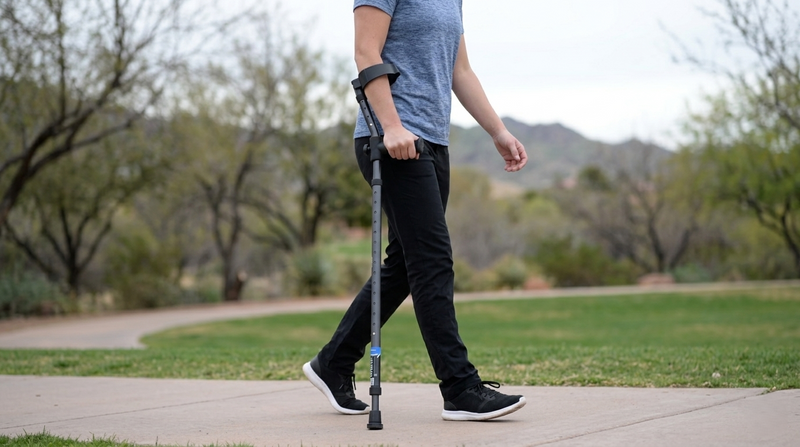
The In-Motion Pro forearm crutch has molded V-shaped forearm cuffs that spread contact across the forearm, angled and contoured grips that hold the wrist in a natural position, and a spring-assist lower post that absorbs impact at ground strike. Each crutch weighs 1.8 lbs and is rated to 350 lbs, and both standard and large cuff sets ship in the box. Pair good equipment with a little strength work and crutch walking gets meaningfully easier. You can see the options in our forearm crutch collection.
When to stop and check with a professional
- Sharp or joint pain during or after exercise, as opposed to normal muscle fatigue. That is a signal to stop and get guidance.
- New shoulder, wrist, or elbow pain that lingers, which can mean an exercise or your technique needs adjusting.
- Numbness, tingling, or weakness in the arms or hands, which should be evaluated rather than trained through.
- Any chest pain, severe shortness of breath, or dizziness during exercise, which means stop immediately and seek medical help.
The bottom line
On crutches, your upper body is doing your legs' job, so building strength there is not vanity, it is maintenance. Stronger shoulders, arms, grip, and core make every step easier and protect the joints that long-term crutch use tends to wear down. You can do most of it from home with bands and light weights.
Get cleared by your team first, start light, train in balance, and rest. Pair that strength with equipment that works with your body, and you will move with more ease and less pain for the long haul.
Frequently asked questions
Why do crutch users need to build strength?
Because crutches turn your arms into your legs. Swing-through crutch walking has been measured at roughly 54 percent higher oxygen consumption than normal walking, and most of that extra work lands on your upper body. Stronger shoulders, arms, grip, and core carry that load so your joints do not have to.
What muscles should crutch users focus on?
The shoulders and upper back, which stabilize and drive each step, the triceps and arms, which push you forward, the grip and forearms, which tire quickly, and the core, which keeps you upright and supports everything else. Training the upper back as much as the front of the shoulders is key to protecting the shoulder joint.
Can I build strength for crutches at home?
Yes. Most of it needs little equipment: a resistance band, a light dumbbell, a soft ball or grip trainer, and a sturdy chair cover the essentials. Seated and supported versions exist for most exercises. Start light, move slowly, and have your doctor or therapist confirm a plan that is safe for your situation.
Is it safe to exercise while recovering on crutches?
Often yes, but only with your care team's guidance. If you are recovering from surgery or injury or have a joint condition, get cleared before starting and let your therapist tailor the exercises. Stop for sharp or joint pain, as opposed to normal muscle effort, and never train through pain that lingers.
How does strength training reduce crutch pain?
Stronger muscles carry the load that would otherwise fall on your joints, and they delay the fatigue that makes your form break down late in the day. Both of those reduce the strain on your shoulders and wrists. Combined with well-designed equipment that lightens the demand on your upper body, strength work makes crutch walking easier and less painful.
Sources
- Energy cost of crutch walking: Hackney J, et al. Estimation of energy expenditure of ambulation with assistive devices. Archives of Physical Medicine and Rehabilitation. https://pubmed.ncbi.nlm.nih.gov/23063790/
- Crutch loading forces: Slavens BA, et al. Upper Extremity Dynamics During Lofstrand Crutch-Assisted Gait. Gait & Posture, 2007. https://pmc.ncbi.nlm.nih.gov/articles/PMC2031971/
- Shoulder pathology from long-term upper-limb weight bearing: Arnet U, et al. Journal of Spinal Cord Medicine, 2021. https://pmc.ncbi.nlm.nih.gov/articles/PMC9661987/