Your needs are not fixed, and neither should your equipment be. The crutches that fit your life two years ago may not be the best tool today, and the gap can creep up so slowly you do not notice until you are working much harder than you should to get around. Reading the signs early is one of the most useful skills a long-term mobility aid user can have.
This is not about decline. Needs shift in every direction. Some people step up to more support for tough days, some add a second aid for specific situations, some upgrade to better equipment, and some step down to less as they regain strength. The goal is always the same. Match the tool to the life you are actually living right now.
This guide helps you recognize when something needs to change, what your options are, and how to make the call without treating it as a defeat.
This connects to our broader pieces on choosing crutches later in life and choosing crutches for long-term use. Any change is best made with your doctor or therapist.
The honest answer: your body will tell you, if you listen
Most people sense a mismatch before they admit it. The trips that did not used to happen. The outings you quietly stopped taking because they cost too much energy. The pain that has crept into your hands or shoulders. These are not things to push through. They are information.
The reason people ignore the signs is usually emotional, not practical. Changing equipment can feel like losing ground, so it is tempting to white-knuckle the current setup past the point where it serves you. That is backward. Using the right tool keeps you more independent, not less, and the bravest, smartest move is to adjust when your situation has changed rather than to struggle on principle.
Signs it is time to change or add
Watch for these, and take them seriously when they show up.
- More trips, stumbles, or near-falls. A rise in instability is the clearest signal that your current aid is not giving you enough support.
- New or growing pain in your hands, wrists, or shoulders. Long-term crutch use loads the upper body heavily, and pain says the load needs to shift, through better equipment or a different aid.
- Exhaustion from distances you used to handle. If getting around now wipes you out, you may need a different tool for longer trips.
- Avoiding activities you want to do. When you quietly skip outings because the effort is too high, the equipment is shrinking your life, which is exactly what it should be preventing.
- Equipment that is worn out or no longer fits. Crutches do not last forever, and a body that has changed needs a refit.
Changing does not always mean stepping up
It helps to see the full range of options, because change is not one direction.
Adding a second aid for specific situations
Many people keep their crutches for daily life and add a wheelchair or scooter for long distances, like airports, theme parks, or big events. This is not giving up walking. It is refusing to spend your whole energy budget on getting there so you have nothing left for being there. Using the right tool for the distance is smart living.
Upgrading your equipment
Sometimes the answer is the same type of aid, done much better. Moving from a basic, heavy pair of crutches to a lighter, ergonomic pair can resolve hand and shoulder pain without changing what kind of aid you use at all.
Stepping up to more support
If your balance or strength has decreased, a more supportive aid like a rollator may keep you safer and let you do more. Choosing more support is wisdom, not weakness.
Stepping down to less
Recovery and rehab go the other way. As strength and balance return, you may move from two crutches to one, or from crutches to a cane, or off an aid entirely. Progressing down is just as valid as stepping up.
How to make the call
A change of equipment is worth a little process rather than a snap decision.
- Talk to your doctor or therapist. They can assess your strength and balance and any pain, then match an aid to where you are now, which beats guessing.
- Be honest with yourself about what you are avoiding. The activities you have quietly dropped are a clue to what your current setup is costing you.
- Try before you commit when you can. A therapist can let you test an option in a safe setting to see how it feels.
- Think in terms of your whole life, not one moment. The right answer may be a combination, like good crutches for daily use plus a wheelchair for distance.
A note on upgrading rather than switching
Before you assume you need a different category of aid, it is worth asking whether you just need a better version of the one you have. A lot of the hand and shoulder pain that pushes people to abandon crutches comes from heavy, poorly designed equipment, not from crutches as a concept. The load is real either way: instrumented gait analysis measured peak axial force at roughly 45 percent of body weight per forearm crutch during normal walking, and about 57 percent in a swing-through gait (Slavens et al., Gait & Posture, 2007).
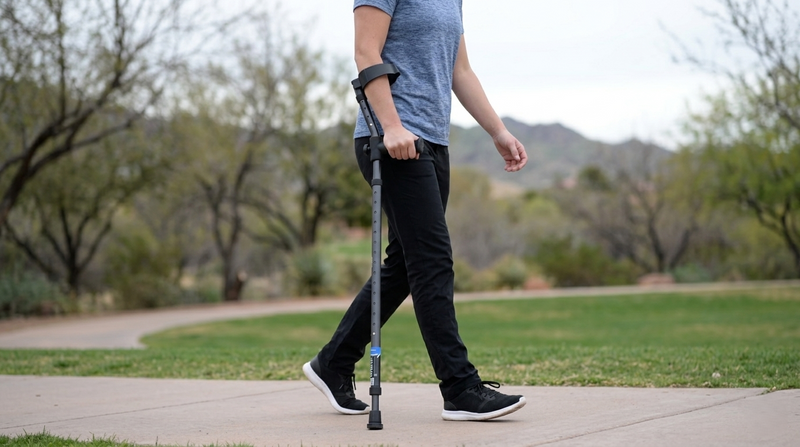
The In-Motion Pro forearm crutch is designed around that load, with molded V-shaped forearm cuffs that spread contact across the forearm instead of concentrating it at the wrist, angled and contoured grips that hold the wrist in a natural position, a spring-assist lower post that absorbs impact at ground strike, 1.8 lbs per crutch, and a 350 lb capacity. Both standard and large cuff sets ship in the box. For many people, upgrading the crutch is the change that was actually needed. You can compare options in our forearm crutch collection.
When to talk to your doctor
- A clear increase in falls or near-falls, which means your current support is no longer enough and needs reassessment.
- New or worsening pain in the hands, wrists, or shoulders from your aid, which signals overload.
- A noticeable change in your strength, balance, or endurance, in either direction, since that may call for a different aid.
- A calf that is swollen, red, warm, or painful, or sudden shortness of breath or chest pain, which can signal a blood clot and is a medical emergency. Get help right away.
The bottom line
Your equipment should keep up with your life, and your life changes. More falls, new upper-body pain, exhaustion, or quietly dropped activities are signals worth heeding, not pushing through. The fix might be adding an aid for distance, upgrading to a better crutch, stepping up to more support, or stepping down to less as you recover.
Reassessing is not losing ground. It is staying in charge of your own mobility. The right tool for today keeps you doing more of what you want, which is the entire point.
Frequently asked questions
How do I know when I need a different mobility aid?
Watch for a rise in trips or near-falls, new pain in your hands, wrists, or shoulders, exhaustion from distances you used to manage, or quietly avoiding activities you want to do. These are signals your current aid no longer matches your needs. A doctor or therapist can assess you and recommend the right change.
Is using a wheelchair sometimes a sign of giving up on walking?
No. Many people keep crutches for daily life and add a wheelchair or scooter just for long distances like airports or big events. That is not giving up walking, it is refusing to spend your whole energy budget getting somewhere so you have nothing left for being there. Using the right tool for the distance is smart.
Should I get a more supportive aid or just a better crutch?
It depends on what changed. If your balance or strength has decreased, a more supportive aid like a rollator may be safer. But a lot of hand and shoulder pain comes from heavy, poorly designed crutches, so sometimes the real fix is upgrading to a lighter, ergonomic pair rather than switching categories. A therapist can help you tell which.
Does changing aids always mean my condition is getting worse?
Not at all. Needs shift in every direction. People step up to more support, add an aid for certain situations, upgrade equipment, or step down to less as strength returns in recovery. Changing your aid simply means matching the tool to your life right now, which is a sign of good self-management, not decline.
How often should I reassess my mobility equipment?
There is no fixed schedule, but it is worth a look whenever your body or your routine changes, when equipment wears out, or when you notice any of the warning signs like more falls or new pain. A periodic check-in with your doctor or therapist keeps your equipment matched to your current needs rather than your past ones.
Sources
- Crutch loading forces: Slavens BA, et al. Upper Extremity Dynamics During Lofstrand Crutch-Assisted Gait. Gait & Posture, 2007. https://pmc.ncbi.nlm.nih.gov/articles/PMC2031971/
- Crutch types and long-term use: Crutches. StatPearls, National Library of Medicine. https://www.ncbi.nlm.nih.gov/books/NBK539724/