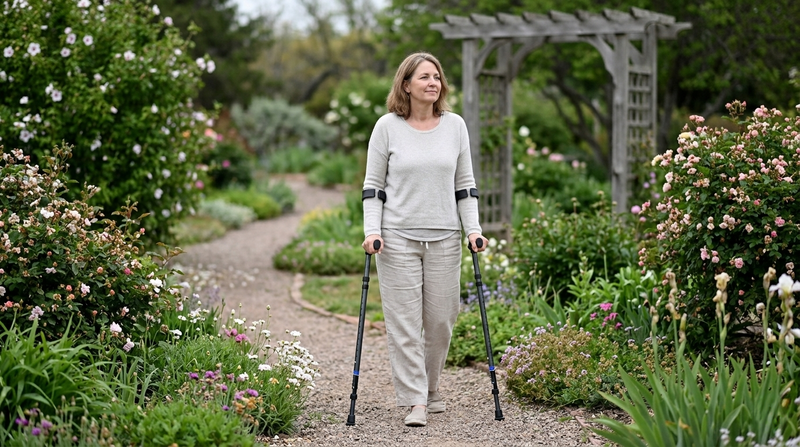
Most crutch advice assumes the problem is a bone, a joint, or a muscle. Neuropathy is different. Here the trouble is the wiring. Damaged nerves mean your foot may not lift when you tell it to, your balance signals may be unreliable, and you may not fully feel the ground under you. That changes what a mobility aid needs to do, and it changes what makes one safe.
This shows up most with two things. Foot drop, where a weak ankle cannot raise the foot so the toe catches and trips you, and reduced sensation, where your feet cannot tell your brain where they are. Both raise your fall risk, especially on uneven ground, curbs, thresholds, and stairs. The good news is that the right combination of bracing and support can make walking far steadier.
This guide covers how neuropathy and foot drop change the mobility question, where bracing and crutches fit, and what to look for when sensation and balance are unreliable.
Related reading: our guides to when to change or add a mobility aid and walking safely indoors and out go hand in hand with this one.
The honest answer: stability is everything here
When nerves are the problem, the single most important quality in your setup is stability, because your body's own balance system is no longer fully trustworthy. A person with a simple leg injury can rely on their good leg and their sense of where their feet are. With neuropathy, that feedback is degraded, so your equipment has to make up the difference.
That has two practical consequences. First, bracing usually comes before, or alongside, any walking aid, because fixing the foot drop removes the thing tripping you. Second, whatever aid you use needs to be genuinely stable and well-maintained, because you may not feel a slip starting the way someone with normal sensation would. Steady and predictable beats light and sporty when the nerves are unreliable.
Bracing usually comes first
For foot drop, an ankle-foot orthosis is often the foundation. This brace holds your foot in a safe, neutral position so the toe does not catch and drag, which is the most common cause of trips in foot drop. Many people find that an appropriate brace does so much of the work that they need less from a walking aid, or none at all on level ground.
Braces are not one-size. There are rigid and dynamic styles, and the right one depends on your pattern and your activity. This is a fitting best done with your doctor or orthotist, because a brace that fits poorly can cause skin problems, which matters even more when your sensation is reduced and you might not feel a pressure sore forming.
Where crutches fit, and where they do not
Whether crutches are right depends on what your neuropathy affects, so be honest with yourself and your care team about the whole picture.
When crutches can help
If your hands and arms are strong and your balance is workable with support, forearm crutches can give you stability and confidence, especially paired with a brace. They give a wider, steadier base than a cane and let you free a hand when you need it.
When something else may fit better
Peripheral neuropathy often affects the hands as well as the feet, and the pattern is common enough that clinicians describe it as stocking-and-glove: the longest nerves are affected first, so symptoms start in the toes and feet and later reach the fingers and hands. If your grip is weak or your hands are numb, gripping crutches safely is hard, and a rollator that lets you rest your forearms and gives a wide, stable base may be the safer choice. There is no prize for using the sportier aid. The right one is the one that keeps you upright.
What to look for when sensation is unreliable
A few features matter more for neuropathy than for almost any other situation, because you cannot rely on feeling a problem in time.
- Maximum stability at the base. Larger, well-treaded tips grip better and add a wider, more forgiving contact with the ground.
- Easy, secure grip. If your hands are affected, a grip you can hold without a tight squeeze, and a forearm cuff that keeps the crutch with you, both help.
- Diligent maintenance. Check your tips often and replace them the moment the tread wears, because a worn tip slips and you may not feel it coming.
- Predictable, steady behavior over flashy lightness. With degraded feedback, you want equipment that does the same thing every time.
Daily habits that prevent falls
With neuropathy, your routines do a lot of the safety work your nerves used to do for free.
- Watch the high-risk spots. Thresholds, curbs, uneven ground, and stairs are where toes catch, so slow down and look at these on purpose.
- Light your home well and clear the clutter, since you may rely on your eyes to make up for what your feet cannot feel.
- Check your feet daily for cuts, blisters, or pressure marks you might not feel, especially if you have diabetes. The CDC and NIDDK both recommend a daily foot check for people with diabetes for exactly this reason.
- Wear supportive, well-fitting shoes that work with your brace. The shoe is part of the system.
A note on equipment quality
When your feet cannot fully feel the ground, your crutches become more important, not less, because they are part of how you stay upright. They also carry a real load: instrumented gait analysis measured peak axial force at roughly 45 percent of body weight per forearm crutch during normal walking (Slavens et al., Gait & Posture, 2007), which is why grip and cuff design matter when your hands are also affected.
The In-Motion Pro forearm crutch has molded V-shaped forearm cuffs that keep the crutch secure to your arm, angled and contoured grips that hold the wrist in a natural position without a tight squeeze, and a spring-assist lower post that absorbs impact at ground strike. Each crutch weighs 1.8 lbs and is rated to 350 lbs, and both standard and large cuff sets ship in the box. Used with the bracing your team recommends, it can add the steadiness neuropathy takes away. See the options in our forearm crutch collection, and if your hands are too affected to grip safely, talk with your team about a forearm-support rollator instead.
When to call your doctor
- New or worsening foot drop, numbness, or weakness, which can mean the underlying condition is progressing and your plan needs updating.
- Any sore, blister, cut, or color change on your feet, especially with diabetes, since reduced sensation can let a small wound become serious before you notice.
- A jump in trips or falls, which signals that your current bracing or aid is no longer enough for your balance.
- A calf that is swollen, red, warm, or painful, or sudden shortness of breath or chest pain, which can signal a blood clot and is a medical emergency. Get help right away.
The bottom line
Neuropathy and foot drop are nerve problems, so the rules are different. Stability is everything, bracing usually comes first, and your equipment then has to make up for the feedback your nerves no longer provide. Forearm crutches can give real steadiness when your hands are up to it, and a rollator may be safer when they are not.
Choose for stability over style, keep your gear in good repair, build fall-prevention habits into your day, and care for your feet. With the right setup, you can move with far more confidence than the diagnosis first suggests.
Frequently asked questions
Do crutches help with foot drop?
They can, usually alongside a brace. The foundation for foot drop is often an ankle-foot orthosis that holds the foot in a safe position so the toe does not catch. With that in place, forearm crutches can add balance and a wider, steadier base. The brace handles the foot while the aid handles support, and together they work better than either alone.
Are crutches safe with peripheral neuropathy?
It depends on what your neuropathy affects. If your hands and arms are strong and your balance is workable with support, crutches can help. If neuropathy has weakened or numbed your hands, gripping crutches safely is hard, and a rollator that supports your forearms and gives a wide base may be safer. Decide with your care team based on the whole picture.
What should I look for in a crutch if I have numb feet?
Stability above all. Larger, well-treaded tips grip better, a secure forearm cuff keeps the crutch with you, and an easy grip helps if your hands are affected. Keep the tips maintained and replace them as soon as the tread wears, because a worn tip slips and you may not feel it starting.
Why does foot drop cause falls?
Because the weak ankle cannot lift the foot, the toe drags and catches, especially on uneven ground, thresholds, and stairs. That catch is what trips you. A brace that holds the foot in a neutral position prevents the drag, which is why bracing is usually the first step in reducing falls from foot drop.
Should I check my feet if I have diabetic neuropathy?
Yes, daily. Reduced sensation means a cut, blister, or pressure sore can develop without you feeling it and become serious. Check your feet every day, wear supportive shoes that work with any brace, and report any sore or color change to your doctor promptly. Foot care and safe mobility go together.
Sources
- Peripheral neuropathy symptom pattern: Peripheral Neuropathy. National Institute of Neurological Disorders and Stroke. https://www.ninds.nih.gov/health-information/disorders/peripheral-neuropathy
- Daily foot checks in diabetes: Diabetes and Your Feet. Centers for Disease Control and Prevention. https://www.cdc.gov/diabetes/diabetes-complications/diabetes-and-your-feet.html
- Crutch loading forces: Slavens BA, et al. Upper Extremity Dynamics During Lofstrand Crutch-Assisted Gait. Gait & Posture, 2007. https://pmc.ncbi.nlm.nih.gov/articles/PMC2031971/