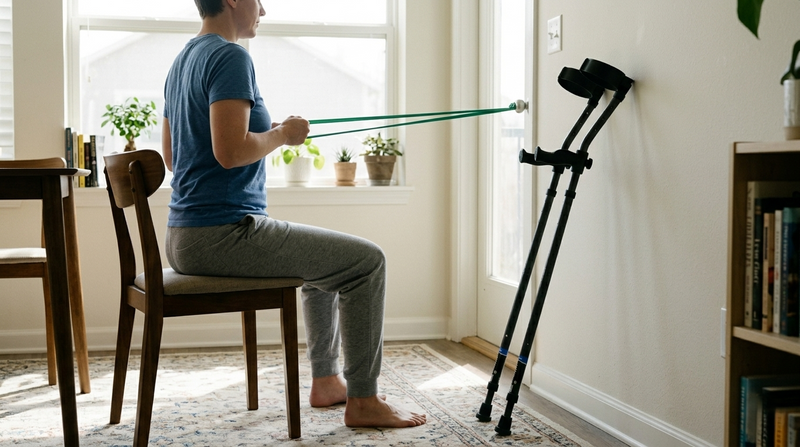
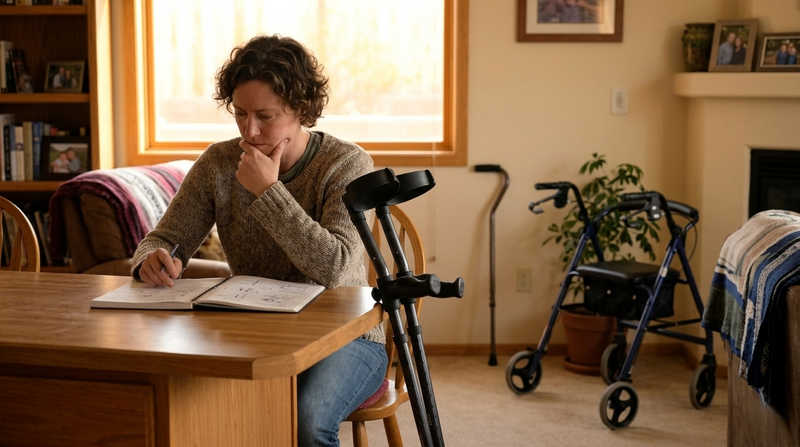
At some point on crutches, the question shows up. Do I still need both? Maybe two feels like overkill now, or maybe you are eyeing that single crutch hopefully because it would free up a hand and feel like progress. It is one of the most common questions crutch users have, and one of the least clearly answered.
Here is the short version. Whether you use one crutch or two is not really a comfort preference. It is a function of how much weight your leg can safely take, and that is decided by your healing and your doctor, not by how ready you feel. Dropping to one crutch too early is a real way to set back a recovery or take a fall. Done at the right time, it is a satisfying step forward.
This guide explains what actually drives the decision, how to make the switch safely, and the mistakes that trip people up.
Always pair this with your doctor's specific instructions. Our guides to walking safely on crutches and when to change or add a mobility aid are close companions.
The honest answer: it depends on your weight-bearing status
The real driver here is a medical one, and it has a name: your weight-bearing status. After an injury or surgery, your doctor sets how much weight your leg is allowed to take, and that determines your crutches, not the other way around.
The categories are standard. Non-weight-bearing means no weight through the leg at all. Touch-down weight-bearing allows the foot to rest on the floor for balance only. Partial weight-bearing allows a set percentage of your body weight. Weight-bearing as tolerated lets you use as much as comfort allows. If you are not allowed to put weight on the leg, you need two crutches to keep it fully off the ground. As you are cleared for more, you eventually reach a point where one crutch can provide the support you still need while the leg does most of the work. Follow the weight-bearing orders you were given, and ask your doctor or therapist before you drop a crutch. Guessing is how people get hurt.
Why two crutches first
Two crutches do two things one cannot. They let you keep weight completely off a healing leg when that is required, and they give you a stable, balanced base while your strength and confidence are still building. Early in recovery, both of those matter, which is why almost everyone starts with a pair.
Trying to manage with one crutch while you still need to offload the leg is not just harder, it is unsafe. The leg gets loaded it should not bear, and your balance has less to work with. There is no prize for using fewer crutches before you are ready.
When one crutch makes sense
Moving to a single crutch usually becomes appropriate once you are cleared to put a meaningful amount of weight through the leg and your balance is solid. At that stage, one crutch offers a few things.
- Enough support to steady you and share some load, without keeping the leg fully unweighted.
- A free hand, which makes daily life dramatically easier.
- A natural step in weaning off crutches entirely, as your leg takes over more of the work.
Your therapist may have you try one crutch in a safe setting first, to see how your leg and balance respond before you rely on it out in the world. That trial run is worth taking seriously.
Which hand holds the single crutch?
This part surprises people. When you go down to one crutch, you hold it on the opposite side from your weaker or injured leg, not the same side. So an injured right leg means the crutch goes in the left hand, and the crutch moves forward at the same time as the injured leg.
It feels backward at first, but it mirrors how you naturally walk, where your opposite arm and leg swing together. Holding the crutch on the opposite side gives you a more balanced, normal gait and better support as the crutch and the healing leg move in rhythm. Standard clinical guidance for single-cane and single-crutch use says the same thing. Your therapist will confirm it and coach the pattern, because doing it on the wrong side undercuts the benefit.
How to make the switch safely
A few steps keep the transition smooth and low-risk.
- Get the green light first. Confirm with your doctor or therapist that your weight-bearing status allows one crutch before you try.
- Practice indoors. Start on flat, familiar ground with something sturdy nearby, before you take a single crutch out into the world.
- Hold it on the opposite side from the weaker leg, and move the crutch and that leg together.
- Build up gradually. Short trips first, harder terrain and stairs later, and keep the second crutch handy for longer or tougher outings during the transition.
If pain increases or your gait gets unsteady, that is a sign you have moved too fast. Go back to two crutches and check in with your team. Stepping back briefly is not a failure, it is good judgment.
A note on the right crutch for this stage
A single crutch carries more of your weight per side than a pair does, so the comfort and security of that one crutch matter even more during this stage. For context on the load involved, instrumented gait analysis measured peak axial force at roughly 45 percent of body weight per crutch during two-crutch reciprocal walking (Slavens et al., Gait & Posture, 2007).
A forearm crutch shines as a single aid, because the cuff keeps it secured to your arm so you can free your hand without dropping it. The In-Motion Pro forearm crutch has molded V-shaped forearm cuffs, angled and contoured grips that hold the wrist in a natural position, a spring-assist lower post that absorbs impact at ground strike, and a weight of 1.8 lbs per crutch with a 350 lb capacity. Both standard and large cuff sets ship in the box. See the options in our forearm crutch collection.
When to check with your doctor
- Before dropping from two crutches to one, or from one to none. Weight-bearing progression is a medical call.
- Pain that increases after you reduce support, or new swelling in the leg, which can mean you advanced too soon.
- A gait that has become unsteady or a rise in stumbles, which says the support you removed was still needed.
- A calf that is swollen, red, warm, or painful, or sudden shortness of breath or chest pain, which can signal a blood clot and is a medical emergency. Get help right away.
The bottom line
One crutch or two is a medical question more than a comfort one. Two crutches keep weight off a healing leg and give you a stable base early on, and one crutch becomes right once you are cleared to load the leg meaningfully and your balance is solid. When you do switch, hold the single crutch on the opposite side from your weaker leg and build up gradually.
Let your weight-bearing orders lead, practice before you rely on it, and do not rush. Dropping a crutch at the right moment is real progress. Dropping it too soon just sends you backward.
Frequently asked questions
When can I switch from two crutches to one?
When your doctor has cleared you to put a meaningful amount of weight through the leg and your balance is solid. It is a medical decision based on your weight-bearing status, not on how ready you feel. Ask your doctor or therapist before you drop a crutch, because switching too early can set back healing or cause a fall.
Which hand should I hold one crutch in?
The hand on the opposite side from your weaker or injured leg. So an injured right leg means the crutch goes in your left hand, and it advances at the same time as the injured leg. It feels backward, but it matches your natural walking rhythm, where the opposite arm and leg move together.
Is it bad to use one crutch too early?
Yes, it can be. If you still need to keep weight off the leg, one crutch cannot do that, so the leg gets loaded before it is ready and your balance has less to work with. That risks both a setback in healing and a fall. There is no benefit to using fewer crutches before your weight-bearing status allows it.
How do I practice using one crutch safely?
Start indoors on flat, familiar ground with something sturdy nearby, after your team confirms you are cleared. Hold the crutch on the opposite side from your weaker leg and move them together. Begin with short trips, add harder terrain later, and keep the second crutch handy for longer outings during the transition.
How do I know if I moved to one crutch too soon?
Watch for increased pain after reducing support, new swelling, or a gait that has become unsteady with more stumbles. Any of those means the support you removed was still needed. Go back to two crutches and check in with your doctor or therapist. Stepping back briefly is good judgment, not failure.
Sources
- Weight-bearing categories and gait training: Crutches. StatPearls, National Library of Medicine. https://www.ncbi.nlm.nih.gov/books/NBK539724/
- Crutch loading forces: Slavens BA, et al. Upper Extremity Dynamics During Lofstrand Crutch-Assisted Gait. Gait & Posture, 2007. https://pmc.ncbi.nlm.nih.gov/articles/PMC2031971/