A lot of "best forearm crutches" roundups still treat a cheap hospital pair as the default, then mention a $250 forearm crutch as the upgrade. That ranking makes sense if you are shopping for four days. It does not make sense if you are looking at six weeks of non-weight-bearing, or a condition that is not going away.
This is a comparison for people who will actually live on forearm crutches. What is different from the pair the hospital handed you, which 2026 options are worth paying for, and where the in-Motion Pro Forearm sits on weight, load, shock, and price.
This is general product information, not personal medical advice. Your surgeon or therapist's instructions override anything here, especially if you have a weight-bearing restriction, nerve symptoms in the hands, or a condition that affects grip.
If you are still choosing a type, start with our forearm vs underarm guide. This piece assumes you are shopping forearm crutches, or you are ready to.
Which forearm crutches are actually best?
Depends what you are asking them to do. Four days is one job. Six weeks, or the rest of this year, is another.
Four days after a simple procedure, the aluminum set from the hospital or the drugstore will get you to the bathroom. Paying $149 for that stretch is optional. We sell a classic A-frame aluminum pair for $34.99 (currently Tall Adult, about 5'10" to 6'6") if that is genuinely all you need.
Six weeks, a long orthopedic rehab, or daily use is a different job. Palms, wrists, and shoulders start keeping score.
For people who will actually live on these, here is how we would sort 2026.
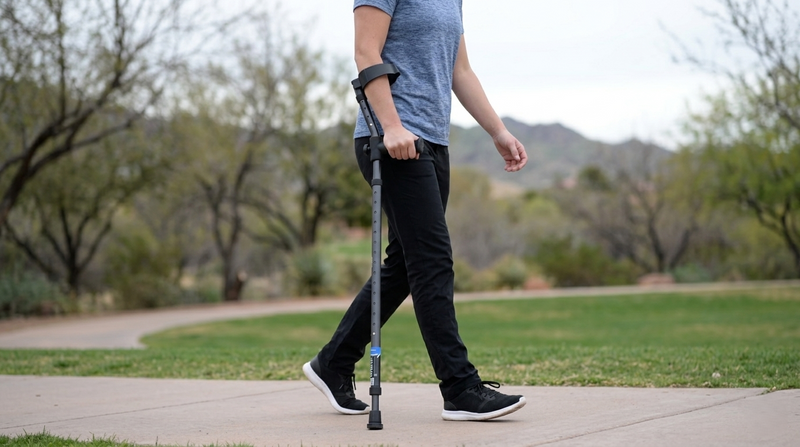
The in-Motion Pro Forearm is the pair we would buy for all-day use. 1.8 lb each, 350 lb capacity, spring-assist in the lower post, left and right grips, two cuff sizes in the box, $149. Certified refurbished is $109 if you want the same model for less.
If you cannot grip a handle, you do not want a standard forearm crutch. You want a design that can take load through the forearm as a platform. SmartCRUTCH is the name that comes up most often for that. We do not make that shape.
If you have never used forearm crutches and surgery was two days ago, underarm is easier to pick up. A lot of people start there because that is what the hospital issued, then switch. Our underarm vs forearm post covers that. The in-Motion Pro Underarm is the familiar underarm shape with the same spring-assist, and it folds.
If you want lights, colors, and extra features and will pay for them, Ergobaum 7G is a real crutch with a different set of tradeoffs. Heavier. More expensive. One of our long-term users, Virginia, compared the two directly in this review.
What we compared (and what we ignored)
We looked at the things that decide whether you still want these crutches in week six:
- Weight of each crutch
- Weight capacity
- How the handle treats your wrist on a long day
- Whether shock is absorbed in the post, the tip, or not at all
- Cuff design and whether you get more than one size
- Height range, including tall users
- Price for a pair you can buy without a clinic account
We did not rank on colorways, LED lights, or Amazon review volume on a folding pair with a 220 lb cap. Those are real products. They fail the job this article is about.
We also did not treat iWALK or a knee scooter as a forearm crutch. Different decision. If your knee cannot take a platform and you still have stairs and outdoor ground, you are still in crutch territory.
The field in 2026
Hospital and drugstore aluminum
This is what most people are handed, and it is almost always underarm. Rigid posts, pads in the armpits, built to be cheap and universal. Our own A-frame pair is $34.99, about 3 lb each, rated to 350 lb, and comes with a 30-day warranty. Fine as a discharge device. A poor long-term tool.
Prolonged use of underarm crutches is also the setup tied to crutch palsy, when people hang on the pads and compress the nerve in the armpit. If that is your current pair, the goal is not to feel guilty about upgrading. The goal is to stop using a device that is working against your shoulders.
Budget folding forearm crutches
These own the word "folding" on Amazon. They are light, they pack small, and some of them look the part. The catch is the cap. PEPE Mobility's folding forearm pair, a common Amazon listing, is rated to 220 lb. Fine as a travel spare if you are well under that. Not the pair we would pick as a daily driver for a long recovery, and a bad match if you are close to the limit.
The Pro Underarm folds in half without losing your height setting. The Pro Forearm does not fold. It is the all-day walker. If folding into an overhead bin is the whole job, the Pro Underarm is the in-Motion that actually folds. Be honest about the weight cap on whatever else you buy.
Ergobaum 7G
Ergobaum 7G is the premium forearm crutch you will see on a lot of comparison pages. It is a serious piece of equipment. List price is $249. Each crutch is 2.9 lb. Official height range is 5'0" to 6'6". Manufacturer-listed capacity is up to 360 lb (some reseller tables still say 350). It folds and has an LED, a knee rest, and a range of colors.
That is 1.1 lb heavier per side than the in-Motion Pro Forearm, and it costs more. In Virginia's review, weight was the biggest factor in her verdict.
Her short version: Ergobaum wins on some grip and accessory details, including color and the flashlight. in-Motion wins on weight and price, and the refurbished pair she bought came out of the box looking new. That is the comparison to read if you are deciding between those two names.
Platform crutches, if your hands are the limiter
SmartCRUTCH and similar designs can be set so the cuff takes the load, which changes the wrist angle and can take pressure off the hands. They show up when rheumatoid arthritis, carpal tunnel, or EDS has made gripping a handle the problem. That is a real use case.
A standard forearm crutch, including ours, still asks you to hold a handle. Two cuff sizes and an angled grip help. They do not turn it into a platform. If you have almost no grip, talk to your therapist about platform vs forearm before you spend $200-plus on the wrong shape.
in-Motion Pro Forearm
This is the crutch we make. Here are the specs from the product page:
- $149 for a new pair, $109 certified refurbished
- 1.8 lb each
- 350 lb capacity
- Short, for floor-to-hip 23.5" to 33.5" (about 4'2" to 5'5")
- Tall, for floor-to-hip 28.5" to 42.5" (about 5'3" to 6'8")
- Left and right ergonomic grips
- Standard and large cuffs in every box
- Spring-assist in the lower post
- Articulating tips
- FSA/HSA eligible
- Free shipping on orders over $99 in the lower 48
- 1-year limited warranty on parts (articulating tips are 60 days). 30-day returns when you buy from us.
Sizing is floor-to-hip, in the shoes you will actually wear, not a guess from your height. If you are between sizes, measure. Short and Tall overlap, so use the tape.
What it is not: a color story, a platform cuff, or a folding travel crutch. It also does not fit under about 4'2". Ergobaum's listed range starts at 5'0". If you are between 4'2" and 5'0", in-Motion Short is the one of these two that is in range. Under 4'2", call before you order.
Certified refurbished pairs are the same model. They were opened, assembled, and returned without much use, then inspected and repackaged. The product page says they arrive looking new or very close to it.
Which one we would actually buy
Long recovery, daily use, or a condition you live with. in-Motion Pro Forearm.
You are over about 220 lb. Skip the popular folding Amazon forearm crutches. in-Motion is rated to 350 lb at 1.8 lb each. If you need more than 350 lb, this is not your crutch.
You are tall. Forearm Tall goes to 6'8". Underarm Tall goes to 7'1". If you are 6'10", you want the underarm Tall, not a forearm that stops at 6'8".
You have EDS, arthritis in the hands, or a long-term condition. Forearm is usually the right type. That is also how we describe it in our EDS and arthritis guides. Then buy the Pro Forearm, not a second pair of axillary crutches. If grip itself is failing, get a platform opinion from PT before you order.
You want to spend less without dropping to a $34.99 pair. Refurbished Pro Forearm at $109. Virginia's pair came out of the box looking new.
You were just handed underarm crutches and surgery was yesterday. Do not force a forearm learning curve on day one unless you already know them. The Pro Underarm is the comfortable version of what you already understand. You can switch later. Both are $149.
Why the spring is the part people argue about
The in-Motion spring sits in the lower post. The product page describes it as a firm, controlled feel, not bouncy, and quieter than traditional spring-loaded crutches. It is meant to take the jolt of each step and give some of that energy back. There is a sound. It is not silent. The page says most users adjust within the first day.
Virginia's first hours on the Pro Forearm felt too bouncy. She could see and hear the posts moving. After she went back to the Ergobaum, the Ergobaum felt rigid, and she kept the spring. She also noted that some people with neurological conditions that affect balance prefer a rigid post. That is a real split, not a review to argue with.
If you want zero give in the post, we make a rigid-post version of the same forearm crutch. Check stock on that page, or call; it is not always on the shelf. The grips are left- and right-specific, so they need to be on the correct sides. Reviews also flag loose cuffs as a stability problem. Snug, not tight.
A quick word on buying them
Order the pair that matches the job, in the size the measuring tape says, from the product page so you get the current stock and the warranty path.
Shop the in-Motion Pro Forearm set ($149, Short or Tall).
Certified refurbished forearm ($109) if you want the same model at a discount.
Pro Underarm if you are staying axillary, or you are taller than 6'8".
The Handy Clip, extra articulating tips, and a round handle set are add-ons on the product page, not requirements. Two cuff sizes already ship in the forearm box. If the large cuff is still small, call. That has come up.
When to talk to your clinician instead of a blog
- A new numbness or tingling in the hand or fingers after you start a crutch, which can mean pressure on a nerve
- A hot, swollen joint, or pain that is getting worse rather than settling
- Grip so limited that a standard handle is not realistic
- A weight-bearing plan you have not actually been cleared for
None of this replaces your surgeon or your therapist.
The bottom line
For all-day use you want a light crutch with a real weight cap, a cuff that fits, a handle that does not kink your wrist, and some way of taking shock out of the step. That is the in-Motion Pro Forearm at $149, or $109 refurbished. Pay more if you specifically want Ergobaum's extras. Buy a platform crutch if you cannot hold a grip. Keep the hospital pair only if you are truly on them for a handful of days.
Frequently asked questions
What are the best forearm crutches in 2026?
The pair we would buy for daily use is the in-Motion Pro Forearm. If you want lights, colors, and a fold, look at Ergobaum 7G and pay more. If you cannot hold a handle, skip both and talk to PT about a platform crutch.
Are expensive forearm crutches worth it?
They are if you will be on them for weeks or longer. A $34.99 aluminum pair is a discharge tool. Over a long non-weight-bearing stretch, or for daily use with a condition, the cost shows up in your hands and shoulders instead of the receipt. For a four-day wean, stay with what you were handed.
Are forearm crutches better than underarm crutches?
For long-term use, yes. That is how we describe it in our type comparison: forearm is the usual choice for conditions like MS, EDS, cerebral palsy, and arthritis, because the load stays off the armpits. Underarm is easier in week one if you have never used forearm crutches. Details are in the type comparison.
What is a good weight capacity for adult forearm crutches?
Know your number and add margin. PEPE Mobility's folding forearm pair is 220 lb. in-Motion is 350 lb. If you need more than that, look at true bariatric equipment rather than stretching a 350 lb crutch.
Do spring-assisted crutches feel bouncy?
The product page describes the in-Motion spring as firm, not bouncy, with most users adjusting within the first day. Virginia found it bouncy at first and then preferred it. If you want zero give in the post, we make a rigid-post version of the same forearm crutch. Check stock on that page, or call; it is not always on the shelf. Loose cuffs and left/right handles on the wrong sides will also make a pair feel wrong. Some people with balance issues from a neurological condition prefer rigid. That is a fit question, not a defect.
Can I use forearm crutches if I am non-weight-bearing?
Yes. Non-weight-bearing is a weight-bearing status (usually walked with a 3-point gait), not a crutch type. Forearm and underarm can both do it. Fit, stability, and your therapist's instruction matter more than the marketing. If you are brand new to crutches and strictly non-weight-bearing (NWB), some people prefer underarm for the first days, then switch.
How should I size in-Motion forearm crutches?
Do not guess from height alone. Stand in the shoes you will wear and measure floor to hip. Short is 23.5" to 33.5" (about 4'2" to 5'5"). Tall is 28.5" to 42.5" (about 5'3" to 6'8"). Between sizes, use the measurement, not the nickname of the size.