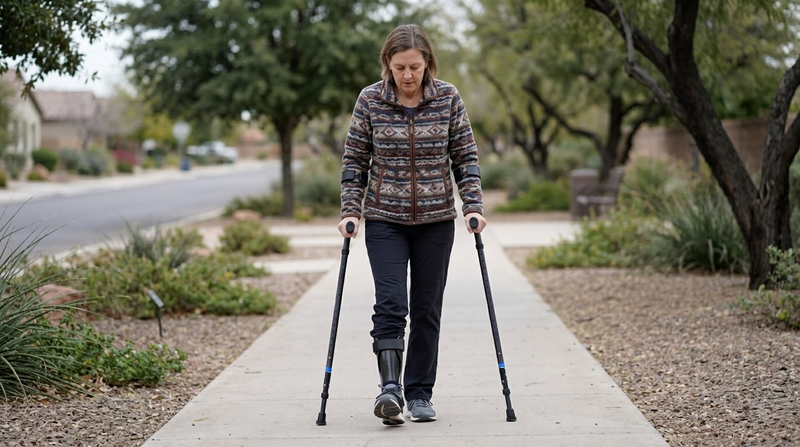
Arthritis puts you in a bind that other crutch users do not face. You need help getting around because your hips, knees, or ankles hurt, but the usual answer, putting weight through your hands and wrists, runs straight into joints that may be arthritic too. A standard crutch can trade pain in one place for pain in another.
That does not mean crutches are off the table. It means the choice matters more for you than for almost anyone else, and the wrong equipment can genuinely make things worse. Done right, the right aid keeps you moving and active, which is one of the best things you can do for arthritic joints. Done wrong, it loads the joints you were trying to protect.
This guide is about getting it right. How arthritis changes the crutch question, what to look for, when a forearm crutch helps and when something else fits better, and how to stay mobile without paying for it later.
Weighing the broader picture? Our guides to choosing crutches later in life and preventing shoulder and wrist pain pair closely with this one.
The honest answer to “will crutches just hurt my hands?”
They can, and that is the real risk worth naming. The loads are not trivial: peak axial force through a single crutch has been measured at roughly 45 percent of body weight during normal crutch gait, and where that force lands depends on the design. If your hand and wrist joints are already inflamed, a hard grip and a thin cuff will hurt, and standard crutches are a common reason arthritis patients give up on them.
Here is the part most people do not know. The problem is usually the design, not the crutch itself. Equipment built to spread the load, through a molded forearm cuff and a shaped grip rather than a narrow handle digging into your palm, changes the experience entirely. The goal is to move the work off your small, painful hand joints and onto your forearm and larger structures. That is exactly what the right crutch does.
Osteoarthritis and rheumatoid arthritis are not the same problem
The two main kinds of arthritis affect your crutch choice differently, so it helps to know which game you are playing.
Osteoarthritis
This is the wear-related kind, often centered in one or two joints like a hip or a knee. If your hands are relatively spared, crutches that take load off the affected leg can work well, and an ergonomic grip keeps the hands comfortable. The aim is to unload the bad joint while keeping the good ones happy.
Rheumatoid arthritis
This is the inflammatory, often body-wide kind, and it frequently hits the hands and wrists hard. That makes the gripping part of crutch use the sticking point. For many people with rheumatoid arthritis, a crutch that loads the forearm cuff rather than the hand is the difference between usable and impossible, and on high-flare days a wheeled walker with forearm supports may serve better. Work with your rheumatologist or therapist on what fits your pattern.
What to look for in crutches for arthritis
A few features matter far more for arthritic joints than for the average user.
- A molded forearm cuff that carries real load, so weight travels through the forearm instead of dumping onto the hand and wrist.
- An ergonomic grip with a wide contact area, angled to keep the wrist in a natural position. A thin, hard, straight handle is the enemy here.
- Light weight, because every ounce you lift with each step is a tax on tired joints. Lighter crutches let you do more before the pain catches up.
- Shock absorption, so the jolt of each step is softened rather than traveling straight up into inflamed joints.
Protecting your joints while you use them
Good technique and good habits keep arthritis crutch use sustainable. Movement helps arthritis, but smart movement helps more.
- Let the forearm cuffs do their job. Settle your weight so the cuff and forearm share the load, rather than white-knuckling the grips.
- Pace yourself across the day. Arthritis rewards steady, moderate activity and punishes overdoing it, so spread your movement out and rest before you are wrecked.
- Warm up stiff joints before a big walk, and listen to the difference between the normal ache of use and the sharper pain that says stop.
- Keep up the gentle strengthening your therapist recommends. Stronger muscles around a joint take load off the joint itself.
Why crutch choice is not a small decision here
For most crutch users, equipment is about comfort. For you, it is about whether crutches are usable at all. This is the exact problem the In-Motion Pro forearm crutch was designed around: molded V-shaped forearm cuffs that spread contact across the forearm, angled and contoured grips that hold the wrist in a natural position rather than forcing it into deviation, a spring-assisted lower post that softens each impact, and a weight of 1.8 lbs per crutch so you are not lifting more than you need to. Both standard and large cuff sets ship in the box. For an arthritic body, that combination is the point, not a luxury. You can see the options at the In-Motion shop. And if your hands are too affected for any handheld crutch, that is worth an honest talk with your care team about a walker or other support.
When to talk to your doctor
- Hand or wrist pain that worsens after you start using a crutch. That is a signal the load or the design is wrong, and pushing through it can damage joints.
- A new, hot, swollen joint, which may mean a flare or another problem that needs evaluation before you load it.
- Numbness or tingling in the hand, which can mean a crutch is pressing on a nerve, a known issue with prolonged crutch use.
- A calf that is swollen, red, warm, or painful, or sudden shortness of breath or chest pain. These can signal a blood clot, which is a medical emergency. Get help right away.
The bottom line
Arthritis makes the crutch decision higher stakes, because the standard answer can aggravate the very joints you are trying to spare. The fix is to choose equipment that moves the load off your hands and onto your forearms, to pace yourself, and to keep moving in the steady, moderate way that arthritis rewards.
Staying mobile is one of the kindest things you can do for arthritic joints. With the right crutch and a little strategy, you can do it without trading one kind of pain for another.
Frequently asked questions
Are forearm crutches good for arthritis?
They can be, if they are the right design. Forearm crutches that carry real load through a molded cuff move work off the small hand and wrist joints, which helps when those joints are arthritic. A thin, hard grip will hurt, so look for a wide ergonomic grip and light weight. For severely affected hands, a walker with forearm supports may fit better.
Will using crutches make my hand arthritis worse?
It can if the crutch loads your hands and wrists with a narrow grip. The key is choosing a design that spreads pressure across a wide grip and carries weight through the forearm cuff rather than the palm. If hand or wrist pain increases after you start, that is a signal to change the equipment or talk to your care team.
Is a cane or a crutch better for arthritis?
It depends on where your arthritis is. A cane puts all the load on one hand, which is hard if your hands are affected. A forearm crutch can spread load to the forearm and give more support for an arthritic hip or knee. Many people benefit from trying both with a therapist before deciding.
Should I still use crutches on a bad arthritis day?
Listen to your body and your care team. Gentle, moderate movement usually helps arthritis, but a hot, swollen, flaring joint may need rest first. On high-flare days, some people switch to an aid that offloads the hands entirely, like a wheeled walker, and return to crutches when the flare settles.
Can the right crutch really make a difference with arthritis?
Yes, more than for almost any other user. For arthritis, the difference between a hard, narrow grip and a molded forearm cuff with a wide angled grip can be the difference between crutches being unusable and being a daily help. The design moves the work off your most painful joints, which is the whole point.