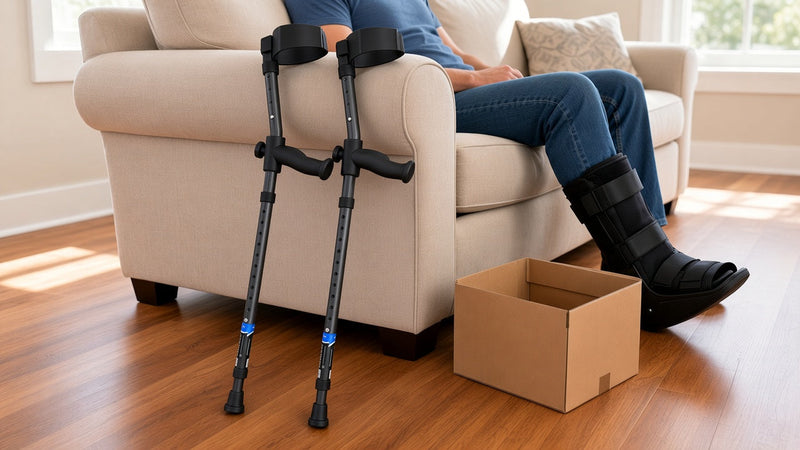
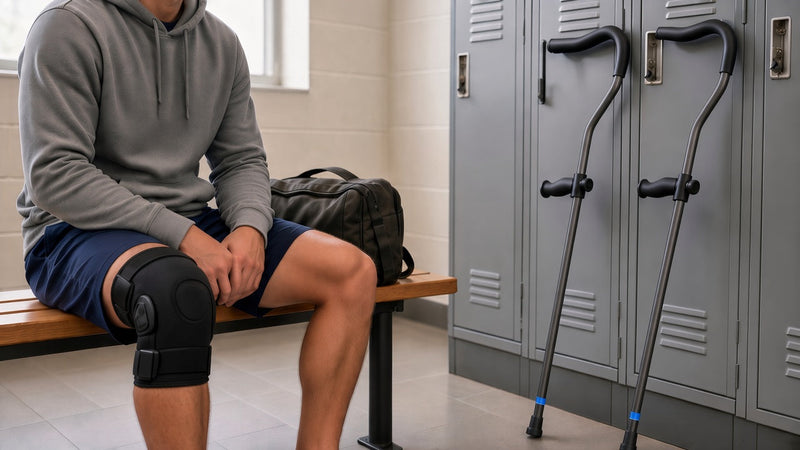
The featured image for this article was generated using AI.
Axillary, Lofstrand, Canadian, European, elbow, wrist, platform, hands-free. If you're shopping for crutches for the first time, the names alone can make your head spin. The good news is that there are really only a few basic designs, and most of those names point to the same two.
Here's a plain guide to each type of crutch, who it tends to suit, and what to ask before you buy.
The short answer
- Underarm (axillary) crutches are the classic hospital crutch. Most people get them for a short recovery.
- Forearm crutches (also called Lofstrand, elbow, Canadian or European crutches) have a cuff around the forearm and no underarm rest. People who use crutches for months or for life often prefer them.
- Platform crutches (also called gutter or forearm support crutches) let you rest your whole forearm on a padded trough, which takes load off the hands and wrists.
- Hands-free crutches strap to your leg and support a bent knee, so you walk without using your hands at all.
Your doctor or physical therapist is the best person to tell you which type fits your injury and how much weight you're allowed to put on your leg.
Underarm (axillary) crutches
"Axillary" just means armpit. These crutches have an underarm rest at the top, a handgrip partway down, and two side rails that meet at a single leg near the floor. Both the overall height and the handgrip height adjust, according to Physiopedia's overview of crutch types.
Good for: short-term injuries like a sprain, fracture or surgery recovery, and people who want something familiar that takes little practice.
What to know: despite the name, you shouldn't lean your weight on the underarm rest. The American Academy of Orthopaedic Surgeons says the top of the crutch should sit about 1 to 2 inches below your armpit, and your weight should rest on your hands, not the underarm supports, to avoid damage to the nerves and blood vessels in your armpits (OrthoInfo).
Our in-Motion Pro Underarm Crutch Set is an underarm design with spring assist, ergonomic left and right grips and articulating tips. It folds in half without changing your height settings. If you want a simple, budget-friendly pair, we also sell Standard A-Frame Aluminum Crutches.
Forearm crutches (Lofstrand, elbow, Canadian or European)
These are all the same basic design. Each crutch has a single shaft, a handgrip, and a cuff that wraps around your forearm just below the elbow (Physiopedia). You put your weight through the handgrip, and the cuff keeps the crutch with your arm, so you can let go of the grip to open a door without dropping it.
The name "Lofstrand" comes from the inventor who patented the design. Our guide What Are Lofstrand Crutches? covers that history and how they compare to standard crutches. "European" or "Euro-style" usually refers to the same forearm design. In online listings, "wrist crutches" usually means forearm crutches too, so check the photos to be sure.
Good for: longer recoveries, people who use crutches every day for a chronic condition, and anyone who wants to keep pressure out of their armpits.
What to know: forearm crutches take a little more practice and arm strength at first, because there's no underarm rest to brace against. They're sized differently too. You measure from the floor to your hip, not to your armpit. See our crutch sizing guide.
Our in-Motion Pro Forearm Crutch Set has spring assist, contoured left and right grips and a semi-closed cuff. Both the Tall and Short sizes include standard and large cuffs in the box. If you prefer no spring, there's a Rigid Post version.
Platform crutches (gutter or forearm support crutches)
Instead of gripping a handle with your weight on your hands, you rest your forearm on a padded platform, secure it with a strap, and hold an adjustable handpiece. Physiopedia notes they're used for people who are partial weight bearing and are particularly useful for people with rheumatoid conditions.
Good for: people who can't put much weight through their hands or wrists, such as some people with arthritis or a hand or wrist injury.
What to know: ask your physical therapist whether a platform crutch makes sense for you before you buy. We don't make platform crutches. If you have painful joints, our guide on crutches and arthritis is a good next read.
Hands-free crutches
A hands-free crutch straps to your injured leg. You kneel on a padded platform with your knee bent, and the device acts as a lower leg so you can walk with both hands free. One well-known example, the iWALK, is designed for below-the-knee injuries.
Good for: some below-the-knee injuries, like a foot or ankle problem. The iWALK has its own height, weight and age requirements and an online qualification test.
What to know: they're only for below-the-knee injuries, and they take some balance and practice. Ask your doctor before you buy one. We don't sell hands-free crutches.
Quick comparison
- Underarm (axillary): weight on your hands, with the underarm rest for stability. Best for short recoveries; little practice needed.
- Forearm (Lofstrand, elbow, Canadian, European): weight on your hands, with a cuff around the forearm. Best for long-term and daily use, with no armpit pressure.
- Platform (gutter): weight on your forearm, resting on a padded trough. Best when hands or wrists are limited, such as with arthritis.
- Hands-free: weight on your bent knee and shin on the injured side. Only for below-the-knee injuries; both hands stay free.
How to choose
- Start with your care team. Your weight-bearing orders, balance and arm strength all matter. A physical therapist can watch you walk and suggest a type.
- Think about how long you'll need them. A few weeks on underarm crutches is often fine. If you'll be on crutches for months, forearm crutches are worth a look.
- Check your hands and wrists. If gripping a handle hurts, ask about grip shape or a platform style. Our guide to hand and palm pain from crutches explains the common causes.
- Check size and weight capacity. Every in-Motion adult crutch on our site is rated to 350 lbs. Compare models on our Shop All Crutches page.
Still torn between the two most common types? Read Forearm Crutches vs. Underarm Crutches, or call us at (877) 753-5556 and talk to a real person.
FAQ
What are the different types of crutches?
The main types are underarm (axillary) crutches, forearm crutches, platform crutches and hands-free crutches. Lofstrand, elbow, Canadian and European crutches are all names for forearm crutches.
Are Lofstrand and forearm crutches the same thing?
Yes. Lofstrand is another name for forearm crutches, from the inventor who patented the design.
Why are they called Canadian crutches?
It's simply another common name for forearm or elbow crutches. Whatever the label, look for the forearm cuff and a single shaft.
Which type of crutch is easiest to use?
Most people pick up underarm crutches fastest, which is why hospitals hand them out. Forearm crutches take a little practice but are often more comfortable for long-term use.
What are platform crutches used for?
They let you bear weight through your forearm instead of your hands. They're often used by people who are partial weight bearing and have hand, wrist or rheumatoid joint problems.
Related guides
- What Are Lofstrand Crutches? The Forearm Crutch Guide
- Forearm Crutches vs. Underarm Crutches: What Nobody Tells You Before Surgery
- Walking Aids Compared: Crutches, Canes, Walkers, Knee Scooters, and Wheelchairs
- Crutch Sizing Guide: Find Your Perfect Fit in 3 Easy Steps
This article is for general information only and isn't medical advice. Talk with your doctor or physical therapist about which type of crutch is right for your injury and how much weight you can put on it.