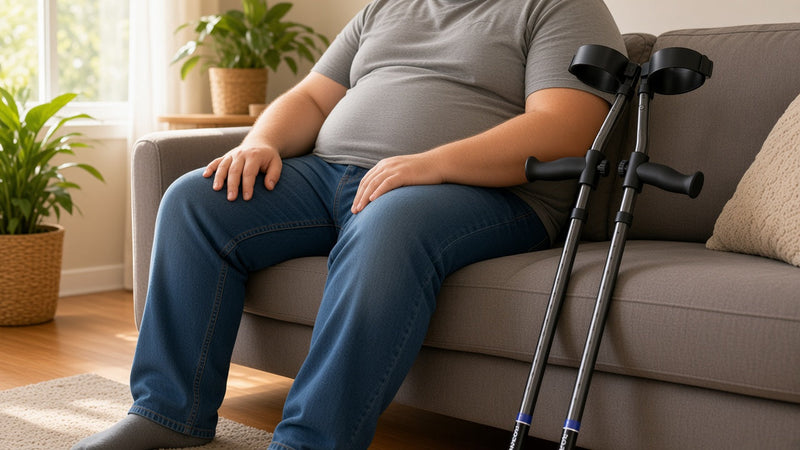
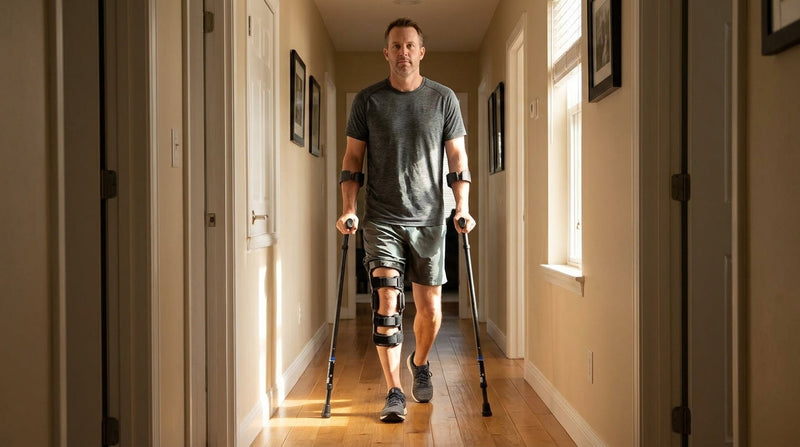
The featured image for this article was generated using AI.
If you train hard, getting hurt is more than an inconvenience. It's a break in routine, sometimes in identity. One day you're logging miles or lifting heavy. The next you're on crutches and running the season's math in your head.
This guide is for athletes, from weekend runners to college players, who are now on crutches because of an injury. We'll cover what actually matters in a crutch when you're used to being active, how to stay in shape without risking your recovery, and how to avoid the mistakes that set people back.
What crutches can and can't do for an athlete
No crutch will make your ankle, knee or Achilles heal faster. Healing takes as long as it takes, and your surgeon or physical therapist sets the timeline: how much weight you can put on the leg, and when.
A good crutch does something different. It makes the weeks between injury and recovery easier to live with. It's less punishing on your hands and shoulders. It's steadier on real-world surfaces. It's comfortable enough that you actually use it the way you were told to, instead of cheating on weight-bearing because the crutches hurt.
That last part matters. Putting weight on an injured leg before you're cleared can set your recovery back. So the "best" crutch for an athlete is the one that lets you follow your weight-bearing plan exactly, every day.
How to handle crutches like an athlete
1. Get your weight-bearing status in plain words
Before anything else, know your instructions. Are you non-weight-bearing, toe-touch, partial, or weight-bearing as tolerated? If you aren't sure, ask. That decides which gait you'll use. Our guide to the 3-point gait, the pattern most often taught when one leg has a weight-bearing limit, explains how it works.
2. Fit the crutches before you go anywhere
It's tempting to grab the crutches and go. Take five minutes first. A crutch set to the wrong height pushes your shoulders up or makes you hunch, and you'll feel it quickly.
Measure in the shoes you'll actually wear. For forearm crutches, measure from the floor to your hip. For underarm crutches, measure from the floor to your underarm. Our crutch sizing guide walks you through it.
3. Carry weight through your hands, not your armpits
On underarm crutches, it's tempting to hang on the top pads. Don't. Steady pressure in the armpit can irritate the nerves there, a problem called crutch palsy. Keep the pads a couple of fingers below your armpit and push down through the grips.
4. Ask your PT what training is safe
Being on crutches doesn't have to mean doing nothing. Whether you can train your upper body, your core, or your uninjured leg depends on your injury and your surgeon's instructions, so ask your PT directly what's allowed and what isn't. When you're cleared, our strength guide for crutch users has ideas for building the arm and core strength that makes crutching easier.
5. Respect the surfaces
Locker rooms, pool decks, wet turf and gym floors can be slippery. Slow down on anything wet, and check your crutch tips for wear. Our tips on stairs, curbs and uneven ground cover the trickier spots.
6. Don't rush the transition off crutches
Going from two crutches to one, and from one to none, is a milestone, and it's easy to jump the gun. Let your PT decide when. Our guide on one crutch or two explains what that step usually looks like.
Forearm or underarm crutches for athletes?
It depends on your injury, how long you'll be on crutches, and what your care team recommends.
- Underarm crutches are what most hospitals hand out. They can feel stable for short-term, non-weight-bearing recovery, but you have to keep weight off your armpits.
- Forearm crutches put your weight through your hands and arms, with a cuff for stability. They take more upper-body strength and some practice to learn.
For a closer look, read forearm vs. underarm crutches.
A note on in-Motion crutches
Here's what our product pages say, with nothing added:
- in-Motion Pro Forearm Crutch Set: spring assist that the page describes as "firm, controlled," not bouncy, plus ergonomic left/right grips, two cuff sizes in the box (standard and large), and articulating tips that pivot to keep contact with the ground on surfaces like hardwood, grass and gravel. Each crutch weighs 1.8 lbs and the rating is 350 lbs. The Short size fits a floor-to-hip measurement of 23.5" to 33.5" (adults 4'2" to 5'5"), and the Tall size fits 28.5" to 42.5" (users 5'3" to 6'8"). It also comes in a rigid-post version without springs.
- in-Motion Pro Underarm Crutch Set: spring assist, ergonomic grips, foam underarm padding and articulating tips, and it folds in half without changing your height settings. Each crutch weighs 2.2 lbs and the rating is 350 lbs. The Short size fits a floor-to-underarm measurement of 42" to 52" (users 4'8" to 5'9"), and the Tall size fits 52.5" to 65.5" (users 5'10" to 7'1").
You can compare every model on our Shop All Crutches page.
FAQ
What are the best crutches for athletes?
The best ones are crutches that fit you correctly, feel comfortable enough to use exactly as your care team instructs, and stay steady on the surfaces you'll actually be on. Brand matters less than fit and following your weight-bearing plan.
Can I work out while I'm on crutches?
Often yes, in some form, but it depends on your injury. Ask your surgeon or PT what's safe before you start anything.
Are spring-loaded crutches good for sports injuries?
Some people like how a spring takes the edge off each step, and others prefer a rigid crutch. That's a matter of feel. We offer both, rated to the same 350 lbs.
When can I stop using crutches and return to my sport?
Only your care team can answer that. Going back before you're cleared can put your recovery at risk.
Related guides
- Building Upper-Body and Core Strength for Crutch Users
- Sprained Ankle Recovery: When You Need Crutches and When You Don't
- How to Use Crutches After ACL Surgery
- Achilles Tendon Surgery Recovery
- Crutches for Teens: Sports, Self-Image, and Independence
This article is for general information only and isn't medical advice. Talk with your doctor or physical therapist about your injury, your weight-bearing status, and when it's safe to return to sport.