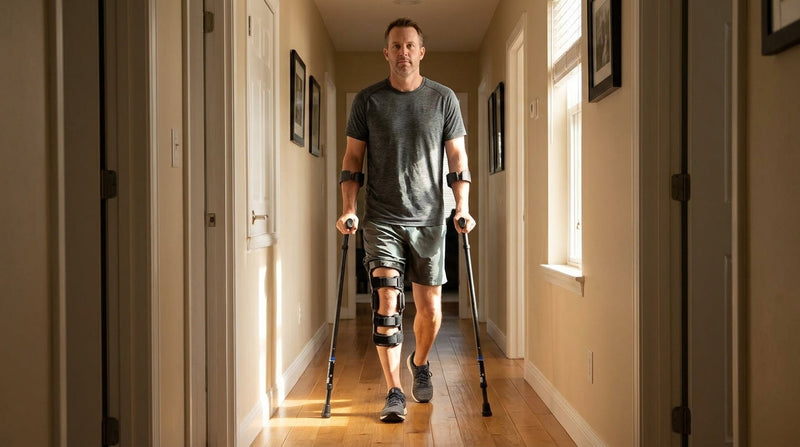
The featured image for this article was generated using AI.
If you're a bigger person shopping for crutches, you've probably noticed that most listings bury the weight rating, or skip it. That's a real problem. A crutch that's rated below your weight is not "probably fine." It's the one piece of equipment holding you up while an injured leg can't.
This guide is for anyone searching for heavy-duty crutches, crutches for adults over 300 lbs, or "bariatric" crutches. We'll cover what a weight rating actually means, how to check whether a pair is right for you, and what to do if you're above what our crutches are rated for.
The honest answer: know the rating, and leave yourself room
Every crutch has a maximum user weight set by its manufacturer. That number is the limit the crutch was designed and tested to carry. It is not a target to aim for.
Here's why the margin matters. When you walk on crutches, especially with a non-weight-bearing leg, your arms and the crutches take most of your body weight with every step. Push off a little hard, catch a curb, or drop into a chair, and the load spikes for a moment. If you weigh right at a crutch's limit, those moments are where hardware wears out.
So the practical rule is simple: choose a crutch rated at or above your current weight, and if you're close to the limit, talk to your doctor or physical therapist before you buy. Count what you'll be carrying, too. A backpack, a laptop bag, or a heavy boot or cast all add to the load.
All of our current in-Motion crutches, both forearm and underarm, spring-assist and rigid-post, are rated for 350 lbs. If you weigh more than that, our crutches aren't the right choice for you, and we'd rather tell you that up front. Ask your care team or a medical equipment supplier about a bariatric-rated device, or whether a walker or knee scooter fits your recovery better.
How to choose heavy-duty crutches that actually hold up
1. Find the weight rating in writing
Don't trust "heavy duty" in a product title. Look for a specific number in the specs or the description. If you can't find one, ask the seller. If they can't tell you, keep shopping.
2. Look at where the stress goes
On a crutch, the weak points tend to be the joints: where the handle meets the post, and where adjustable sections lock together. A sturdy crutch puts reinforcement right there. On the in-Motion Pro, for example, the product pages call out a reinforced cylinder bracket and a double-reinforced strut where the handle attaches.
3. Get the fit right, because fit is a strength issue too
A crutch that's set too tall or too short makes you lean, twist, or hang on it at odd angles. That's harder on your shoulders and wrists, and it puts uneven load on the crutch. Measure before you order:
- Forearm crutches: stand up straight in the shoes you'll normally wear and measure from the floor to your hip. Sizing is based on handle height, not just how tall you are. On the in-Motion Pro forearm set, the Short size fits a floor-to-hip measurement of 23.5" to 33.5" and the Tall size fits 28.5" to 42.5".
- Underarm crutches: measure from the floor to your underarm, again in your everyday shoes.
Our crutch sizing guide walks through it step by step.
4. Think about your hands, wrists and armpits
More body weight means more pressure on whatever part of you meets the crutch. On traditional underarm crutches, people often end up leaning on the top pad, which presses on nerves in the armpit (it's called crutch palsy). On straight-grip crutches, the wrist bends back under load. Look for grips that keep your wrist straight and, for forearm crutches, a cuff that fits your arm snugly without pinching.
5. Check the tips
The rubber tip is the only thing between you and the floor. Worn, cracked or smooth tips slip. Check them often and replace them when the tread wears down.
6. Inspect your crutches regularly
Every week or so, look for bent tubes, loose push-buttons, rattling joints, or anything that has shifted. If something looks off, stop using that crutch until it's fixed or replaced. Our maintenance guide has a quick checklist.
Forearm or underarm for a bigger frame?
There's no single right answer. It depends on your injury, your balance, how long you'll need crutches, and what your doctor or PT recommends.
- Forearm crutches put your weight through your hands and arms with the cuff for stability. They do take more upper-body strength and some practice.
- Underarm crutches can feel more stable for short-term, non-weight-bearing recovery, and they're what most hospitals hand out. The catch is that you should carry weight through your hands, not your armpits.
If you're torn, read forearm vs. underarm crutches and bring the question to your PT.
A note on in-Motion crutches
We design our crutches for people who use them hard, so here's exactly what the product pages say, with nothing added:
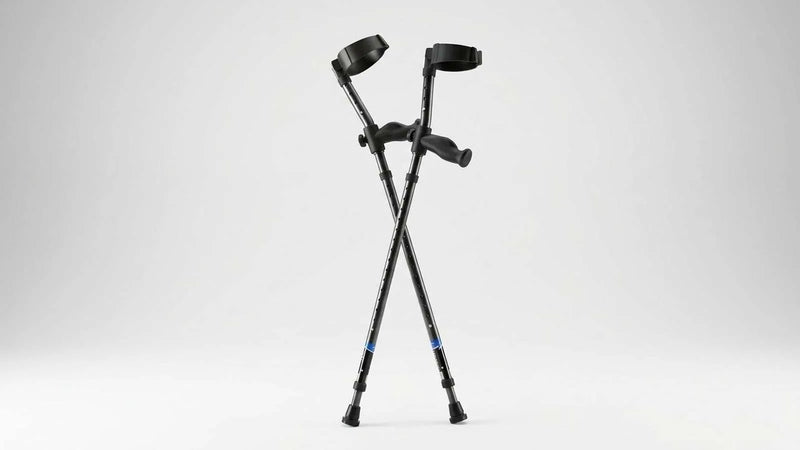
- in-Motion Pro Forearm Crutch Set: 350 lb weight capacity, 1.8 lbs per crutch. Tall fits users 5'3" to 6'8" and Short fits 4'2" to 5'5". It has spring assist, ergonomic left/right grips, two cuff sizes in the box (standard and large), and articulating tips. Also available as a rigid-post version without springs, with the same 350 lb rating.
- in-Motion Pro Underarm Crutch Set: 350 lb weight capacity, 2.2 lbs per crutch. Tall fits users 5'10" to 7'1" and Short fits 4'8" to 5'9". It has spring assist, ergonomic grips, foam underarm padding, articulating tips, and it folds in half without changing your height settings.
The included large cuff on the forearm set is worth noting if standard cuffs have felt tight on you. You can compare every model on our Shop All Crutches page.
FAQ
What weight capacity do I need in a crutch?
At least your current body weight, plus anything you regularly carry. If you're near the limit, ask your doctor or PT whether that crutch is a safe choice for you.
Are in-Motion crutches good for people over 300 lbs?
Our current forearm and underarm models are rated for up to 350 lbs. If you're between 300 and 350 lbs, get your sizing right and check your crutches regularly. If you're over 350 lbs, please choose a device rated for your weight.
What does "bariatric" mean on a crutch?
It generally means the device is made for users above standard weight limits. The term isn't a fixed rating, so always check the actual number the manufacturer lists.
Do heavier people break crutches more often?
Any crutch used above its rating, set to the wrong height, or left with worn parts is more likely to fail. Staying within the rating, fitting it correctly, and inspecting it regularly matter more than anything else.
Do spring-assist crutches work for heavier users?
Our spring-assist and rigid-post models carry the same 350 lb rating. The spring is there to absorb some of the shock of each step. Whether you prefer that feel is personal, and we offer both.
Related guides
- Crutch Sizing Guide: Find Your Perfect Fit in 3 Easy Steps
- The Best Crutches for Tall Adults
- Best Forearm Crutches of 2026: An Honest Comparison
- Preventing Shoulder and Wrist Pain While Using Crutches
- Building Upper-Body and Core Strength for Crutch Users
This article is for general information only and isn't medical advice. Talk with your doctor or physical therapist about which mobility aid, and which weight rating, is right for you.