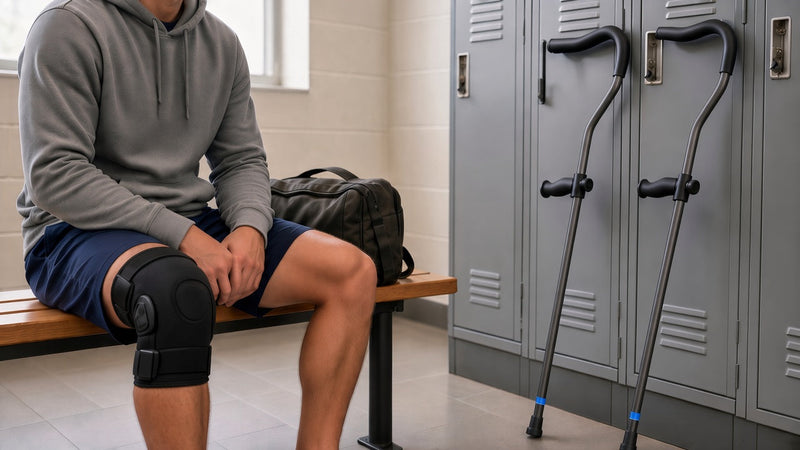
The featured image for this article was generated using AI.
Maybe you just left urgent care with a boot and a "stay off it" order. Maybe the crutches the ER gave you are rubbing your armpits raw. Or maybe surgery is on the calendar and you'd rather sort this out before the big day. Either way, you're asking the same question a lot of people type into Google: where do you actually buy crutches?
Here's a plain rundown of every option, what each one is good for, and how to pay for them without overspending.
The short answer
It depends on how fast you need them and how long you'll use them:
- Need them today? Ask the clinic, ER or surgeon's office that's treating you, or call a local medical supply store or pharmacy before you drive over.
- Have a few days? Ordering online gives you far more choice in style, size and comfort than a store shelf.
- Money is tight? Check your insurance, use your FSA or HSA, or look for a free medical equipment loan closet near you.
Wherever you buy, the same three things matter most: the right size, a weight rating that covers you, and the right type of crutch for your injury.
Your options, one by one
1. The hospital, ER, urgent care or surgeon's office
If you're being treated for an injury, ask whether they can send you home with crutches. Many clinics keep basic underarm crutches on hand and will adjust them to your height before you leave. That's the fastest route, and you get a quick fitting from someone who knows your injury.
Two things to ask first: whether the crutches will show up on your bill, and whether insurance covers them. They're usually standard aluminum underarm crutches, which work fine for a short recovery but aren't built with comfort in mind if you'll be on them for weeks.
2. Pharmacies and big-box stores
Some drugstores and large retailers carry basic adjustable crutches. Stock and sizes vary a lot from store to store, so call ahead instead of hobbling through the aisles hoping. Don't expect much fitting help. Bring your measurements, or check the fit yourself with our crutch sizing guide.
3. Medical supply stores
A local medical supply store (sometimes called a DME store, for durable medical equipment) is often the best in-person option. Staff can usually help you size the crutches, and some stores also rent equipment. If you plan to use Medicare or insurance, ask whether the store is in network or enrolled with Medicare before you buy.
4. Online marketplaces
Amazon and other big marketplaces have a huge selection and fast shipping in a lot of areas. The trade-off is that you're doing all the homework yourself. Before you click buy, look for a weight capacity listed in writing, a clear height range for each size, and who handles returns and replacement parts. If a listing doesn't say, ask the seller.
5. Directly from the company that makes them
Buying from the maker means you can ask questions about sizing, parts and warranty directly. That's what we do at crutches.com. Our shipping policy spells out the details:
- Orders ship mainly from St. George, Utah, and most in-stock orders placed before 3:30 pm ship the same business day.
- Shipping is free on orders of $99 or more within the contiguous U.S. Typical delivery is 3 to 7 business days after shipping.
- Local pickup is available in St. George.
- Returns can be requested within 30 days of receiving them, for unused items with tags in original packaging, per our refund policy. The cost of the return label is deducted from the refund.
Not sure which size or model fits you? Call us at (877) 753-5556 and talk to a real person.
6. Free or borrowed crutches
If cost is the barrier, look for a medical equipment loan closet. These are usually run by nonprofits, churches or community groups, and many lend crutches, walkers and wheelchairs at no cost. GotDME is a free national directory where you can search for lending programs by ZIP code. Call first to confirm they have crutches in your size.
Borrowing a pair from a friend works too. Just make sure they adjust to your height, the push-buttons lock firmly, and the rubber tips aren't worn smooth.
How to pay for crutches
Medicare
According to Medicare.gov, Part B covers crutches as durable medical equipment when they're medically necessary and your provider prescribes them for use at home. After you meet the Part B deductible, you pay 20% of the Medicare-approved amount, as long as your supplier accepts assignment.
Medicare only pays for equipment from suppliers enrolled in Medicare, so ask before you buy. Our guide on how to get crutches through Medicare walks through the steps.
Private insurance
Many plans cover crutches under their durable medical equipment benefit, but coverage varies. Call your insurer and ask whether crutches are covered, whether you need a prescription, and whether you have to buy from an in-network supplier. We don't bill insurance directly, but we provide the paperwork you need to request reimbursement. See our insurance reimbursement page for how it works.
FSA and HSA
Crutches are generally an eligible expense for a flexible spending account (FSA) or health savings account (HSA). You can pay with your FSA or HSA card at checkout on crutches.com. Our guide Are crutches FSA and HSA eligible? covers the details.
Before you buy: a quick checklist
- Measure first. Forearm crutches are sized from the floor to your hip. Underarm crutches are sized from the floor to your underarm. Measure in the shoes you'll usually wear.
- Check the weight rating. Look for a specific number, and include anything you'll carry, like a backpack.
- Pick the type. Underarm crutches are what most people get for a short recovery. Forearm crutches take a little practice but keep pressure off your armpits. If you're not sure, read forearm vs. underarm crutches and ask your doctor or physical therapist.
- Look at the tips and grips. Grippy rubber tips and comfortable handles matter more than you'd think once you're on them every day.
- Know the return policy. Especially if you're guessing at a size.
A note on in-Motion crutches
If you're buying crutches you'll actually live with for a while, our in-Motion line was designed for comfort over the long haul:
- in-Motion Pro Forearm Crutch Set: spring assist, ergonomic left and right grips, standard and large cuffs in the box, and articulating tips. Rated to 350 lbs.
- in-Motion Pro Underarm Crutch Set: spring assist, ergonomic grips, foam underarm padding and articulating tips, and it folds without changing your height settings. Rated to 350 lbs.
- Certified refurbished forearm sets: in-Motion Pro Forearm Crutches that were opened, assembled and returned without much use, then inspected and repackaged. They arrive looking new or very close to new, at a lower price.
- Standard A-Frame Aluminum Crutches: a classic, budget-friendly underarm pair for a short recovery or as a backup. Rated to 350 lbs and sold as a pair.
You can compare everything on our Shop All Crutches page.
FAQ
Do I need a prescription to buy crutches?
Not to buy them yourself. You can order crutches on crutches.com without a prescription. If you want insurance or Medicare to pay, though, your plan may require a prescription or doctor's order.
Can I buy crutches at a pharmacy?
Some pharmacies carry basic crutches, but stock and sizes vary by location. Call ahead to make sure they have your size.
Where can I get crutches for free?
Try a medical equipment loan closet in your area. The GotDME directory lists free lending programs by ZIP code. You can also ask your clinic or physical therapist if they know of one nearby.
Should I rent or buy crutches?
It depends on how long you'll need them and what your insurance covers. Medicare notes that, depending on the equipment, you may rent, buy, or choose between the two. Our renting vs. buying guide lays out the trade-offs.
How fast can I get crutches online?
It depends on the seller and where you live. On crutches.com, most in-stock orders placed before 3:30 pm ship the same business day, and typical delivery in the contiguous U.S. is 3 to 7 business days after shipping.
Related guides
- Choosing the Right Crutches: A Buyer's Guide
- Crutch Sizing Guide: Find Your Perfect Fit in 3 Easy Steps
- Forearm Crutches vs. Underarm Crutches: What Nobody Tells You Before Surgery
- Does Medicare Cover Crutches? A Complete 2026 Guide
- Best Crutches to Buy With FSA or HSA Dollars (2026 Guide)
This article is for general information only and isn't medical advice. Talk with your doctor or physical therapist about which crutches are right for your injury and how much weight you can put on it.