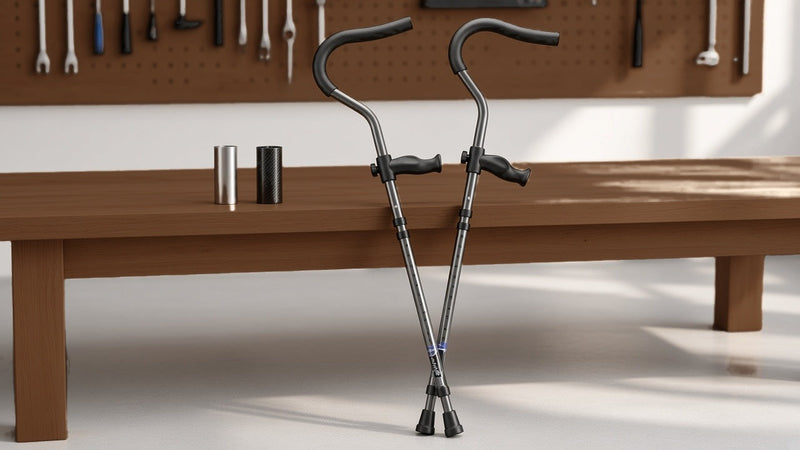
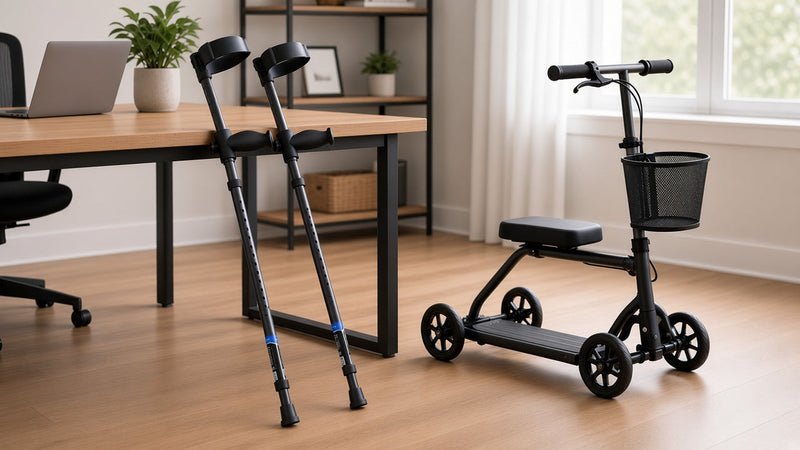
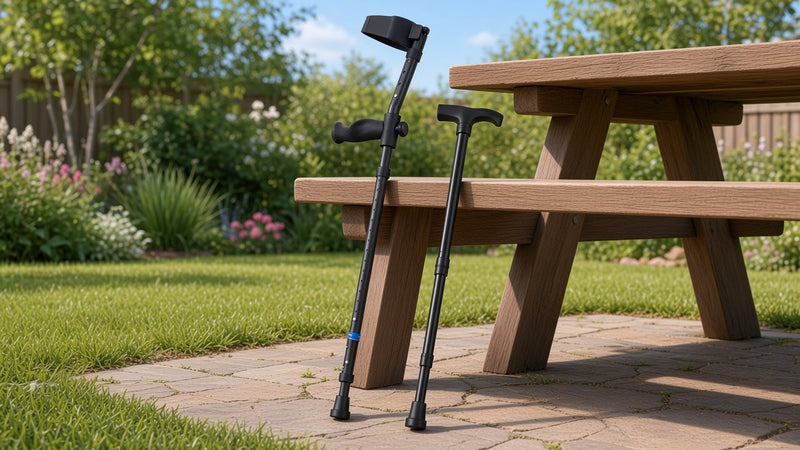
The featured image for this article was generated using AI.
Search "crutch accessories" and you'll find hundreds of add-ons: pads, covers, bags, cup holders, clips, straps. Some of them make life on crutches easier. Plenty of them just add bulk. And when something on your crutch actually wears out, it can be hard to tell what you need, or whether a part will even fit.
This guide sorts it out: what's worth buying, which parts wear out and when to replace them, and how to make sure a replacement fits your crutches.
The short answer
Start with the parts that touch you and the ground: the tips, the underarm pads or forearm cuffs, and the handgrips. Those affect comfort and safety every single step. After that, the most useful extras are simple ones: a way to carry your things hands-free and a way to keep your crutches from falling over when you set them down.
Before you buy anything, know your crutch's brand, model, and size. Replacement parts are rarely universal.
The accessories that actually help
A way to carry things hands-free
This is the one almost everyone needs. With your hands on the crutches, carrying a phone, a water bottle, or a plate across the room gets tricky fast. MedlinePlus suggests using a small backpack, fanny pack, or shoulder bag to hold the things you need with you, like your phone. The American Academy of Orthopaedic Surgeons (AAOS) suggests a backpack, fanny pack, or an apron with pockets.
You probably already own one of these. That makes it the cheapest accessory on the list.
Something to keep your crutches from falling over
Anyone who has used crutches knows the sound of them sliding down a wall and clattering to the floor. AAOS notes that crutches tend to fall over when you lean them on their tips, and suggests leaning them upside down instead.
A crutch clip that holds the pair together is another fix. Our in-Motion Handy Clip snaps your in-Motion crutches together so they stay paired when you set them down. It comes in forearm and underarm versions, and it's made only for in-Motion crutches, so it may not fit other brands. You can see it in action in our Handy Clip video.
Bags, cup holders, and other add-ons
Clip-on bags, phone mounts, and cup holders can be handy. Before you attach anything to a crutch, ask yourself a few questions:
- Does it get in the way of your hand on the grip, your arm in the cuff, or the underarm pad?
- Does it swing or bump your leg when you walk?
- Does it cover the height-adjustment buttons, so you can't see that they're fully locked?
- Is it heavy? Every ounce you hang on a crutch is something you lift with every step.
If the answer to any of these is yes, a backpack or fanny pack is the better choice.
Parts that wear out (and when to replace them)
Crutches have a handful of parts that take a beating. A quick regular check catches most problems before they cause a slip. The York and Scarborough Teaching Hospitals NHS Foundation Trust's crutch leaflet suggests regularly checking that:
- The rubber tips aren't worn to the point where no tread is showing
- The crutches are a matching pair
- The crutches are tight and not cracked
- The tubing isn't cracked or damaged
- The adjustment mechanism moves freely
- The holes on the adjustment legs are round, not worn into an oval
If you find any of these problems, stop using that crutch until it's fixed or replaced.
Tips
Tips are the part most likely to need replacing. MedlinePlus recommends checking your crutch tips daily and replacing them when they're worn. A worn, cracked, or loose tip can slip, especially on wet or smooth floors.
Tips come in different sizes, so measure before you buy. Our guide to when to replace crutch tips walks through what wear looks like and how to make sure new tips fit.
Underarm pads and foam
On underarm crutches, the pad at the top gets squeezed against your side all day. Over time, foam can flatten, tear, or get grimy. A fresh pad can make a crutch feel much better.
One important note: pads are there for comfort, not for holding your weight. MedlinePlus says to let your hands carry your weight, not your armpits. If your underarms hurt even with good pads, the crutches may be set too tall, or you may be leaning on them. Our guide to using underarm crutches without discomfort covers fit and technique.
Handgrips
Grips take a lot of pressure. If yours are cracked, loose, or spinning on the crutch, replace them. If your hands or wrists hurt, the grip shape and height may matter more than any cushion. See hand and palm pain from crutches for causes and fixes.
Forearm cuffs and clips
On forearm crutches, the cuff holds your arm and the clip connects the cuff to the crutch. A cracked cuff or a worn clip can make the cuff feel loose or wobbly. Replace these as soon as you notice a problem.
How to make sure a replacement part fits
- Know your model and size. Many parts come in Tall and Short versions to match the crutch.
- Measure. For tips, measure the inside opening of your current tip or the bottom of the post.
- Replace in pairs. Two tips or two pads with different wear can make your crutches feel uneven.
- When in doubt, ask. If your crutches came from a hospital or clinic, the department that supplied them may know which parts fit.
Replacement parts for in-Motion crutches
If you use in-Motion crutches, we sell the parts that wear out most, all listed on our Shop Accessories page:
- Tips: Articulating Tips Pair, which the product page lists for all in-Motion spring-assist crutches and the most recent version of the rigid posts. Older rigid posts use a different tip, so measure first or call us.
- Underarm pads: the Underarm Crutch Pad Set and the Replacement Underarm Foam Set, both for in-Motion Pro Underarm Crutches, plus cradle end caps.
- Handgrips: the Replacement Handle Set, in forearm and underarm versions. Per the product page, the round handle only fits the in-Motion model with the blue sticker on the lower post.
- Forearm cuffs and clips: the Forearm Cuff Set in Small (about 9" around) and Large (about 12.5" around), and the Replacement Forearm Cuff Clip Set. The in-Motion Pro Forearm Crutch Set already comes with both cuff sizes in the box.
- Lower posts: the Lower Spring-Assisted Post Pair and the Lower Rigid Post Pair, both in Tall and Short for in-Motion Pro Underarm and Forearm models. The spring-assisted post page recommends replacing the spring assist every 12 months to keep it working properly.
Before you buy a part, check your warranty. The in-Motion Pro Forearm Crutch Set and in-Motion Pro Underarm Crutch Set both come with a 1-year parts and replacement warranty. Not sure which part you need? Call us at (877) 753-5556 and we'll help you figure it out.
FAQ
What crutch accessories do I actually need?
Most people do fine with good tips, comfortable pads or cuffs, and a backpack or fanny pack to carry things. A clip that holds your crutches together is a nice bonus. Everything else is optional.
Are crutch parts universal?
No. Tips, pads, handgrips, and cuffs come in different sizes and shapes. Check your crutch's brand, model, and size, and measure the part you're replacing before you order.
How often should I replace crutch parts?
There's no single schedule. It depends on how much you walk and where. Check your tips daily, as MedlinePlus recommends, and look over the rest of the crutch regularly. Replace any part that's cracked, loose, or worn smooth.
Can I add extra padding to my crutches?
You can, but more padding won't fix crutches that are set at the wrong height or a habit of leaning on the underarm pads. Check your fit first. If your pads are worn out, replacing them is often better than adding covers over them.
Can I hang a bag on my crutches?
You can, but keep it light and make sure it doesn't swing into your legs, cover the height-adjustment buttons, or get in the way of your grip. A backpack or fanny pack is usually easier and safer.
Do in-Motion parts fit other crutch brands?
Our parts are listed for in-Motion crutches. We don't list them for other brands, so call us at (877) 753-5556 before ordering parts for a different crutch.
Related guides
- Crutch Tips: When to Replace Them and How to Choose New Ones
- in-Motion Crutches: Replacing the Articulating Tips
- Forearm Crutch Handle Replacement
- Hand and Palm Pain From Crutches: Why It Happens and How to Fix It
- Maintenance Mastery: Ensuring the Longevity and Performance of Your Mobility Aids
Sources: MedlinePlus, Using crutches; American Academy of Orthopaedic Surgeons (OrthoInfo), How to Use Crutches, Canes, and Walkers; York and Scarborough Teaching Hospitals NHS Foundation Trust, Use of Crutches (patient leaflet, PDF). Product details are from crutches.com product pages as of October 30, 2026. This article features no affiliate products.
This article is for general information only and isn't medical advice. Talk with your doctor or physical therapist about how your crutches should fit and which accessories are safe for you.