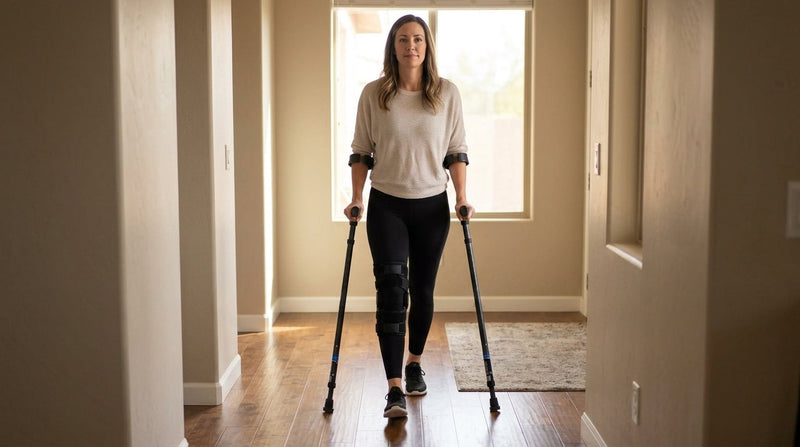
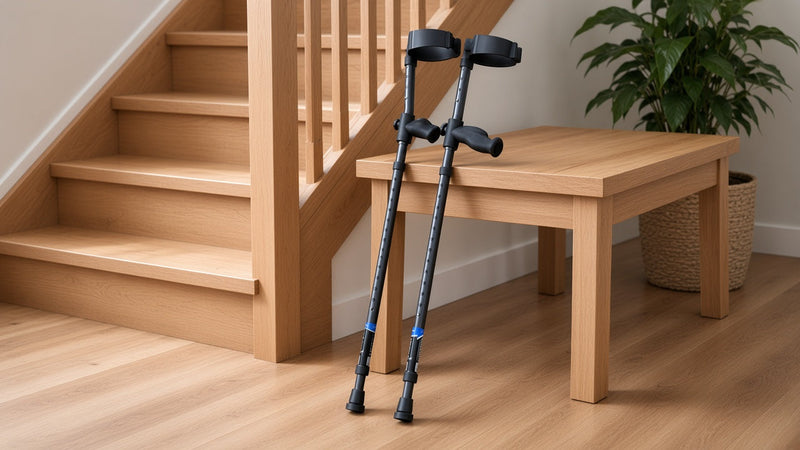
The featured image for this article was generated using AI.
Maybe your ankle is healing and two crutches are starting to feel like overkill. Or your knee has started aching on longer walks and you're wondering whether a cane would help. Either way, "cane or crutches?" sounds like a small question, but the wrong pick can leave you with too little support or with more equipment than you need.
Here's how to tell which one fits your situation, how to size a walking cane so it actually helps, and how to walk with one safely.
The short answer
A cane is for people who can put weight on both legs and just need a little help: a bit of extra balance, a leg that's slightly weak, or mild pain. MedlinePlus and the American Academy of Orthopaedic Surgeons (AAOS) both describe a cane this way.
If your doctor has told you to keep weight off a leg, a cane isn't the right tool. That's what crutches are for. And if you're dealing with a lot of pain, weakness, or balance trouble, MedlinePlus notes that crutches or a walker may be better options than a cane.
Your weight-bearing instructions decide this, not how ready you feel. If you're not sure what yours are, ask your surgeon or physical therapist before you switch.
When a cane makes sense
- You're cleared to walk on both legs and only need a little support for balance or stability.
- One leg is a little weak or sore, for example from arthritis, a minor injury, or late in a recovery once your care team says you can put full weight through it.
- You're stepping down from crutches and your therapist agrees you're ready. Some people go from two crutches to one before moving to a cane. Our guide to using one crutch or two covers that stage.
AAOS also notes that for older adults, a single-point cane may help with walking more comfortably and safely, and that a quad cane (four small feet at the bottom) gives more stability if you need it.
When crutches are the better call
- You've been told not to put weight on the leg (non-weight-bearing). A cane can't keep a leg off the ground. Crutches can.
- You've been told to limit how much weight goes through the leg (touch-down or partial weight-bearing). Crutches let your arms take the share your leg isn't allowed to carry yet.
- You have a lot of pain, weakness, or balance problems. This is where MedlinePlus suggests crutches or a walker may serve you better.
- You catch yourself leaning hard on a cane or limping heavily anyway. That's worth a conversation with your doctor or PT about whether you need more support for now.
If you're not sure which crutch style fits, our guide to forearm vs. underarm crutches walks through the trade-offs.
How to size a walking cane
A cane at the wrong height makes you lean or hunch, which defeats the point. Both MedlinePlus and AAOS use the same simple check:
- Put on the shoes you usually wear and stand up straight with your arms relaxed at your sides.
- The top of the cane, where your hand goes, should line up with the crease of your wrist.
- When you hold the handle, your elbow should be slightly bent, not locked straight.
Before you buy, have someone measure from the floor to your wrist crease while you stand that way. Then check that the number falls inside the cane's adjustment range. If it doesn't, that cane won't fit you, no matter how good it looks.
How to walk with a cane
- Hold it in the hand opposite your weaker or injured leg. If your right leg is the sore one, the cane goes in your left hand. This is the most common question people have, and it feels backward at first.
- Move the cane and your weaker leg forward together. The cane tip should land about even with that foot.
- Press down on the cane to take some pressure off the weaker leg, then step past it with your stronger leg.
- Make sure the tip is on the ground before you put weight on it.
- Turn by pivoting on your stronger leg, and look ahead rather than down at your feet.
Go slowly at first. MedlinePlus points out that it can take a while to get used to walking with a cane.
Stairs and curbs with a cane
The memory trick is "up with the good, down with the bad."
- Going up: hold the handrail if there is one, with the cane in your other hand. Step up with your stronger leg first, then bring up your weaker leg and the cane.
- Going down: put the cane on the step below first, then your weaker leg, then your stronger leg.
- Take one step at a time, and pause at the top to get your balance before you move on.
Stairs on crutches work differently. If you're still on crutches, see Stairs, Curbs & Uneven Terrain: Real-World Crutch Skills.
Small things that prevent falls
- Check the cane tip every day and replace it when it's worn. A worn tip can slip.
- Wear shoes with non-skid soles. MedlinePlus advises against heels and leather soles.
- Clear the floor. Secure loose rugs and cords, remove clutter, and keep floors dry.
- Keep your hands free. A small backpack, fanny pack, or shoulder bag holds your phone and keys so you're not juggling them with the cane.
- Have someone nearby at first while you get the hang of it.
The same tip logic applies to crutches. Our guide on when to replace crutch tips shows what worn tips look like.
A note on what we carry
We're a crutch company first, so we'll be straight about our options.
If a cane is the right call, we carry the Medline Folding T-Handle Cane. It's made by Medline, not by us. The product page lists it as lightweight aluminum at about 1 lb, adjustable from 32" to 36", folding for travel, with a T-handle grip and a 250 lb weight capacity. Measure your floor-to-wrist-crease height first to make sure 32" to 36" fits you. You'll find it in our Canes collection.
If you need more support than a cane gives, our in-Motion crutches are rated to 350 lbs:
- in-Motion Pro Forearm Crutch Set: spring-assisted, ergonomic left/right grips, standard and large cuffs in every box. Short fits adults 4'2" to 5'5" and Tall fits 5'3" to 6'8".
- Single in-Motion Pro Forearm Crutch: the same forearm crutch sold one at a time, in Tall or Short and left or right grip, for people who only need one.
- in-Motion Pro Underarm Crutch Set: spring-assisted with foam underarm padding. Short fits 4'8" to 5'9" and Tall fits 5'10" to 7'1".
You can compare every model on our Shop All Crutches page.
FAQ
Which hand should I hold a cane in?
The hand opposite your weaker or injured leg. A sore right knee means the cane goes in your left hand, and the cane moves forward together with the right leg.
How do I know what size cane I need?
Stand straight in your everyday shoes with your arms relaxed. The top of the cane should reach the crease of your wrist, and your elbow should bend slightly when you hold it.
Can I use a cane instead of crutches for a sprained ankle?
Only if your care team says you can put weight on that ankle and you just need a little support. If walking on it hurts a lot or you've been told to limit weight on it, crutches are the safer choice for now. Our sprained ankle guide covers the crutch phase.
Should I go from two crutches to one crutch or to a cane?
It depends on how much weight your leg can take and how steady your balance is. Some people use one crutch for a while before moving to a cane. Ask your physical therapist which step fits where you are.
What's the difference between a single-point cane and a quad cane?
A single-point cane has one tip. A quad cane has four small feet at the bottom, which AAOS notes can help if you need more stability.
Related guides
- One Crutch or Two? Knowing When and How to Transition
- Walking Aids Compared: Crutches, Canes, Walkers, Knee Scooters, and Wheelchairs
- When to Change or Add a Mobility Aid: Reading the Signs
- Types of Crutches Explained
- Crutch Tips: When to Replace Them
Sources: MedlinePlus (U.S. National Library of Medicine), Using a cane; American Academy of Orthopaedic Surgeons (OrthoInfo), How To Use Crutches, Canes, and Walkers. Product specifications are from crutches.com product pages as of October 28, 2026. This article features no affiliate products.
This article is for general information only and isn't medical advice. Talk with your doctor or physical therapist about your weight-bearing instructions and which walking aid is safe for you.