The featured image for this article was generated using AI.
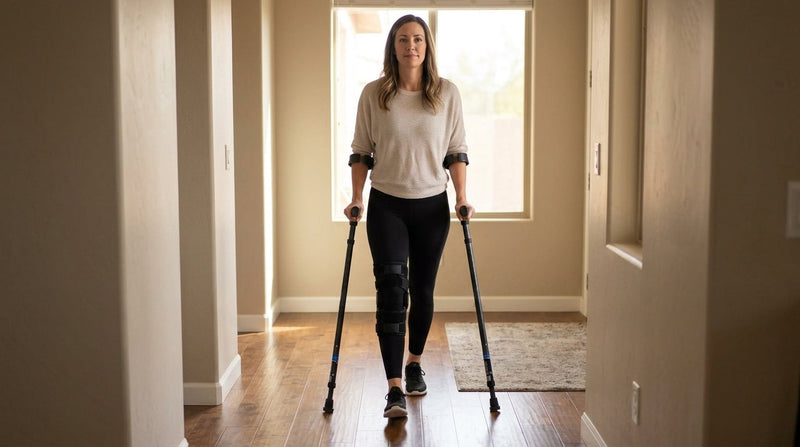
Your surgeon just said the words "non-weight-bearing," and now you're staring at two options: a pair of crutches or one of those knee scooters you've seen rolling through clinic hallways. Both keep your foot off the ground. They just do it in very different ways, and the better choice depends on your injury, your body, and your home.
Here's an honest look at how they compare, who each one suits, and why a lot of people end up using both.
The short answer
For getting around on flat floors, a knee scooter is usually easier. Your injured leg rests on a padded platform, your good leg pushes, and your arms just steer. Research on this is pretty consistent: people tire less on a knee scooter and most say they prefer it.
But a knee scooter can't do stairs, it doesn't like rough ground, and it needs one strong, steady leg and good balance. Crutches can go almost anywhere, including up and down steps, once you learn the technique.
So the real question isn't "which is better?" It's "where do I need to go, and what can my body handle?" Your surgeon's or physical therapist's instructions come first, so check with them before you choose.
What each one is
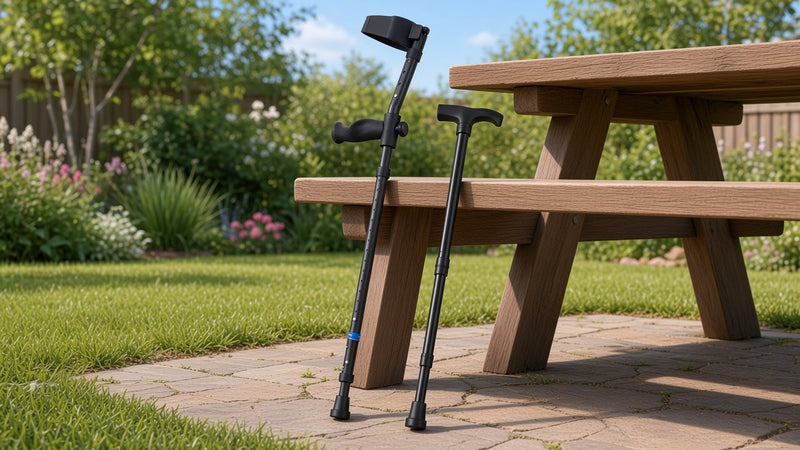
Crutches take your weight through your hands and arms while you swing past them on your good leg. They come in two main styles: underarm (axillary) crutches and forearm crutches with a cuff that wraps your forearm. Our guide to types of crutches explains the differences.
A knee scooter (also called a knee walker) has a padded knee rest, handlebars, hand brakes, and wheels. The American Orthopaedic Foot & Ankle Society (AOFAS) describes it this way: you place your knee on the pad and roll yourself forward, using the handlebars to balance and steer. AOFAS also notes knee scooters can be rented or purchased and may be covered by insurance.
What the research says
A few studies have compared the two directly. Most were small, and some used healthy volunteers rather than patients, so take them as a general picture, not a promise.
- Less effort on a scooter. In a 2016 study in Foot & Ankle International, 24 healthy volunteers did a six-minute walk test with each device. They covered more ground and rated their effort lower with the knee walker, and 88% preferred it. The authors noted this was on level surfaces.
- Patients liked scooters more. In a group of 106 foot and ankle surgery patients, scooter users reported higher satisfaction, and most said they would choose a scooter for a future surgery. The number of falls wasn't significantly different between scooters and crutches.
- Different aches. In another group of 62 foot and ankle patients who used both devices, the most common complaint with the knee walker was knee pain on the injured side, while crutch users most often reported pain in the armpit or wrist.
The takeaway: on flat ground, a knee scooter is usually less tiring. That doesn't make it safe or practical for everyone.
When a knee scooter makes sense
- Your injury is below the knee. Knee scooters are built for foot, ankle, and lower-leg injuries where you rest your shin on the pad. Think bunion surgery, ankle fractures, Achilles repairs, or foot stress fractures, if your surgeon agrees.
- Your home is mostly one level, with room to turn around in hallways, the kitchen, and the bathroom.
- You'll be off your foot for weeks, and you want to move farther without wearing out your arms.
- Your other leg is strong and your balance is good. Alberta Health Services' physiotherapy guidance says not to use a knee scooter if you have problems with balance, coordination, or vision, or if your non-injured leg isn't strong and healthy.
When crutches are the better call
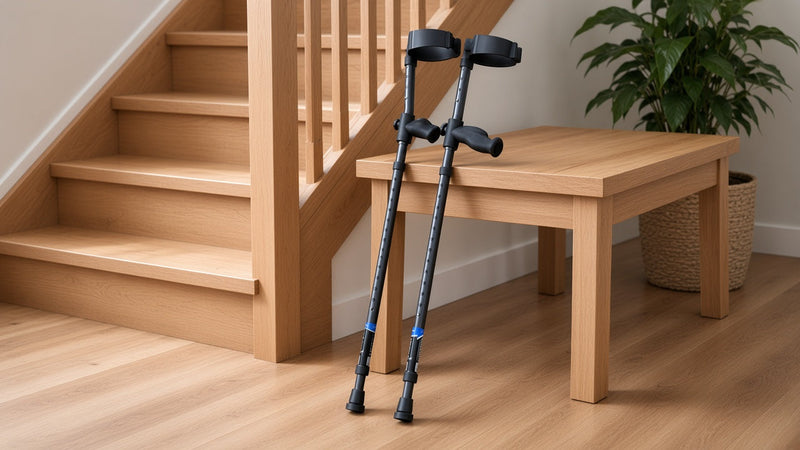
- You have stairs you can't avoid. Alberta Health Services' guidance is clear: don't use a knee scooter on stairs or steps. Crutches can handle stairs with practice. See Stairs, Curbs & Uneven Terrain: Real-World Crutch Skills.
- Your injury involves the knee. If you can't comfortably kneel on the pad, a knee scooter is out.
- You'll be on gravel, grass, or rough sidewalks. Scooters are happiest on smooth surfaces, and the same guidance advises avoiding steep or uneven ground.
- Your space is tight. Small bathrooms, narrow halls, and crowded rooms are easier on crutches.
- You're allowed some weight on the leg. If you're cleared for touch-down or partial weight-bearing, crutches let you put down the amount your care team allows. A knee scooter keeps the foot fully off the ground. Our guide to partial weight-bearing explains how that works.
- You need to get in and out of cars or travel. Crutches are lighter and simpler to bring along, while a scooter has to be folded and loaded each time.
Why many people use both
Here's what a lot of recoveries actually look like: a knee scooter for longer stretches on flat floors, like the kitchen, the office, or the grocery store, and crutches for the stairs, the bathroom, the car, and anywhere the scooter won't fit.
If you go this route, set both up before your surgery. Practice getting on and off the scooter with the brakes locked, and practice with crutches too, ideally with a physical therapist. AOFAS notes that you may need training from a physical therapist to walk smoothly and safely with an assistive device.
Getting the fit right
Knee scooter. Alberta Health Services suggests:
- Bend the knee of your injured leg to 90 degrees and have someone measure from the bottom of your bent knee to the floor. Set the knee rest to that height.
- Stand up straight and set the handlebars somewhere between your hips and your waist, so you aren't hunched over.
- Always lock the brakes before you get on or off, and before you reach for anything.
Crutches. AOFAS says you should be able to fit two fingers between your armpit and the top of an underarm crutch, and the handle should sit at the crease of your wrist with your arms hanging down. Our crutch sizing guide walks you through it step by step.
Safety tips for either one
- Slow down before turns on a scooter, and use the brakes going downhill.
- Don't pull yourself up from a chair using the scooter. It can roll.
- Keep your hands free. A scooter basket or a small backpack carries your phone and water so you're not juggling them.
- Clear the floor. Pick up loose rugs and cords and keep floors dry.
- Watch your hands, wrists, and shoulders on crutches. If they start to hurt, see Preventing Shoulder and Wrist Pain While Using Crutches.
A note on what we offer
We sell crutches, so we'll be upfront: for a lot of non-weight-bearing recoveries, a knee scooter is a great tool, and we're happy to say so.
Even if you go with a scooter, you'll probably still want crutches for the places a scooter can't go. Our in-Motion crutches are spring-assisted and rated to 350 lbs:
- in-Motion Pro Forearm Crutch Set: ergonomic left/right grips, and standard and large cuffs in every box. Short fits 4'2" to 5'5" and Tall fits 5'3" to 6'8".
- in-Motion Pro Underarm Crutch Set: spring-assisted underarm crutches. Short fits 4'8" to 5'9" and Tall fits 5'10" to 7'1".
You can compare every model on our Shop All Crutches page. Not sure which style suits you? Read forearm vs. underarm crutches.
FAQ
Is a knee scooter better than crutches?
On flat ground, a knee scooter is usually less tiring, and studies show most people prefer it. Crutches are better for stairs, rough ground, tight spaces, and partial weight-bearing. Many people use both.
Can I use a knee scooter on stairs?
No. Physiotherapy guidance from Alberta Health Services says not to use a knee scooter on stairs or steps. Use crutches, a handrail, or another plan your therapist approves.
Who shouldn't use a knee scooter?
People with balance, coordination, or vision problems, people whose other leg isn't strong and healthy, and anyone who can't comfortably rest the injured leg's knee on the pad, such as after a knee injury. Ask your surgeon if you're unsure.
Is a knee scooter safer than crutches?
Not necessarily. In one study of 106 foot and ankle surgery patients, the number of falls wasn't significantly different between scooter and crutch users. Safety depends on your balance, your home, and how carefully you use the device.
Should I rent or buy a knee scooter?
For a recovery of a few weeks, renting often makes sense. AOFAS notes scooters can be rented or purchased and may be covered by insurance. Check with your insurer before you choose, since coverage can affect the cost.
Related guides
- Best Crutches for Non-Weight-Bearing: What Actually Matters When Your Foot Can't Touch Down
- Foot & Ankle Surgery: Your Complete Crutch Recovery Guide
- Achilles Tendon Surgery Recovery: Navigating the Non-Weight-Bearing Phase
- Walking Aids Compared: Crutches, Canes, Walkers, Knee Scooters, and Wheelchairs
Sources: American Orthopaedic Foot & Ankle Society (FootCareMD), How to Be Non-weightbearing After Surgery; Alberta Health Services (MyHealth.Alberta.ca), Physiotherapy: How to use a knee scooter; Kocher BK et al., Comparative Study of Assisted Ambulation and Perceived Exertion With the Wheeled Knee Walker and Axillary Crutches in Healthy Subjects, Foot & Ankle International, 2016; Solon L et al., Standard Crutches vs Rolling Knee Scooters: Analysis of Patient Satisfaction and Risk of Falling after Foot and Ankle Surgery, Foot & Ankle Orthopaedics; Song JH et al., Efficacy of a Knee Walker for Foot and Ankle Patients: Comparative Study with an Axillary Crutch, Foot & Ankle Orthopaedics. Product specifications are from crutches.com pages as of October 29, 2026. This article features no affiliate products.
This article is for general information only and isn't medical advice. Talk with your surgeon or physical therapist about your weight-bearing instructions and which mobility aid is safe for you.