Work is where a lot of the real questions about long-term crutch use land. Do I have to tell my employer? What can I actually ask for? Will this change how people see me as a professional? These are not small worries, because your job is tied to your income, your routine, and a good chunk of your identity.
The reassuring part is that you have more rights and more options than you might think, and most workplaces handle this better when you give them a clear, specific ask rather than leaving them to guess. This is about staying good at your job while your body gets what it needs to do that job, which is a reasonable thing to want and, in many cases, a protected one.
This guide walks through whether and how to disclose, the accommodations worth requesting, and how to carry yourself so crutches never become the headline of your career. One note up front: this covers general United States ADA guidance and is not legal advice, so check with a professional or the resources below for your specific situation.
This pairs with our pieces on owning your mobility aid and handling questions and unsolicited help. If your situation stems from a work injury, our return-to-work guides cover that angle separately.
The honest answer to “do I have to tell my employer?”
Legally, in the United States, you generally do not have to disclose a disability unless you want a formal accommodation. Here is the catch worth understanding. An employer is only required to accommodate something they know about, so the accommodation process starts with you disclosing and tying it to a job duty. Simply mentioning a condition is usually not enough. You connect it to the work, as in, I am having trouble with this specific task because of my disability, and here is what would help.
If you do not need anything changed, you are not obligated to explain yourself, and crutches that are visible often answer the basic question without a conversation. The practical reality is that a brief, confident heads-up usually serves you better than silence, because it heads off speculation and opens the door to support if you end up needing it.
How disclosure actually works
Disclosure is less dramatic than it sounds. It is a practical conversation, usually with your manager or human resources, and you stay in control of it.
- You control the medical detail. You can request an accommodation while sharing very little about your diagnosis. Keep the initial information limited to what is needed to explain the work issue.
- Your information is confidential. Accommodation details are shared only on a need-to-know basis, are not placed in your general personnel file, and are not announced to coworkers.
- The process is meant to be interactive. By law it is a back-and-forth between you and your employer to find a workable solution, not a yes-or-no verdict handed down from above.
Put your request in writing when you can, keep it specific, and frame it around staying effective at your job. That tone tends to get a far better response than an apology or a vague mention.
Accommodations worth asking for
A reasonable accommodation is a change that lets you do your job without causing the employer undue hardship, and the right ones depend on your role. Here are common ones for people on crutches, to spark ideas for your own situation.
- Accessible parking close to the entrance, and a route into the building that avoids stairs.
- A workspace you can reach and use comfortably, including desk height and a clear path that does not force tricky maneuvering.
- A flexible schedule or remote work on harder days, which can make the difference between a tough week and an impossible one.
- Relief from non-essential physical tasks, like carrying supplies, that are not core to your role.
- A place to keep your crutches secure and within reach, and somewhere to rest if your job involves long stretches on your feet.
You do not have to figure out the perfect solution before you ask. That is what the interactive process is for. Bring the problem and a starting idea, and work it out together.
Carrying yourself on crutches at work
How you frame your situation shapes how colleagues read it. When you treat crutches as a non-issue that does not touch your competence, most people follow your lead. When you over-apologize or act like you have something to prove, you invite doubt that was not there.
- Keep the focus on your work. Let your output, not your equipment, be what people associate with you.
- Answer questions briefly and move on. A simple line about your situation, then back to business, signals that it is handled and not up for discussion.
- Accept practical help when it genuinely helps, and decline the rest warmly. Both read as confidence, not weakness.
Why the right crutches matter on the job
A workday is a long stretch of short trips and standing, often with your hands full of work, not just crutches. Equipment that aches your hands or forces a hunch makes the day harder and reads as struggle, which is the opposite of what you want at work. There is a real energy cost too: oxygen uptake on standard axillary crutches has been measured at 54 percent above normal walking, which is a meaningful tax across an eight-hour day.
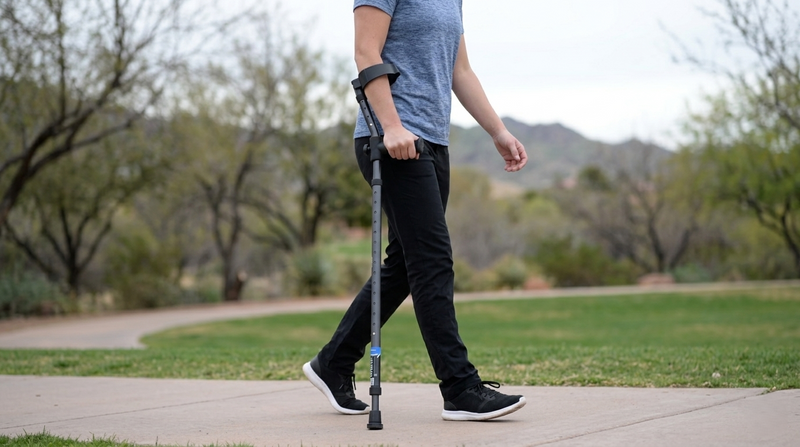
Forearm crutches help because they free a hand to carry a laptop, open a door, or shake hands, and they support the upright posture that reads as capable. The In-Motion Pro forearm crutch is built for long days: molded V-shaped forearm cuffs, angled and contoured grips that hold the wrist in a natural position, a spring-assisted lower post that softens each step, and 1.8 lbs per crutch so you are not lifting more than you have to. You can see the options at the In-Motion shop.
Where to get reliable help
Because this touches your livelihood, it is worth knowing where the real guidance lives. A few trustworthy starting points for United States workers.
- The Job Accommodation Network offers free, confidential guidance on requesting accommodations and has practical examples by situation.
- The Equal Employment Opportunity Commission explains your rights under the ADA and how the accommodation process is supposed to work.
- For your specific circumstances, an employment attorney or a disability rights organization can advise you directly. This article is general information, not legal advice.
The bottom line
Crutches at work are a logistics-and-communication challenge, not a verdict on your career. You usually do not have to disclose unless you want an accommodation, and when you do, you stay in control of the medical detail and the framing. Ask specifically, lean on the interactive process, and let your work speak for you.
Your job is something you do, and your crutches are how you get there. With the right accommodations and a steady, confident frame, there is no reason the two cannot coexist for the long haul.
Frequently asked questions
Do I have to tell my employer I use crutches?
In the United States, you generally do not have to disclose a disability unless you want a formal accommodation. Because employers can only accommodate what they know about, the process starts when you disclose and tie the issue to a specific job duty. If you do not need anything changed, you are not obligated to explain, though a brief, confident heads-up often helps.
How much medical information do I have to share?
Less than you might think. You can request an accommodation while sharing very little about your diagnosis, keeping the information to what is needed to explain the work issue. Accommodation details are confidential, shared only on a need-to-know basis, kept out of your general personnel file, and not announced to coworkers.
What accommodations can I ask for with crutches?
Common ones include accessible parking and a stair-free route, a reachable and comfortable workspace, a flexible or remote schedule on hard days, relief from non-essential physical tasks like carrying supplies, and a secure place to keep your crutches and rest. The right mix depends on your role, and you work it out through the interactive process.
Can my employer treat me differently for using crutches?
Under the ADA, employers generally cannot discriminate against a qualified person with a disability, and accommodation information is meant to stay confidential. This article is general information rather than legal advice, so if you believe you are being treated unfairly, contact the EEOC or an employment attorney about your specific situation.
How do I stay confident at work on crutches?
Keep the focus on your output, answer questions briefly and move on, and accept help only when it genuinely helps. When you treat crutches as a non-issue that does not touch your competence, colleagues tend to follow your lead. Equipment that lets you move smoothly and keep a hand free supports that confident frame.