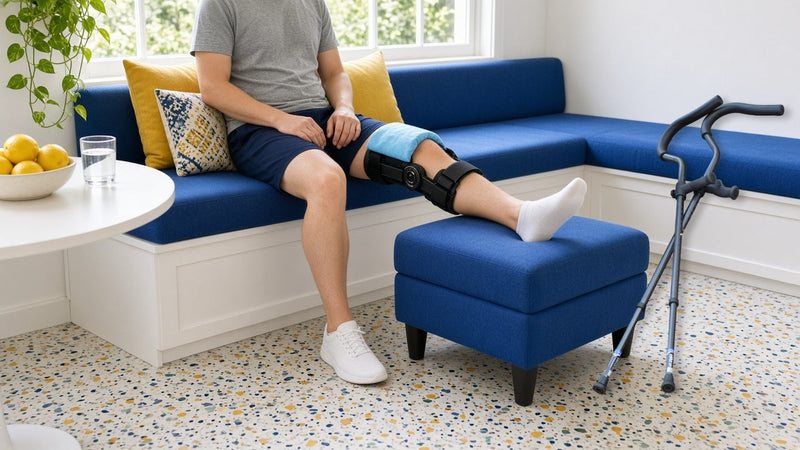
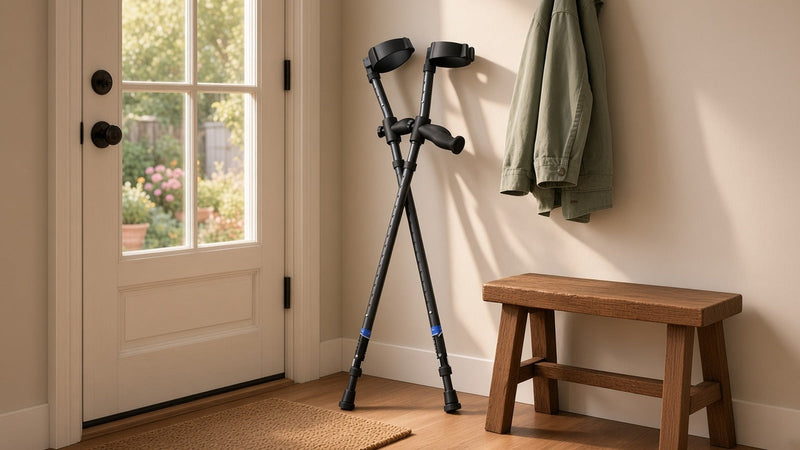
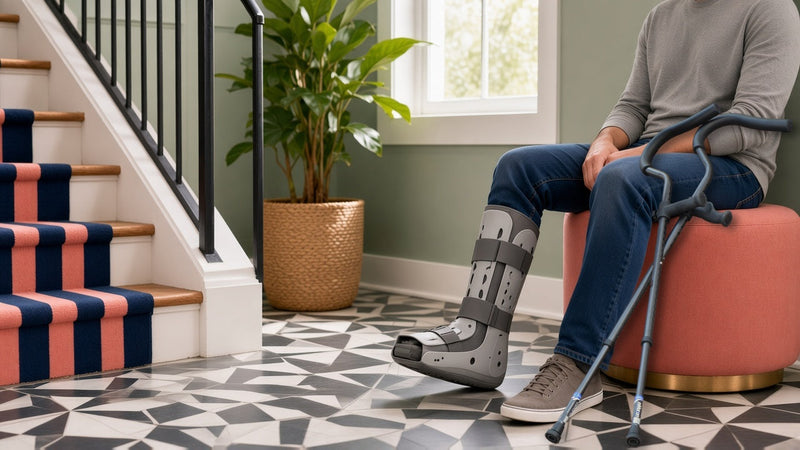
The featured image for this article was generated using AI.
You leave the clinic with a walking boot on one foot and a pair of crutches under your arm. The boot looks like it should let you walk. The crutches look like they mean you shouldn't. So which is it?
Both can be right. A walking boot (sometimes called a CAM boot or walker boot) protects and supports your foot or ankle. Crutches control how much weight goes through that limb. Your doctor decides how those two tools work together, and that plan can change as you heal.
Key takeaways
- A walking boot protects the injury. Crutches manage how much weight you put on it. You may need one, the other, or both.
- Follow your clinician's weight-bearing instructions exactly. "Walking boot" does not automatically mean full weight on that foot.
- Dorset County Hospital notes that crutches may be necessary for balance even when you're allowed to walk in the boot, and that you should not put weight through the foot when the boot is off.
- AAOS guidance for ankle sprains often pairs a removable boot or brace with crutches as needed in the early days, then progresses as pain and swelling settle.
- Size crutches correctly, keep your weight on your hands (not your armpits), and ask before you drive, climb stairs alone, or stop using the crutches.
In this guide
- Why would you need a walking boot and crutches at the same time?
- What do weight-bearing instructions actually mean?
- How do you walk with a boot and crutches?
- How do you handle stairs, sitting, and uneven ground?
- How long will you need both?
- What else should you know about living in a boot?
- Which crutches make sense with a walking boot?
- FAQ
Why would you need a walking boot and crutches at the same time?
A walking boot and crutches do different jobs.
The boot holds your foot and ankle in a more protected position. AAOS OrthoInfo notes that for a Grade 2 ankle sprain, a removable plastic device such as a walking boot or aircast brace can provide support, and that Grade 3 sprains may need a short leg cast or cast-brace for 10 to 14 days.
AAOS also describes a CAM walking boot as a way to support and immobilize a sprained ankle after soft-tissue injury.
Crutches take load off the injured side (or steady you while you learn to walk in the boot). For ankle sprains, AAOS says walking may be difficult for 2 to 3 days and that your doctor may recommend crutches as needed. Early weight bearing as tolerated is typically recommended in phase 1 of sprain treatment, but that is still "as your doctor allows," not a free pass to ignore pain.
Boots are also used after fractures, stress injuries, and some surgeries. Dorset County Hospital explains that a walking boot supports a gradual increase in weight bearing while the limb heals, and that crutches may be necessary to provide balance when walking. The exact mix of boot plus crutches depends on your injury, not on the fact that the device is labeled a "walking" boot.
What do weight-bearing instructions actually mean?
This is the part that trips people up. Ask your clinician which of these applies, and write it down:
- Non-weight-bearing (NWB): Keep the injured foot off the floor. The boot may still be on for protection, but you hop or swing with the crutches and do not stand on that foot. Our best crutches for non-weight-bearing guide goes deeper on this phase.
- Touch-down or toe-touch: The foot may brush the floor for balance only. It does not carry your body weight.
- Partial weight-bearing (PWB): You put some weight on the injured side, often a fraction your clinician names, and take the rest through the crutches. Our partial weight-bearing tips help with the feel of that.
- Weight-bearing as tolerated (WBAT): You put as much weight as pain and your clinician allow, still usually in the boot at first.
- Full weight-bearing in the boot: You can put full weight through the booted foot. You may still use one crutch or none for balance at first.
Dorset County Hospital is clear on one point people miss: no weight should go through the foot when the boot is removed (for example when washing or sleeping), unless your clinician says otherwise. Crutches by the bedside help you avoid accidentally standing barefoot on the injured side at night.
If your instructions are unclear, call the clinic before you guess. Putting full weight on a fracture or repair too early can set healing back.
How do you walk with a boot and crutches?
How should the crutches fit?
AAOS OrthoInfo recommends that when you stand up straight, the tops of underarm crutches sit about 1 to 2 inches below your armpits, the handgrips line up with the top of your hip line, and your elbows stay slightly bent.
Keep your weight on your hands, not on the underarm pads, so you do not press on the nerves and blood vessels in your armpits. Our crutch sizing guide walks through the adjustments.
What's the basic pattern when you can put some or no weight on the boot?
A common pattern with two crutches is a 3-point gait:
- Place both crutches about a foot in front of you.
- Move the injured (booted) side forward to the crutches, putting only as much weight on it as you're allowed (or none, if you're non-weight-bearing).
- Press down through your hands and step through with your good leg.
- Look ahead, not down at your feet.
Our 3-point gait guide covers this in more detail. If you've been cleared for more load and feel steady, your clinician or therapist may move you toward a 2-point pattern or a single crutch. Hold a single crutch on the side opposite the injured leg, unless your care team tells you otherwise. See one crutch or two.
What about the height difference from the boot?
Many walker boots have a thicker, rocker-style sole. That can leave your good leg shorter than the booted side and pull at your hip or lower back. Some clinics suggest a shoe with a thicker sole on the uninjured foot to even things out. Ask your clinician before you add anything under that shoe, and take shorter strides until the gait feels controlled.
How do you handle stairs, sitting, and uneven ground?
Stairs
AAOS guidance for crutches on stairs:
- Going up: lead with the good foot, then bring the crutches and injured side up.
- Going down: move the crutches to the lower step first, keep the injured foot forward and raised, and hop down on your good foot.
- Use a handrail whenever there is one. If you feel unsteady, AAOS notes it may be easier to sit and move up or down on your bottom.
Practice with someone nearby the first few times. Our guide to stairs, curbs, and uneven terrain has more real-world tips. Wet floors, gravel, and thick rugs are especially awkward in a rocker boot. Slow down.
Sitting and standing
To sit with crutches (AAOS):
- Back up to a sturdy chair until you feel it at the back of your legs.
- Put the injured foot forward and hold both crutches in one hand.
- Reach back for the seat with your free hand and lower yourself slowly.
- Lean the crutches nearby upside down so they are less likely to tip over.
To stand, scoot forward, hold both crutches on the injured side, and push up on your good leg.
Getting around the house
AAOS also recommends clearing throw rugs and cords, keeping paths wide and well lit, and carrying items hands-free in a backpack or bag with a strap so your hands stay on the crutches. Plan bathroom trips before you get desperate. Boots and crutches make every extra step count.
How long will you need both?
It depends entirely on the injury and your clinician's plan.
For many ankle sprains, AAOS describes a three-phase program that may take about 2 weeks for a mild sprain or up to 6 to 12 weeks for more severe ones. Crutches are often "as needed" early on while swelling and pain are worst, then you wean as walking in the boot (and later out of it) feels safer.
After a fracture or surgery, boot time and crutch time are set by your surgeon. Some people use both for days; others for weeks. Do not drop the crutches just because the boot feels familiar. Wait for clearance, then step down gradually: two crutches, then one, then none, as pain and balance allow.
What else should you know about living in a boot?
Practical points drawn from Dorset County Hospital's walking-boot advice and common clinic instructions:
- Fit and skin care. Heel all the way back in the boot. Check for pressure marks from straps as swelling changes. Contact your care team if you get burning pain, numbness, color changes in the toes, or sores under the boot.
- When it can come off. Your clinician decides when you may remove it for washing, sleeping, or exercises. Do not invent your own schedule.
- Swelling. Elevate the leg when you sit. Ice only as your clinician directs, and never put ice directly on bare skin.
- Driving. Dorset County Hospital stresses that patients should not drive while wearing a boot, and that insurance may not be valid. Ask your clinician and check your insurer before you get behind the wheel.
- Warning signs. Seek urgent care for calf or thigh pain, sudden shortness of breath, increasing redness or warmth in the leg, or toes that turn blue, numb, or very swollen. These can signal a clot or a boot that is too tight.
A boot protects the injury. It does not replace follow-up appointments, physical therapy, or the weight-bearing rules you were given.
Which crutches make sense with a walking boot?
Most people in a short-term boot do fine with a well-fitted pair of underarm crutches. Forearm crutches are another option if you'll be on them longer or prefer cuff support. Our underarm vs. forearm guide compares the two.
A note on our crutches
If you're buying, our Standard A-Frame Aluminum Crutches are our most affordable pair for short-term recovery. They weigh about 3 lbs each, are rated for 350 lbs, and the Tall Adult size fits adults about 5'10" to 6'6".
If you want something easier on your hands and wrists for longer days in a boot, our in-Motion Pro Underarm Crutches weigh 2.2 lbs each, have a spring in the lower post to absorb step impact, use contoured left/right grips, and fold in half for travel. They're rated for 350 lbs and come in Short (4'8" to 5'9") and Tall (5'10" to 7'1").
For longer recoveries, our in-Motion Pro Forearm Crutches weigh 1.8 lbs each, use the same spring-assist lower post, and are rated for 350 lbs (Tall about 5'3" to 6'8", Short about 4'2" to 5'5" by handle-height fit).
Compare options in our crutches collection. Our crutches are FSA/HSA eligible; see are crutches FSA/HSA eligible? for details.
FAQ
Can you walk in a walking boot without crutches?
Sometimes yes, if your clinician has cleared you for full or as-tolerated weight bearing in the boot and you feel steady. Many people still use one crutch at first for balance. If you were told to stay off the foot, the boot alone is not permission to walk on it.
Why did I get both a boot and crutches?
The boot protects and supports the injury. The crutches control load and help with balance while the boot feels tall, stiff, or uneven. Dorset County Hospital notes crutches may be necessary for balance even when walking in a boot is allowed.
Should the boot come off at night?
Only if your clinician says so. Some plans allow removal for sleep and washing; others require the boot around the clock at first. Keep crutches nearby if you may get up without the boot on.
How do I know I'm ready to stop using crutches?
When your clinician says you can put the prescribed amount of weight through the booted foot and you can walk without a limp that forces you to hop or lean hard on the crutches. Move from two crutches to one, then none, rather than quitting overnight.
Can I drive in a walking boot?
Dorset County Hospital advises patients not to drive while wearing a boot and notes insurance may not cover you. Get clearance from your clinician and check your policy before driving.
Do I need special crutches for a walking boot?
No. You need crutches that fit, feel stable, and match your weight-bearing plan. Underarm crutches are common for short boot recoveries; forearm crutches suit some longer courses. Fit matters more than brand.
Related guides
- Best Crutches for Non-Weight-Bearing
- Partial Weight-Bearing Tips
- 3-Point Gait on Crutches
- Sprained Ankle Recovery on Crutches
- Broken Ankle Recovery: Crutch Phase Guide
- Foot and Ankle Surgery Crutch Recovery Guide
- One Crutch or Two?
- Where to Buy Crutches
Sources: American Academy of Orthopaedic Surgeons (OrthoInfo), Sprained Ankle, Sprains, Strains & Other Soft-Tissue Injuries, and How To Use Crutches, Canes, and Walkers; Dorset County Hospital NHS Foundation Trust, Advice for Patients with a Walking Boot. Product details are from crutches.com product pages as of November 5, 2026. This article features no affiliate products.
About the author
The in-Motion Team is the crew behind Millennial Medical. We're the people behind in-Motion crutches, and we write these guides to help you move with more comfort and confidence.
This article is for general information only and isn't medical advice. Follow your doctor's weight-bearing plan for your walking boot and crutches, and contact your care team if pain, swelling, numbness, or skin problems get worse.