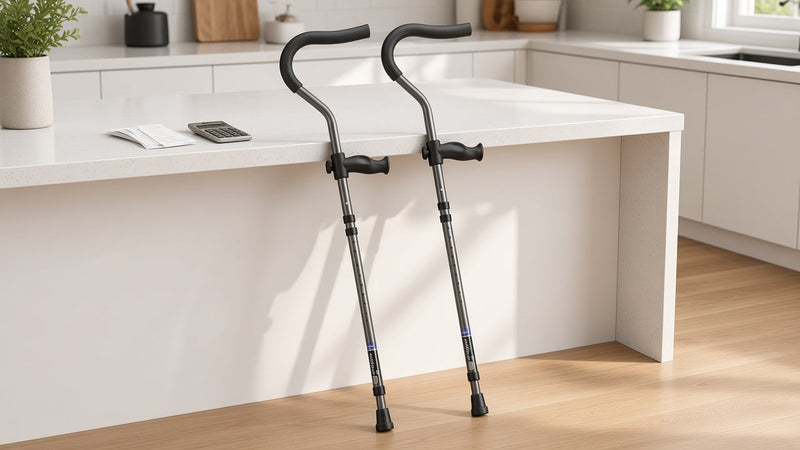
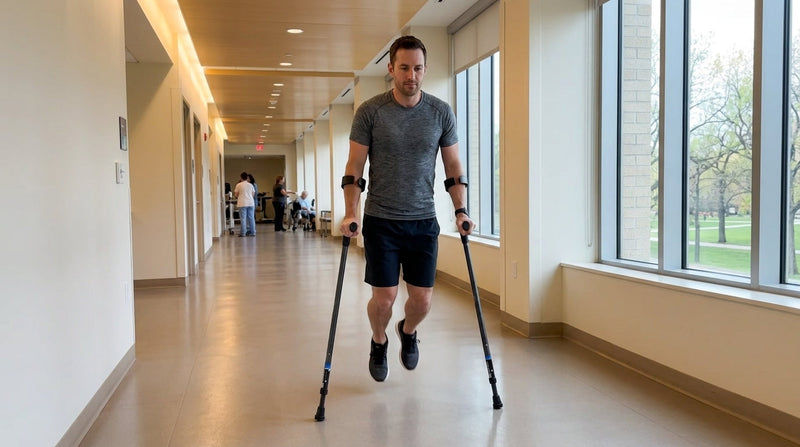
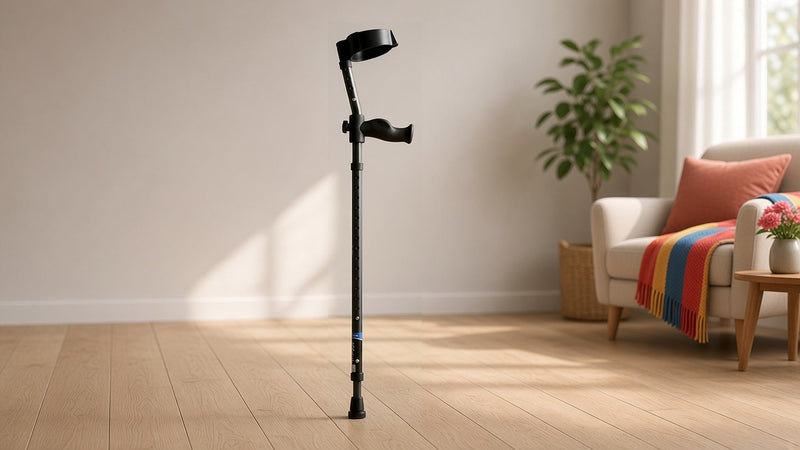
The featured image for this article was generated using AI.
You stubbed it on the bed frame, dropped something heavy on it, or caught it on a step. Now your toe is swollen, purple, and every step hurts. One of the first things people wonder is whether they need crutches, or whether that's overkill for something as small as a toe.
Here's the honest answer: many broken toes heal without crutches. But crutches can make the first few days, or the first few weeks, a lot less painful, and some toe fractures need more protection than tape and a sturdy shoe.
Key takeaways
- Many broken smaller toes don't need crutches. Buddy taping, a stiff-soled shoe, rest, ice, and elevation are the usual first steps.
- Crutches help when walking is too painful, especially in the first few days. The NHS says walking with a support or crutches for a few weeks may help.
- The big toe is different. It does a lot of work when you walk, so a suspected big toe fracture should be checked by a doctor. It may need a boot, cast, or other hospital treatment.
- Get urgent care if the toe points at an odd angle, the bone breaks the skin, there's a wound, or your toe or foot feels numb or tingly.
- If you use crutches, size them correctly and follow your doctor's weight-bearing instructions.
In this guide
- Do you need crutches for a broken toe?
- When do crutches actually help with a broken toe?
- Is a broken big toe different?
- When should you see a doctor?
- How do you walk on crutches with a broken toe?
- How long will you need crutches?
- Which crutches make sense for a short recovery?
- FAQ
Do you need crutches for a broken toe?
Often, no. The American Academy of Orthopaedic Surgeons (AAOS) says most broken toes can be treated without surgery. It may hurt to put weight on the toe for several days, and as the pain eases you can begin to bear weight as you're comfortable. A wider than normal shoe can help, and taping the broken toe to the toe next to it can sometimes relieve pain.
The NHS gives similar home-care advice for a broken toe that isn't your big toe, isn't pointing at an odd angle, and doesn't have a wound or bone showing:
- Rest your foot and keep it raised while it's swollen.
- Ice it, wrapped in a towel, for up to 20 minutes every few hours for the first few days.
- Wear wide, comfortable, flat shoes with stiff soles.
- Buddy tape the toe for 2 to 3 weeks, with a little cotton wool or gauze between the toes.
- Avoid walking or standing for long periods for the first few days.
That last point is where crutches come in. You don't need them to heal a typical small-toe fracture, but they can take enough pressure off your foot that you can get through work, school, or a trip to the store without wincing at every step.
When do crutches actually help with a broken toe?
Crutches are worth having when:
- Walking hurts too much. If you're limping badly or can't get a shoe on, crutches let you take weight off the front of your foot while the worst swelling settles.
- Your doctor tells you to limit weight. If you've been told to stay off the foot, or to put only some weight on it, crutches are how you follow that instruction.
- You're in a walking boot and still unsteady. A boot protects the toe, but it can feel awkward and uneven at first. Crutches or a single crutch can steady you while you get used to it.
- You have to cover distance. A long walk across a campus, a parking lot, or an airport is a lot easier with crutches than limping the whole way.
- It's a big toe fracture. These may need a boot or cast, and your doctor may want you to keep weight off the front of your foot.
Crutches are probably not necessary when you can walk in a stiff-soled shoe with only mild pain. In that case, buddy taping and good shoes usually do the job.
Not sure whether you need one crutch or two? If your doctor says you can put weight on your foot as you're comfortable, one crutch is sometimes enough. Our guide to one crutch or two covers when each makes sense.
Is a broken big toe different?
Yes. Your big toe carries a lot of your weight when you push off, and it helps with balance. A 2024 review in American Family Physician says doctors should pay close attention to big toe fractures because of the big toe's role in weight-bearing.
That's why the NHS says to go to A&E (the UK's emergency department) if you think you've broken your big toe, and not to tape it yourself. The NHS notes that a broken toe may need hospital treatment such as a boot, cast, or surgery.
The American Family Physician review also says most toe fractures can be managed without surgery in a hard-soled shoe for two to six weeks.
- Smaller toes (2nd to 5th): buddy taping, a stiff-soled shoe, rest, ice, and elevation. Crutches are optional, but they help if walking is very painful in the first days.
- Big toe: get it checked by a doctor. Crutches are often helpful early on, so follow your doctor's weight-bearing plan.
- Displaced, open, or numb toe: get urgent medical care and ask your care team about crutches.
Based on NHS and American Family Physician guidance. Your doctor's plan comes first.
When should you see a doctor?
The NHS says to get emergency care if:
- You think you've broken your big toe.
- Your toe is pointing out at an odd angle.
- The bone is sticking out of your toe.
- You feel tingling in your toe or foot, or it feels numb.
- Your child has hurt or broken their toe.
Get an urgent appointment if you have a bad cut or wound, or severe toe pain. And see a doctor if the pain and swelling haven't started to ease five days after the injury, if it still hurts to walk six weeks later, or if you have diabetes and have hurt your toe, since foot problems can be more serious with diabetes.
The AAOS adds that a fracture that isn't treated can lead to chronic foot pain and arthritis and affect your ability to walk. If you're unsure, getting it checked is the safe call.
It's also worth knowing that pain on the outside edge of the foot, rather than in the toe itself, can be a fifth metatarsal fracture. That's a different injury with its own treatment, and our broken foot recovery guide covers it.
How do you walk on crutches with a broken toe?
How should crutches fit?
The AAOS recommends that the top of your crutches sit about 1 to 2 inches below your armpits when you stand up straight, with the handgrips even with the top of your hip line and your elbows slightly bent. Keep your weight on your hands, not on the underarm pads, to avoid pressure on the nerves and blood vessels in your armpits. Our crutch sizing guide walks through it step by step.
What's the basic walking pattern?
- Put both crutches about a foot in front of you.
- Step toward them with your injured foot, putting only as much weight on it as your doctor allows (or none, if you've been told to keep it off the ground).
- Press down through your hands and step through with your good foot.
- Look ahead, not down at your feet.
When your injured foot touches down alongside the crutches like this, it's called a 3-point gait. Our 3-point gait guide explains it in more detail, and our partial weight-bearing tips help if you've been told to put some weight on the foot.
How do you handle stairs?
Going up, step up with your good foot first, then bring the crutches and your injured foot up. Going down, put the crutches on the lower step first, then step down with your good foot. Use a handrail whenever there is one. The AAOS notes that if you feel unsteady, it may be easier to sit and move up or down the stairs on your bottom. See stairs, curbs, and uneven terrain for more.
What about at home?
Clear throw rugs and cords out of your path, keep a light on between the bedroom and bathroom at night, and wear your stiff-soled shoe on the injured foot rather than walking barefoot. A small backpack keeps your hands free for the crutches.
How long will you need crutches?
For a typical small-toe fracture, usually not long. The AAOS says it may be painful to bear weight for several days, and you can begin to bear weight as you're comfortable as the pain eases. The NHS mentions walking with a support or crutches for a few weeks.
The toe itself takes longer. The NHS says broken toes usually heal within 4 to 6 weeks, though it can take several months. The AAOS says it may take 6 to 8 weeks before you're comfortable walking in normal shoes, and the toe can stay achy and swollen for 3 to 6 months.
If you have a big toe fracture or you're in a boot, follow your doctor's plan for when to stop using crutches. When you're ready, step down gradually, from two crutches to one and then none, as your pain allows.
Which crutches make sense for a short recovery?
For a broken toe, you probably don't need anything fancy. You need crutches that fit, feel stable, and don't leave your armpits and hands sore.
- Underarm crutches are a common choice for short-term injuries. They're easy to learn and give you a lot of support.
- Forearm crutches take some practice but can be more comfortable if you'll be on them longer. Our guide on underarm vs. forearm crutches compares them.
- Borrowing a pair is fine too, as long as you can adjust them to your height and the tips aren't worn smooth.
A note on our crutches
If you're buying, our Standard A-Frame Aluminum Crutches are our most affordable pair, made for short-term recovery from things like sprains and fractures. They weigh about 3 lbs each, are rated for 350 lbs, and are sized for adults 5'10" to 6'6".
If you want something easier on your hands and wrists, our in-Motion Pro Underarm Crutches weigh 2.2 lbs each, have a spring in the lower post to absorb the shock of each step, use contoured left/right grips, and fold in half for travel. They're rated for 350 lbs and come in Short (4'8" to 5'9") and Tall (5'10" to 7'1") sizes.
You can compare everything in our crutches collection. Our crutches are FSA/HSA eligible; see are crutches FSA/HSA eligible? for details.
FAQ
Can you walk on a broken toe?
Often, yes, once the first few painful days pass. The AAOS says that as the pain eases you can begin to bear weight as you're comfortable, and a wider shoe can help. Big toe fractures and displaced fractures are different, so follow your doctor's instructions for those.
Should I use crutches or a walking boot for a broken toe?
They do different jobs. A boot or stiff-soled shoe protects the toe. Crutches take weight off the foot. A big toe fracture may be treated with a boot or cast, and some people use crutches with the boot early on. Your doctor will tell you which you need.
Do I need one crutch or two for a broken toe?
If you've been told not to put weight on your foot, use two. If you can put some weight on it and just need a little support, one crutch may be enough. Hold a single crutch on the side opposite your injured foot, but ask your doctor or physical therapist to confirm. See one crutch or two for more.
How long does a broken toe take to heal?
The NHS says broken toes usually heal within 4 to 6 weeks, though it can take several months. The AAOS notes the toe may stay achy and swollen for 3 to 6 months.
Can I tape a broken big toe myself?
The NHS advises against taping your toe yourself if you've hurt your big toe or the toe is pointing at an odd angle. Get it checked first.
Is a broken toe or a bruised toe treated differently?
Often not. The NHS says not to worry if you're unsure whether it's broken or just bruised, because treatment is usually the same for both. The exceptions are the warning signs above, like a big toe injury, an odd angle, or numbness.
Related guides
- Broken Foot Recovery on Crutches: What to Really Expect
- Sprained Ankle Recovery on Crutches
- Stress Fracture Recovery on Crutches
- One Crutch or Two?
- Where to Buy Crutches
Sources: NHS, Broken toe; American Academy of Orthopaedic Surgeons (OrthoInfo), Toe and Forefoot Fractures and How To Use Crutches, Canes, and Walkers; American Family Physician, Common Foot Fractures (2024). Product details are from crutches.com product pages as of November 4, 2026. This article features no affiliate products.
About the author
The in-Motion Team is the crew behind Millennial Medical. We're the people behind in-Motion crutches, and we write these guides to help you move with more comfort and confidence.
This article is for general information only and isn't medical advice. If you think you've broken a toe, talk with your doctor about how much weight you can put on it and whether you need crutches, a boot, or other care.