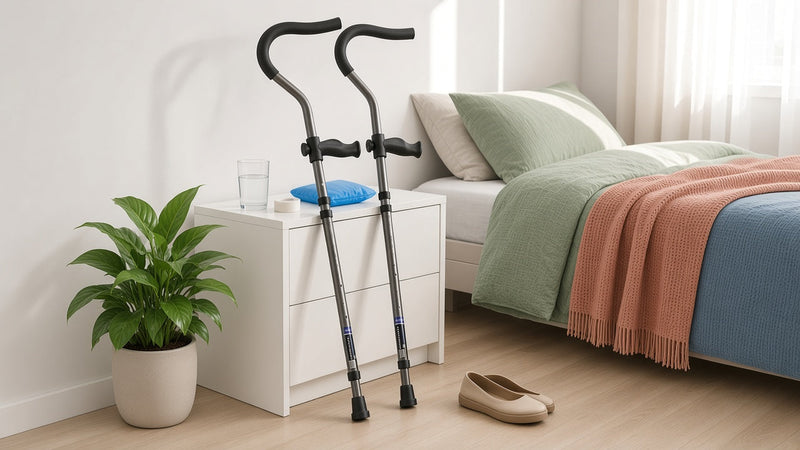
The featured image for this article was generated using AI.
You just found out you need crutches. Maybe the ER handed you a pair, maybe the urgent care sent you home with a list, or maybe you're shopping before a scheduled surgery. Either way, one of the first questions is simple: how much is this going to cost?
Here's the honest answer: it depends on three things. What kind of crutches you get, where you get them, and how you pay. A basic aluminum pair is the least expensive new option. Ergonomic, spring-assisted designs cost more. And insurance, Medicare, or your FSA or HSA can change what actually comes out of your pocket.
This guide walks through how our own crutches compare, what you get for the extra money, the costs people forget, and the practical ways to pay less.
The short answer
- Budget underarm crutches are the most affordable way to buy a new pair. Our Standard A-Frame is our lowest-priced pair.
- Premium ergonomic crutches with springs, contoured grips, and articulating tips cost more. Our in-Motion Pro sets are at the top of our range.
- Refurbished pairs sit in between. Our refurbished in-Motion Pro sets cost less than new ones.
- What you actually pay can drop with Medicare, other insurance, or FSA/HSA funds, and crutches from a hospital or clinic aren't always free.
How our crutches compare at crutches.com
Here's how our options line up, from our most affordable pair to our premium sets. Prices change, so check each product page or our crutches collection for the current price before you order.
- Standard A-Frame Aluminum Crutches: our most affordable pair. Classic underarm design in lightweight aluminum, about 3 lbs per crutch, rated for 350 lbs, tool-free push-button height adjustment, 30-day warranty. Sized Tall Adult (5'10" to 6'6").
- in-Motion Youth Crutch Set: a mid-priced pair sized for younger and shorter users. Made for the 4'11" to 5'7" range, aluminum frame, rated to 300 lbs, left and right contoured handles, articulating tips, and a rigid lower post with no spring.
- Single in-Motion Pro Forearm Crutch: costs less than a full pair, for people who have been told they only need one.
- Refurbished in-Motion Pro Underarm and Refurbished in-Motion Pro Forearm sets: cost less than new in-Motion Pro sets. Returned pairs that may have minor cosmetic marks but are fully functional.
- in-Motion Pro Underarm Crutch Set: one of our premium sets. 2.2 lbs per crutch, rated for 350 lbs, spring in the lower post, contoured left/right grips, articulating tips, and folds in half for travel.
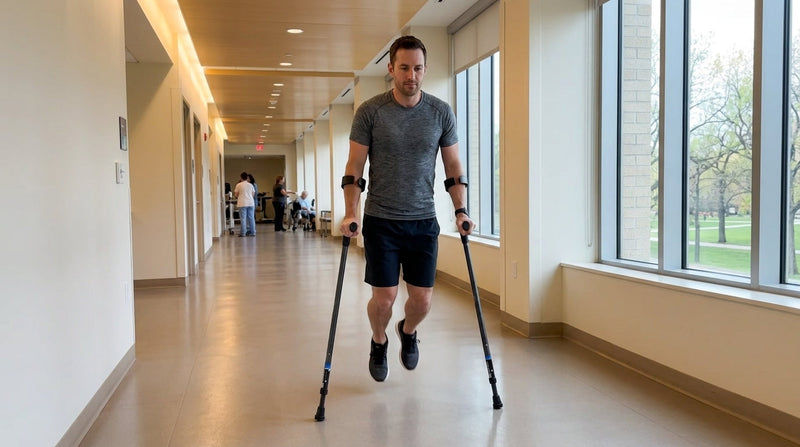
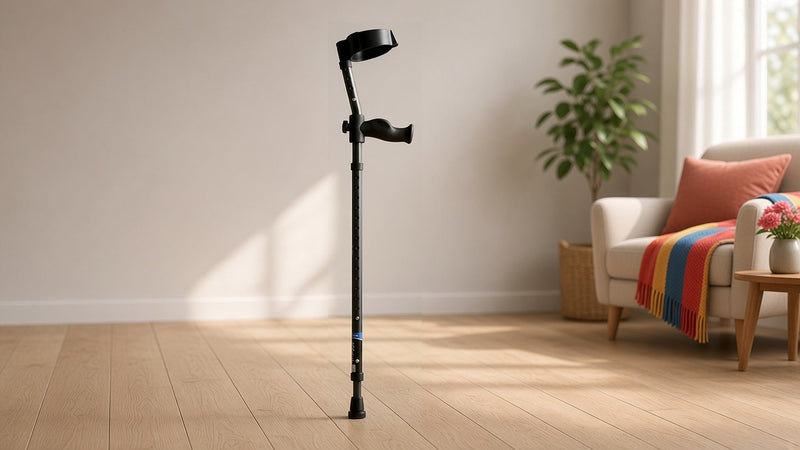
- in-Motion Pro Forearm Crutch Set: our other premium set. 1.8 lbs per crutch, rated for 350 lbs, spring in the lower post, contoured left/right grips, two cuff sizes in the box, and comes apart into an upper and lower post for travel.
The in-Motion Pro sets come with a 1-year parts and replacement warranty. You can see every option side by side in our crutches collection.
What the extra money actually buys
If a basic pair costs a fraction of a premium pair, it's fair to ask what the difference is. Here's what tends to separate them, using our own two underarm crutches as the example. Both are aluminum and both are rated for 350 lbs.
- Weight per crutch. Our standard A-frame is about 3 lbs per crutch. The in-Motion Pro Underarm is 2.2 lbs. You lift each crutch with every step, so that difference adds up over a long recovery.
- Shock absorption. The in-Motion Pro has a spring in the lower post that absorbs the impact of each step. The standard A-frame doesn't list any shock absorption.
- Grips. Our standard A-frame has extra-thick, latex-free hand grips. The in-Motion Pro uses contoured left/right grips angled to keep your wrist in a more natural position.
- Tips. Our standard A-frame uses non-skid, jumbo contoured tips. The in-Motion Pro uses articulating tips that pivot to stay in contact with the ground at different angles.
- Travel. The in-Motion Pro Underarm folds in half without changing your height settings. The forearm version comes apart into two posts.
- Warranty. 30 days on our standard A-frame versus 1 year on the in-Motion Pro sets.
None of that means a budget pair is a bad choice. It means you're paying for comfort and features that matter more the longer you're on crutches.
Costs people forget about
- Replacement tips. Tips wear down, and worn tips slip. Our Articulating Tips Pair is an inexpensive way to restore grip. See when to replace crutch tips.
- Comfort add-ons. If your underarms get sore, our Crutch Pad Set for in-Motion Pro Underarm Crutches adds cushioning, and a Replacement Underarm Foam Set is a lower-cost refresh.
- Shipping. We ship free on orders of $99 or more within the contiguous U.S. Details are in our shipping policy.
- Getting the size wrong. A pair that doesn't fit means a return or a second purchase. Our refund policy allows returns within 30 days for unused items in original packaging, and the return label cost is deducted from the refund. Measuring first is cheaper. Our crutch sizing guide walks you through it.
Are crutches from the hospital free?
Not always. Crutches handed to you at a hospital, ER, urgent care, or clinic may be billed to you or your insurance as durable medical equipment, sometimes at a price you don't see until the bill arrives. If cost matters to you, ask how the crutches will be billed before you leave, and whether you can use a pair you already own or buy your own.
If you're curious how crutches show up on a medical bill, our guide to crutch HCPCS codes E0110 vs. E0117 explains the billing codes.
Ways to pay less
1. Medicare
Medicare Part B covers crutches as durable medical equipment. After you meet the Part B deductible, which is $283 in 2026, you pay 20% of the Medicare-approved amount, as long as your supplier is enrolled in Medicare and accepts assignment. Our guide on what crutches cost with Medicare walks through the math, including when buying outright costs about the same.
2. Medicaid and private insurance
Coverage varies by plan and state. Call your plan, ask whether crutches are covered as durable medical equipment, and ask what you'll owe. See does Medicaid cover crutches and our insurance reimbursement page.
3. FSA or HSA dollars
The IRS lists crutches as a medical expense in Publication 502, which is why crutches are generally an eligible FSA and HSA purchase. Using pre-tax money lowers what the pair really costs you. Learn more in are crutches FSA and HSA eligible.
4. Refurbished crutches
A refurbished pair gets you the same design for less. Ours are returned pairs that may have minor cosmetic marks but are fully functional.
5. Only buy what you need
If your doctor or physical therapist says one crutch is enough, a single crutch costs less than a pair. Don't make that call on your own, though. Our guide on one crutch or two explains when it usually makes sense.
6. Free lending programs
Many communities have loan closets run by nonprofits, churches, or community groups that lend mobility equipment at no cost. GotDME is a free national directory you can search by ZIP code. Our where to buy crutches guide covers this and other options.
Cheap or premium: which makes sense for you?
- A short recovery, like a sprain: A budget pair that fits you is often all you need.
- Several weeks or more on crutches: Weight, shock absorption, and grip comfort start to matter. That's where a premium or refurbished pair earns its price.
- Long-term or daily use: Comfort, warranty, and replacement parts matter most. Think in terms of cost per month of use, not just the price tag.
- Tight budget: Check insurance, FSA/HSA, refurbished pairs, and lending programs before you settle for a pair that doesn't fit.
FAQ
How much does a pair of crutches cost?
It depends on the type and features. At crutches.com, a standard aluminum underarm pair is our most affordable option, refurbished in-Motion Pro pairs cost less than new, and new in-Motion Pro underarm or forearm pairs are our premium sets. Check the product pages or our crutches collection for current pricing.
Why do some crutches cost more than others?
You're usually paying for lighter weight per crutch, shock absorption, ergonomic grips, better tips, travel features, and a longer warranty. Those features matter most on longer recoveries.
Does insurance pay for crutches?
Often, but not always in full. Medicare Part B covers crutches as durable medical equipment, and you pay 20% of the Medicare-approved amount after your deductible. Medicaid and private plans vary, so call your plan first.
Can I buy crutches with my FSA or HSA?
Generally, yes. The IRS includes crutches as a medical expense in Publication 502. Check your plan's rules to be sure.
Are refurbished crutches worth it?
They can be a good way to save. Ours are returned pairs that may have minor cosmetic marks but are fully functional, and they come with the same 1-year parts and replacement warranty as new in-Motion Pro sets.
Related guides
- Where to Buy Crutches: Hospital, Pharmacy, Online, or Free
- How Much Do Crutches Cost With Medicare? (2026 Out-of-Pocket Breakdown)
- Are Crutches FSA and HSA Eligible? Yes. Here's What to Know
- Types of Crutches Explained: Underarm, Forearm, Platform, and Hands-Free
- Aluminum vs. Carbon Fiber Crutches: Which Is Right for You?
- Crutch Accessories and Replacement Parts: What's Worth Buying
Sources: Medicare.gov, Crutches coverage; CMS, 2026 Medicare Parts A & B Premiums and Deductibles; IRS, Publication 502, Medical and Dental Expenses. Product details are from crutches.com product pages and policies as of November 2026.
This article is for general information only and isn't medical, insurance, or tax advice. Talk with your doctor or physical therapist about which crutches are right for you, and confirm coverage with your insurance plan or benefits administrator.