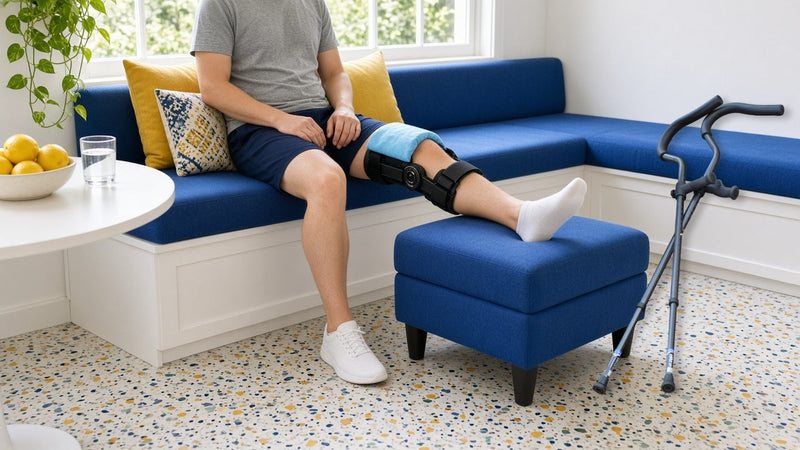
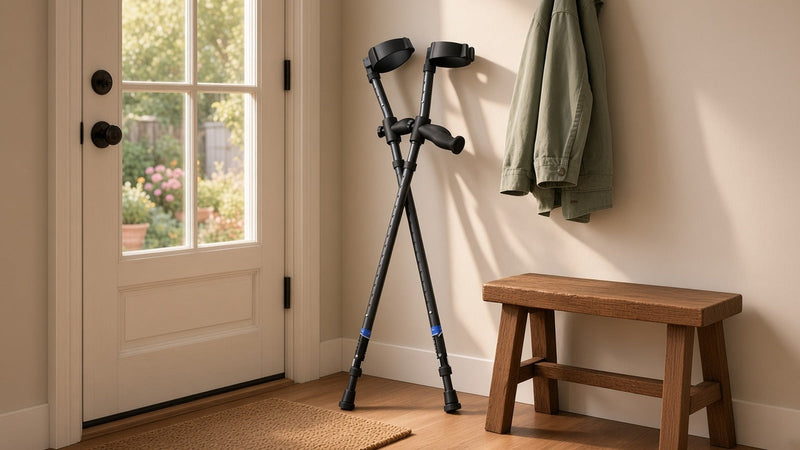
The featured image for this article was generated using AI.
You were sprinting for a loose ball, pushing off on a run, or reaching for one more stride, and something grabbed hard at the back of your thigh. Now walking hurts, the leg feels weak, and you are wondering whether you should be on crutches.
A mild pulled hamstring often doesn't need crutches at all. A worse strain, or any hamstring injury that makes it hard to put weight on your leg, often does, at least for a while. Your doctor or physical therapist decides how much weight the leg can take. This guide covers when crutches help, how long people usually need them, and how to get around safely while you heal.
Key takeaways
- MedlinePlus says you may need crutches if you cannot put any weight on your leg after a hamstring strain.
- Mayo Clinic says that for more than a minor strain, your healthcare professional may recommend crutches to keep weight off the injured leg.
- Recovery depends on the grade. MedlinePlus says symptoms may last 2 to 5 days for a grade 1 strain and up to a few weeks or a month for grade 2 or 3.
- A complete tear or a tendon pulled off the bone may need surgery, and AAOS says you'll need to keep weight off the leg afterward to protect the repair.
- Fit matters: tops about 1 to 2 inches below your armpits, grips at your hip line, elbows slightly bent, and your weight on your hands.
In this guide
- Do you need crutches for a pulled hamstring?
- When should you get a hamstring injury checked?
- How long will you need crutches for a hamstring strain?
- How do you walk on crutches with a hamstring injury?
- How do you handle stairs, resting, and getting off crutches?
- Underarm or forearm crutches for a hamstring injury?
- A note on our crutches
- FAQ
Do you need crutches for a pulled hamstring?
It depends on how bad the strain is and how walking feels. AAOS OrthoInfo describes a hamstring strain as an injury to one or more of the muscles at the back of the thigh, and says most hamstring injuries respond well to simple, nonsurgical treatment.
That treatment usually starts with RICE: rest, ice, compression, and elevation. Under "rest," AAOS says your doctor may recommend that you use crutches to avoid putting weight on your leg. Mayo Clinic says the same thing about strains that are more than minor.
MedlinePlus puts it plainly: you may need crutches if you cannot put any weight on your leg, and you may need them when you have to move during the first days or weeks. NHS advice for the first 2 to 3 days is to stop exercise and try not to put any weight on the injury.
If you can walk normally with only mild discomfort, you may not need crutches. If every step hurts, you are limping badly, or the leg feels like it won't hold you, crutches let you rest the hamstring and still get to the kitchen, the bathroom, and the car.
When should you get a hamstring injury checked?
AAOS says a strain can be a pull, a partial tear, or a complete tear. In the most severe injuries, the tendon tears completely away from the bone. NHS says that with a severe injury you may feel a snapping sensation or hear a pop.
NHS advises getting urgent help if:
- It's very painful, or the pain is getting worse
- There's a large amount of swelling or bruising, or it's getting worse
- It hurts to walk or stand on the injured leg
- Your leg feels very stiff or is hard to move
- It isn't feeling any better after treating it yourself
MedlinePlus adds that an injury very close to the buttock or knee, or a lot of bruising, may mean the tendon was pulled off the bone. In that case you will likely be referred to a sports medicine or orthopedic doctor. MedlinePlus also says to contact your provider for sudden numbness or tingling or a sudden increase in pain or swelling.
How long will you need crutches for a hamstring strain?
Only your provider can tell you for your leg, but the grade of the strain gives a rough idea. MedlinePlus describes three grades:
- Grade 1. A mild muscle strain or pull. Symptoms may last 2 to 5 days.
- Grade 2. A partial muscle tear. Symptoms may last up to a few weeks or a month.
- Grade 3. A complete muscle tear. AAOS says a grade 3 strain may take months to heal.
NHS says mild hamstring injuries usually get better in a few days, while severe ones can take weeks or months and may need a specialist. Many people with a grade 1 pull only need crutches for a short time, if at all. A bigger tear usually means more time with support.
After hamstring surgery
Surgery is most often done when the tendon has pulled completely away from the bone. AAOS says that after surgery you will need to keep weight off your leg to protect the repair, using crutches and possibly a brace that keeps the hamstring relaxed. How long depends on the injury.
AAOS says rehabilitation after a repair near the pelvis typically takes at least 6 months, and a repair near the knee needs about 3 months of rehab before returning to sports. Your surgeon will set your weight-bearing plan. Our non-weight-bearing guide can help you prepare.
How do you walk on crutches with a hamstring injury?
Start with the right fit
Stand up straight in the shoes you usually wear. AAOS OrthoInfo says the tops of underarm crutches should be about 1 to 2 inches below your armpits, the handgrips should be even with the top of your hip line, and your elbows should be slightly bent. Your hands carry your weight, not your armpits. Our crutch sizing guide walks through it.
Know your weight-bearing instruction
Your provider will tell you how much weight the injured leg can take. The common terms are non-weight-bearing (leg stays off the ground), toe-touch weight-bearing (toes touch for balance only), partial weight-bearing (some weight, as much as you are told), and weight-bearing as tolerated. If you aren't sure which one you have, call and ask.
If your leg stays off the ground
- Stand on your strong leg with a crutch under each arm and your hands on the grips.
- Place both crutch tips about 1 foot in front of you, a little wider than your body.
- Press down through the handgrips and keep the injured leg off the floor.
- Swing your body forward between the crutches and land on your strong leg.
- Get your balance, look ahead, and repeat.
If you can put some weight on the leg
Move both crutches and your injured leg forward together, press evenly on both handgrips, then step through with your strong leg. Only put as much weight on the injured leg as you've been told. See our partial weight-bearing guide and our 3-point gait guide for more detail.
When you turn, pivot on your strong leg, not the injured one, and take small steps. New to crutches in general? Our step-by-step guide to how to use crutches covers the basics from your first step.
How do you handle stairs, resting, and getting off crutches?
Stairs
Take stairs one step at a time, and have someone nearby the first few times. Going up, your strong leg goes first, then the crutches and the injured leg. Going down, the crutches and injured leg go first, then your strong leg.
If there's a handrail, use it and hold both crutches together on your other side. If you feel shaky, sitting on the step and scooting up or down is a safe option. Our guide to stairs, curbs, and uneven terrain has more.
Resting, ice, and elevation
AAOS suggests cold packs for 20 minutes at a time, several times a day, never directly on the skin, plus an elastic compression bandage. To reduce swelling, recline and put your leg up higher than your heart while resting.
NHS also suggests avoiding heat, such as hot baths and heat packs, massage, and alcohol for the first 3 days to help prevent swelling. Lean your crutches somewhere close so you don't have to hop to reach them.
Getting off crutches
Resting the leg doesn't mean keeping it frozen forever. NHS says that when you can move your leg without pain stopping you, try to keep moving it so the hamstring doesn't get stiff. Mayo Clinic says that after a few days you can start using the injured leg gently, and it should get better at supporting your weight over time.
Some people step down to a single crutch on the way off. Hold it on the side opposite your injured leg and move it forward with that leg, but only when your provider says it's OK. Our guide to walking with one crutch explains how.
Don't rush back to sport. AAOS warns that reinjuring your hamstring increases your risk of permanent damage, and MedlinePlus says to talk to your provider before returning to work or physical activity. Our guide to crutches for athletes covers staying active while you recover.
Underarm or forearm crutches for a hamstring injury?
Both work. Underarm (axillary) crutches have a padded top that sits below your armpit. Forearm crutches, also called elbow or Lofstrand crutches, have a cuff around your forearm and a handgrip. For a short recovery, many people start with underarm crutches. If you'll be on crutches for weeks, some find forearm crutches easier to live with.
Whichever you use, keep your weight on your hands. Leaning on the underarm pads can press on nerves and blood vessels under your arms. Numbness, tingling, or weakness in your hands or arms is a reason to call your care team, and our crutch palsy guide explains the warning signs. For a side-by-side comparison, see underarm vs. forearm crutches.
A note on our crutches
According to our product pages, the in-Motion Pro Underarm Crutches have foam padding at the underarm cradle, contoured left and right handgrips angled to keep your wrist in a natural position, a spring in the lower post that absorbs the impact of each step, and articulating tips that pivot to stay in contact with the ground.
The in-Motion Pro Forearm Crutches have the same spring assist, ergonomic grips, and articulating tips, with two cuff sizes in the box. If your provider moves you down to one crutch, we also sell a single in-Motion Pro Forearm Crutch. The in-Motion Handy Clip keeps a pair of in-Motion crutches together and standing upright when you set them down.
You can compare every model on our Shop Crutches page.
FAQ
Do I need crutches for a pulled hamstring?
Not always. MedlinePlus says you may need crutches if you cannot put any weight on your leg, and Mayo Clinic says crutches may be recommended for more than a minor strain. If walking hurts or the leg feels weak, have a provider check it.
How long are you on crutches for a hamstring strain?
It depends on the grade. MedlinePlus says symptoms may last 2 to 5 days for a grade 1 strain and up to a few weeks or a month for grade 2 or 3. After surgery for a torn tendon, AAOS says you'll keep weight off the leg for a time set by your surgeon.
Can I walk on a pulled hamstring?
For the first 2 to 3 days, NHS advises trying not to put weight on the injury. After a few days, Mayo Clinic says you can start using the leg gently. If it hurts to walk or stand, get it checked.
Is a grade 2 hamstring strain bad enough for crutches?
Often, early on. A grade 2 strain is a partial muscle tear. If walking is painful, crutches help you rest the muscle. Your provider will tell you how much weight to put on the leg.
When does a hamstring injury need surgery?
Mostly when the tendon has pulled away from the bone, according to AAOS. MedlinePlus says pain very close to the buttock or knee, or a lot of bruising, can be a sign of this, so get it checked.
Which side does one crutch go on for a hamstring injury?
The side opposite your injured leg. Move it forward together with the injured leg.
Related guides
- Crutches for Athletes: Staying Mobile Through a Sports Injury
- How to Use Crutches: A Step-by-Step Guide for Beginners
- Crutches for a Knee Injury: Sprains, Tears, and Getting Around
- Crutch Sizing Guide: Find Your Perfect Fit in 3 Easy Steps
- Sprained Ankle Recovery: When You Need Crutches and When You Don't
- Building Upper-Body and Core Strength for Crutch Users
Sources: American Academy of Orthopaedic Surgeons (OrthoInfo), Hamstring Muscle Injuries; AAOS OrthoInfo, How To Use Crutches, Canes, and Walkers; MedlinePlus Medical Encyclopedia, Hamstring strain - aftercare (reviewed June 27, 2026); MedlinePlus, Using crutches; Mayo Clinic, Hamstring injury: Diagnosis and treatment (December 13, 2025).
Also: NHS, Hamstring injury (reviewed July 28, 2025); Cleveland Clinic, How To Use Crutches. Product details are from crutches.com product pages as of November 13, 2026. This article features no affiliate products.
About the author
The in-Motion Team is the crew behind Millennial Medical. We're the people behind in-Motion crutches, and we write these guides to help you move with more comfort and confidence.
This article is for general information only and isn't medical advice. Get a hamstring injury checked by a healthcare provider, follow your doctor's or physical therapist's guidance on weight-bearing and crutch use, and seek care right away for severe or worsening pain, heavy bruising, numbness or tingling, or a leg you can't stand on.