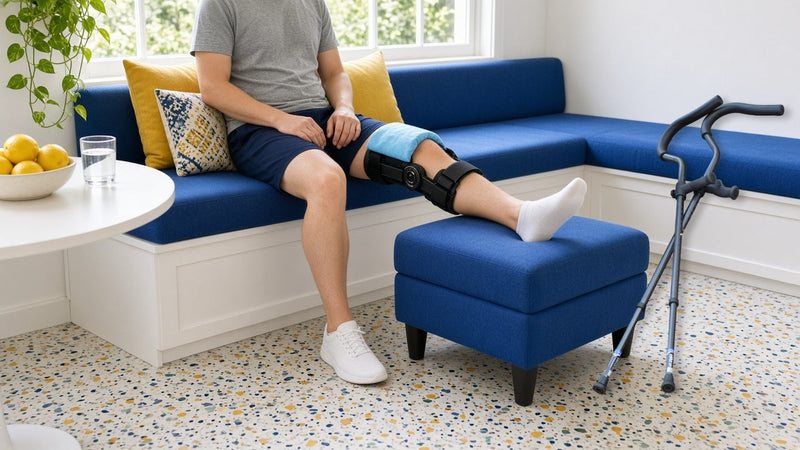
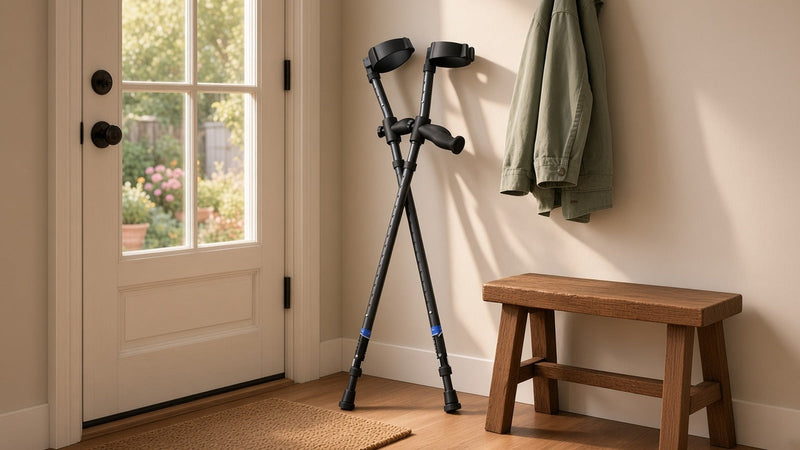
The featured image for this article was generated using AI.
You have been on two crutches for days or weeks. Your clinician says you can put more weight through the healing leg. Suddenly you are holding one crutch and wondering which hand it belongs in, how to step, and whether this is actually safe.
Walking with one crutch is a common next step after two crutches, not a shortcut for non-weight-bearing. The crutch usually goes in the hand opposite your injured or weaker leg. Your weight-bearing orders still come first.
Key takeaways
- Hold one crutch in the hand opposite the injured or weaker leg, unless your care team tells you otherwise.
- Move the crutch forward with the healing leg, put allowed weight through that leg and the crutch, then step through with the stronger leg.
- One crutch is typically for partial weight-bearing, weight-bearing as tolerated, or balance support as you wean off two crutches. It is not a substitute for two crutches when you must keep all weight off a leg.
- Fit still matters: underarm crutches need space under the armpits and weight on the hands; forearm crutches need a solid cuff and grip height fit.
- Practice on flat ground first. Use a rail on stairs, and keep the second crutch nearby until you feel steady outdoors.
In this guide
- When is it safe to walk with one crutch?
- Which side should hold the crutch?
- How do you walk with one crutch, step by step?
- How do you manage stairs with one crutch?
- How should one crutch fit?
- What mistakes should you avoid?
- Which crutch makes sense if you only need one?
- FAQ
When is it safe to walk with one crutch?
Honest answer: when your doctor or physical therapist says your weight-bearing status and balance allow it.
AAOS OrthoInfo explains that crutches help keep weight off an injured or weak leg and support safer daily movement. Clinic teaching sheets for single-crutch walking describe one crutch as useful when you have a milder balance issue, some weakness, injury, or pain in one leg, not when the limb must stay fully unloaded.
Weight-bearing language matters:
- Non-weight-bearing: no body weight on the injured leg. Keep it off the floor. This almost always means two crutches (or another plan your clinician names), not one.
- Touch-down / toe-touch: the foot may touch for balance only. Ask whether one crutch is allowed yet; many people stay on two until partial weight is cleared.
- Partial weight-bearing: you put a limited amount of weight through the healing leg. One crutch is often introduced here as you progress.
- Weight-bearing as tolerated / full weight-bearing: you may still use one crutch for confidence, limp control, or uneven days.
Alberta Health Services notes the same opposite-hand rule: use the single crutch in the hand opposite the injured leg. Our guides on one crutch or two, partial weight-bearing tips, and 2-point gait cover the bigger transition picture.
If pain spikes, the limp gets worse, or you feel unsteady, go back to two crutches and check in with your care team. Dropping a crutch early is a common way people reinjure themselves.
Which side should hold the crutch?
Usually the opposite side from the injured or weaker leg.
Cleveland Clinic: hold the crutch on the side opposite your recovering leg. Children's Wisconsin: hold the crutch or cane in the hand opposite the healing leg, and do not place it on the same side as the healing leg. Alberta Health Services: use the crutch in the hand opposite the injured leg for better support and a more normal walking pattern.
Example: injured right ankle means the crutch goes in the left hand. The crutch and the healing leg move forward together. That mirrors a natural arm-leg opposite swing and gives the healing side a wider support base.
It can feel backward the first day. That is normal. Your therapist can watch a few steps and confirm the side for your specific injury, surgery, or one-sided weakness. Stroke-related weakness and other neurological patterns sometimes need a different setup; follow the plan you were taught.
How do you walk with one crutch, step by step?
Use this pattern only after you are cleared for the weight your clinician prescribed.
- Stand tall. Place the crutch tip slightly out to the side for a stable base. Keep your weight on the handgrip (underarm crutches) or through the grip and cuff (forearm crutches), not jammed into an armpit pad.
- Step the healing leg forward and move the crutch forward at the same time.
- As that foot takes its allowed load, press down through the crutch for support so the healing leg is not carrying everything alone.
- Step the stronger leg through, past the healing foot.
- Look ahead, not down at your feet. Take short, controlled steps until the rhythm feels automatic.
Cleveland Clinic describes the same pairing: recovering leg and opposite-hand crutch together, then bring the strong leg forward to line up. Children's Wisconsin adds stepping through with the good leg and putting weight through the aid when you step on the healing leg.
If you are still on two crutches some of the day, keep the spare nearby for longer walks, crowds, or bad-pain days. Gradual is safer than all-or-nothing.
How does this relate to 2-point gait?
With two crutches, a 2-point pattern pairs opposite crutch and foot. With one crutch, you are essentially doing a single-aid version of that opposite pairing. Our 2-point gait guide helps if you are still bridging from two crutches. Early recovery on two crutches often starts with a 3-point gait instead.
How do you manage stairs with one crutch?
Go slowly, one step at a time, and use a handrail whenever one exists.
Children's Wisconsin teaching for one crutch or cane on stairs:
- Up: step up with the good foot, then the healing foot, then bring the crutch up.
- Down: place the crutch on the lower step, step down with the healing foot, then the good foot.
AAOS OrthoInfo stair advice for crutches (often with a rail and the crutches tucked on the other side) is the same big idea people memorize as "up with the good, down with the bad."
Hold the rail with one hand and the crutch with the other when that is what you were shown. If you feel unsafe, sit and scoot one step at a time, or ask for help. Our stairs, curbs, and uneven terrain guide has more real-world tips.
Wet steps, gravel, and thick rugs deserve extra caution. Check the rubber tip for wear before you trust it outdoors.
How should one crutch fit?
A badly fitted single crutch is still a badly fitted crutch.
For underarm crutches, AAOS OrthoInfo recommends about 1 to 2 inches of space between the top pads and your armpits, handgrips even with the top of your hip line, and a slight elbow bend. Put your weight through your hands, not the underarm pads, so you do not press on nerves and blood vessels in the armpit.
Alberta Health Services uses a similar 2- to 3-finger gap under the armpit and sets the handgrip near wrist height when the arm hangs at your side.
For forearm crutches, the cuff should sit on the forearm without digging into the elbow crease, and the grip height should let you stand tall with a soft elbow bend. Our crutch sizing guide and how to use forearm crutches walk through adjustments.
Wear supportive shoes (or go barefoot if that is safer than floppy slippers). Clear throw rugs and cords. Carry items hands-free in a backpack or shoulder bag so one hand stays on the crutch.
What mistakes should you avoid?
- Holding the crutch on the injured side. Clinic sheets warn that same-side use can twist your gait and load the hip or back oddly.
- Dropping to one crutch while still non-weight-bearing. One crutch cannot unload a leg the way two crutches can.
- Leaning on underarm pads. AAOS is clear: weight belongs on the hands.
- Looking at your feet the whole time. It throws off balance. Glance down when you need to, then look ahead.
- Skipping practice before stairs or parking lots. Flat indoor floors first.
- Ignoring tip wear, wet floors, or ice. Replace cracked tips; take smaller steps on slick surfaces.
Which crutch makes sense if you only need one?
Many people keep one crutch from the pair they already own. Underarm and forearm both work for single-crutch gait when they fit and match your clinician's advice. Compare styles in our underarm vs. forearm guide.
A note on our crutches
If you need to buy only one forearm crutch, we sell a single in-Motion Pro Forearm Crutch (one crutch only, left or right grip). It is the same spring-assisted forearm design as our pair: about 1.8 lb per crutch, 350 lb weight capacity, Short about 4'2" to 5'5" and Tall about 5'3" to 6'8" by handle-height fit. Check the product page for current options and sizing details.
We do not currently list a single underarm crutch as its own web product. Clinicians still prescribe one underarm crutch often. If that is your plan, use one side of a fitted pair, such as our in-Motion Pro Underarm Crutches (about 2.2 lb each, 350 lb capacity, Short about 4'8" to 5'9", Tall about 5'10" to 7'1"), or keep one from the pair you already have.
Looking at a full set for earlier recovery stages? See the in-Motion Pro Forearm Crutch pair page. Product details above are from our live product pages as of November 6, 2026.
FAQ
Which hand holds the single crutch?
Usually the hand opposite the injured or weaker leg. Injured right leg means crutch in the left hand, unless your therapist taught a different pattern for your condition.
Can I walk with one crutch if I am non-weight-bearing?
Generally no. Full non-weight-bearing needs enough support to keep that foot off the floor, which is a two-crutch (or other clinician-directed) job. Ask before you invent a one-crutch workaround.
Should the crutch move with the good leg or the healing leg?
With the healing leg. Step them forward together, load as allowed through the foot and the crutch, then step through with the stronger leg.
Is one forearm crutch better than one underarm crutch?
Neither is automatically better. Forearm crutches free the underarm and suit many longer-term users. Underarm crutches are common for shorter recoveries. Fit, balance, and your clinician's preference matter more than the label.
How do I know I am ready to stop using the last crutch?
When your clinician says you can walk with the allowed weight and you can do your usual distances without a limp that forces heavy leaning on the aid. Wean over days, not in one afternoon.
What if one-crutch walking hurts my other hip or back?
Stop and reassess. Same-side crutch use, a crutch that is too tall or too short, or moving on too fast can irritate the other side. Have a therapist watch your gait.
Related guides
- One Crutch or Two?
- 2-Point Gait on Crutches
- 3-Point Gait on Crutches
- How to Use Forearm Crutches
- Underarm vs. Forearm Crutches
- Crutch Sizing Guide
- Stairs, Curbs, and Uneven Terrain
- Partial Weight-Bearing Tips
- Crutches for Post-Polio Syndrome
Sources: American Academy of Orthopaedic Surgeons (OrthoInfo), How To Use Crutches, Canes, and Walkers; Cleveland Clinic, How To Use Crutches; Children's Wisconsin, Single Crutch or Cane Walking; Alberta Health Services / MyHealth.Alberta.ca, Physiotherapy: How to use crutches; MedlinePlus, Using crutches. Product details are from crutches.com product pages as of November 6, 2026. This article features no affiliate products.
About the author
The in-Motion Team is the crew behind Millennial Medical. We're the people behind in-Motion crutches, and we write these guides to help you move with more comfort and confidence.
This article is for general information only and isn't medical advice. Follow your doctor's or physical therapist's weight-bearing plan for one-crutch walking, and contact your care team if pain, numbness, swelling, or unsteadiness gets worse.