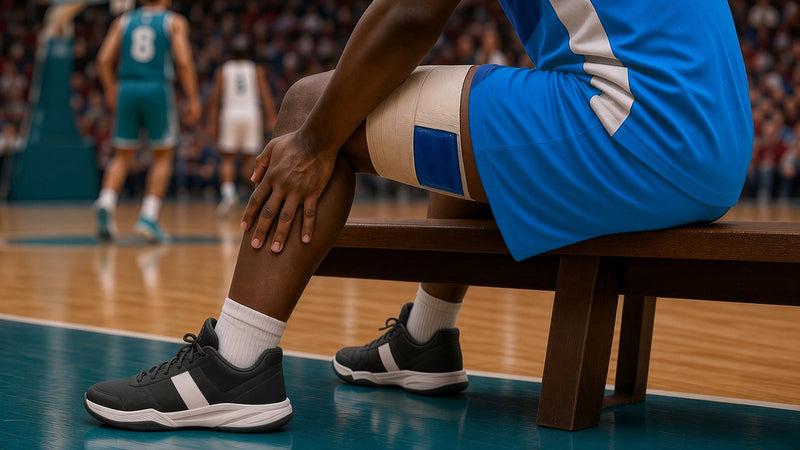
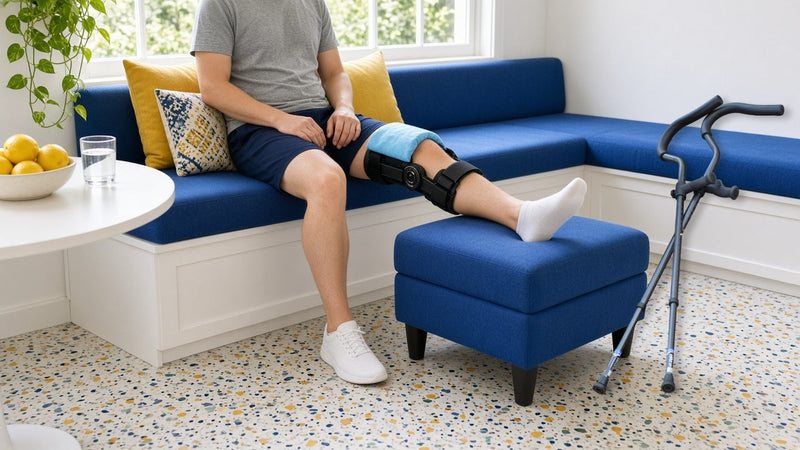
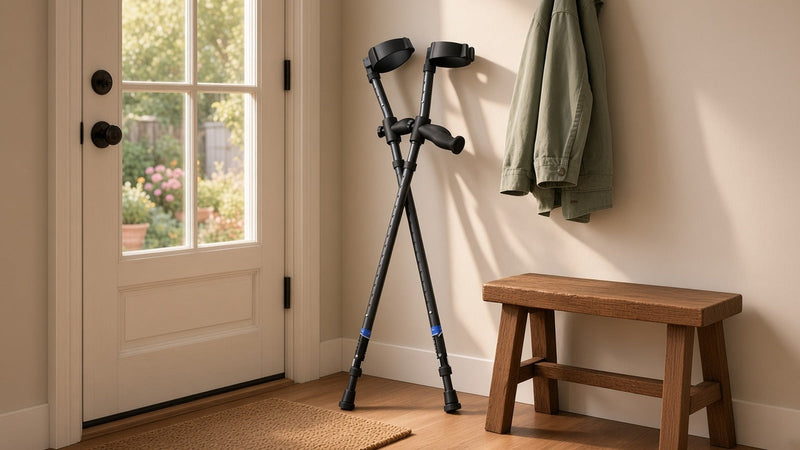
The featured image for this article was generated using AI.
You pushed off for a sprint, lunged for a tennis ball, or jumped for a rebound, and it felt like someone kicked you in the back of the leg. Now your calf is tight and sore, standing on your toes hurts, and every step comes with a limp.
Not every pulled calf needs crutches. But if you can't walk without pain or a limp, a short stretch on crutches lets the muscle rest while you still get around. Your doctor or physical therapist decides how much weight the leg can take. This guide covers when crutches help, how long people usually use them, and how to get around safely while your calf heals.
Key takeaways
- An NHS calf strain leaflet from Nottingham says to avoid walking on the leg for days 1 to 3 and use crutches until you can walk without pain or a limp.
- Cleveland Clinic says that with a torn calf muscle you may have to use crutches or wear a boot for several days.
- Calf pain is not always a strain. Cleveland Clinic says a provider may need imaging to rule out an Achilles tendon rupture or a blood clot (DVT).
- North Bristol NHS Trust says it may take up to 8 weeks for a calf strain to return to normal, depending on how bad it is.
- Fit matters: tops about 1 to 2 inches below your armpits, grips at your hip line, elbows slightly bent, and your weight on your hands.
In this guide
- Do you need crutches for a calf strain?
- When should you get calf pain checked?
- How long will you need crutches for a pulled calf?
- How do you walk on crutches with a calf strain?
- How do you handle stairs, resting, and getting off crutches?
- Underarm or forearm crutches for a calf injury?
- A note on our crutches
- FAQ
Do you need crutches for a calf strain?
It depends on how badly the muscle is hurt and how walking feels. Cleveland Clinic describes a calf strain, or pulled calf muscle, as an overstretch of the muscles in the back of your lower leg. It can range from mild to severe. A torn calf muscle is a severe strain, and the tear can be partial or complete.
The early treatment is usually RICE: rest, ice, compression, and elevation. For a torn calf, Cleveland Clinic says you may have to use crutches or wear a boot for several days, and some people need crutches or another assistive device to get around while the injury heals.
NHS emergency departments in England give similar advice. The Nottingham leaflet says to avoid walking on the leg for the first 1 to 3 days and to use crutches until you can walk without pain or a limp. North Bristol NHS Trust says to avoid walking on the injured leg for the first 3 days, using crutches or a stick if you were given them.
If you can walk normally with only mild tightness, you may not need crutches at all. If you're limping, can't put your heel down, or every push-off hurts, crutches let the muscle rest while you still get to the kitchen, the bathroom, and the car.
When should you get calf pain checked?
Cleveland Clinic recommends seeing a provider for a calf strain, mild or severe, because early diagnosis and treatment can get you back to your activities sooner. That matters even more because sudden calf pain can be something other than a strain.
Cleveland Clinic says a torn calf muscle can look like an Achilles tendon rupture, a burst Baker's cyst, compartment syndrome, or deep vein thrombosis (DVT), a blood clot in a deep vein. Its calf strain page adds that research shows up to 10% of people with symptoms of a calf pull have DVT, which can be life-threatening, so your provider may order an ultrasound or MRI.
Cleveland Clinic says to contact your provider if you:
- Can't walk or bear weight on your leg
- Can't rise up on your toes
- Have severe or prolonged pain in your calf
- Have trouble moving your ankle or knee
- Notice swelling or serious bruising in your lower leg, foot, or ankle
The Nottingham leaflet lists increasing pain, tenderness, and swelling of the leg, or redness or discoloration, as possible signs of a clot. If you have those signs, or you develop chest pain or trouble breathing, get urgent medical help.
How long will you need crutches for a pulled calf?
Only your provider can tell you for your leg, but NHS leaflets give a rough timeline for a typical strain. The NHS leaflets focus crutch use on the first few days, and the goal is to stop using them as soon as you can walk without pain or a limp.
- Days 1 to 3. Protect, rest, ice, and elevate. Both the Nottingham and North Bristol leaflets say to avoid walking on the injured leg during this time.
- Days 3 to 14. North Bristol says to start gentle exercises and build up activity, avoiding too much discomfort. Short walks are good for the healing muscle, but avoid long distances and standing for long periods.
- 2 weeks onward. Hull University Teaching Hospitals says most of these injuries feel better after 2 weeks, but you should avoid strenuous exercise for up to 8 weeks.
A more serious tear takes longer. Cleveland Clinic says most people recover from a calf muscle tear within a few weeks or months, depending on the injury. The Hull leaflet says to contact your physiotherapy team if, 10 days after the injury, you still can't put weight on the leg and the calf is still painful and swollen.
If you need a boot or surgery
Cleveland Clinic says treatment for a torn calf may include a soft cast or boot, and that surgery is sometimes needed for a ruptured calf muscle. If you're in a boot, our walking boot and crutches guide explains how the two work together. If your provider says to keep all weight off the leg, our non-weight-bearing guide can help you prepare.
How do you walk on crutches with a calf strain?
Start with the right fit
Stand up straight in the shoes you usually wear. AAOS OrthoInfo says the tops of underarm crutches should be about 1 to 2 inches below your armpits, the handgrips should be even with the top of your hip line, and your elbows should be slightly bent. Your hands carry your weight, not your armpits. Our crutch sizing guide walks through it.
Know your weight-bearing instruction
Your provider will tell you how much weight the injured leg can take. MedlinePlus lists the common options: non-weight-bearing (leg stays off the ground), touch-down or toe-touch weight-bearing (toes touch for balance only), partial weight-bearing (as much weight as you're told), and weight-bearing as tolerated. If you aren't sure which one you have, call and ask.
If your leg stays off the ground
- Stand on your strong leg with a crutch under each arm and your hands on the grips.
- Place both crutch tips about 1 foot in front of you, a little wider than your body.
- Press down through the handgrips and keep the injured leg off the floor.
- Swing your body forward between the crutches and land on your strong leg.
- Get your balance, look ahead, and repeat.
If you can put some weight on the leg
Move both crutches and your injured leg forward together, press evenly on both handgrips, then step through with your strong leg. Only put as much weight on the injured leg as you've been told. See our partial weight-bearing guide and our 3-point gait guide for more detail.
North Bristol notes that people with a calf strain often walk with the injured foot turned outward and placed in front of them, and that this should improve day by day. When you turn, MedlinePlus says to pivot on your strong leg, not the injured one. New to crutches? Our guide to how to use crutches covers the basics.
How do you handle stairs, resting, and getting off crutches?
Stairs
Take stairs one step at a time, and have someone nearby the first few times. AAOS says that going up, you lead with your good foot. Going down, you hold the injured foot up in front and hop down each step on your good foot. If there's a handrail, hold it with one hand and tuck both crutches under your arm on the other side.
If you feel shaky, AAOS says it may be easier to sit on each step and move up or down on your bottom. Our guide to stairs, curbs, and uneven terrain has more.
Resting, ice, and elevation
Cleveland Clinic suggests an ice pack or cold compress for 20 minutes every two hours, never directly on the skin, plus a compression bandage or wrap. While resting, raise your leg above the level of your heart and support the whole length of it with pillows.
Cleveland Clinic also says to avoid heat on the injured area, massaging your calf, and alcohol while it heals. Lean your crutches somewhere close to your chair or bed so you don't have to hop to reach them.
Shoes can help
The Hull and North Bristol leaflets both say shoes with a slight heel raise or a thicker sole can feel better at first, because they lessen the stretch on the calf. Wear the same shoes when you set your crutch height.
Getting off crutches
Resting the calf doesn't mean keeping it still for weeks. North Bristol says gentle exercise is important once the calf feels less hot and painful, to prevent tightness and weakness. Its advice is to stop using crutches as soon as you can, and to get up and about more once you can put weight through the leg.
Some people step down to a single crutch on the way off. Hold it on the side opposite your injured leg and move it forward with that leg, but only when your provider says it's OK. Our guide to walking with one crutch explains how.
Don't rush back to running or sport. Cleveland Clinic says once you've had a calf strain, you have a higher risk of future strains in that area. North Bristol says not to return to running sports until the calf has its full stretch and strength back. Our guide to crutches for athletes covers staying active while you recover.
Underarm or forearm crutches for a calf injury?
Both work. Underarm (axillary) crutches have a padded top that sits below your armpit. Forearm crutches, also called elbow or Lofstrand crutches, have a cuff around your forearm and a handgrip. For a few days on crutches, many people start with underarm crutches. If a bigger tear means weeks of support, some people find forearm crutches easier to live with.
Whichever you use, keep your weight on your hands. AAOS says leaning on the underarm supports can damage the nerves and blood vessels in your armpits. Numbness, tingling, or weakness in your hands or arms is a reason to call your care team, and our crutch palsy guide explains the warning signs. For a comparison, see underarm vs. forearm crutches.
A note on our crutches
According to our product pages, the in-Motion Pro Underarm Crutches have foam padding at the underarm cradle, contoured left and right handgrips angled to keep your wrist in a natural position, a spring in the lower post that absorbs the impact of each step, and articulating tips that pivot to stay in contact with the ground.
The in-Motion Pro Forearm Crutches have the same spring assist, ergonomic grips, and articulating tips, with two cuff sizes in the box. If your provider moves you down to one crutch, we also sell a single in-Motion Pro Forearm Crutch. The in-Motion Handy Clip keeps a pair of in-Motion crutches together and standing upright when you set them down.
You can compare every model on our Shop Crutches page.
FAQ
Do I need crutches for a pulled calf muscle?
Not always. NHS leaflets say to use crutches until you can walk without pain or a limp, and Cleveland Clinic says a torn calf may need crutches or a boot for several days. If walking hurts or you can't rise onto your toes, have a provider check it.
How long are you on crutches for a calf strain?
For a typical strain, NHS leaflets advise avoiding walking on the leg for the first 1 to 3 days, then building up activity as the pain allows. A bigger tear can take weeks or months to heal, and your provider will set your plan.
Can I walk on a torn calf muscle?
Not until your provider says it's OK. Cleveland Clinic says to avoid walking, exercise, and physical activity until then. Once you can put weight through the leg, North Bristol says short walks are good for the healing muscle.
Is it a calf strain or a blood clot?
You can't tell for sure on your own. Cleveland Clinic says a provider may use an ultrasound to check for a clot. Get urgent care for increasing pain, swelling, redness, chest pain, or trouble breathing.
What is tennis leg?
Cleveland Clinic says a calf strain is sometimes called "tennis leg." These strains are common in athletes who make quick stop-and-go moves, like sprinters, soccer players, football players, and tennis players.
Which side does one crutch go on for a calf strain?
The side opposite your injured leg. Move it forward together with the injured leg.
Related guides
- Crutches for a Hamstring Injury: When You Need Them and How to Use Them
- Crutches for Athletes: Staying Mobile Through a Sports Injury
- How to Use Crutches: A Step-by-Step Guide for Beginners
- Walking Boot and Crutches: When You Need Both and How to Use Them
- Crutch Sizing Guide: Find Your Perfect Fit in 3 Easy Steps
- Building Upper-Body and Core Strength for Crutch Users
Sources: Cleveland Clinic, Calf Strain (Pulled Calf Muscle) (updated April 3, 2025); Cleveland Clinic, Torn Calf Muscle (updated July 8, 2024); Nottingham University Hospitals NHS Trust Emergency Department, Calf Strain patient leaflet (April 2026); North Bristol NHS Trust, How to treat your injured calf (April 2024).
Also: Hull University Teaching Hospitals NHS Trust, Soft Tissue Injury: Calf Strain (updated June 30, 2025); AAOS OrthoInfo, How To Use Crutches, Canes, and Walkers; MedlinePlus, Using crutches. Product details are from crutches.com product pages as of November 16, 2026. This article features no affiliate products.
About the author
The in-Motion Team is the crew behind Millennial Medical. We're the people behind in-Motion crutches, and we write these guides to help you move with more comfort and confidence.
This article is for general information only and isn't medical advice. Get a calf injury checked by a healthcare provider, follow your doctor's or physical therapist's guidance on weight-bearing and crutch use, and get urgent care for calf pain with growing swelling or redness, chest pain, or trouble breathing.